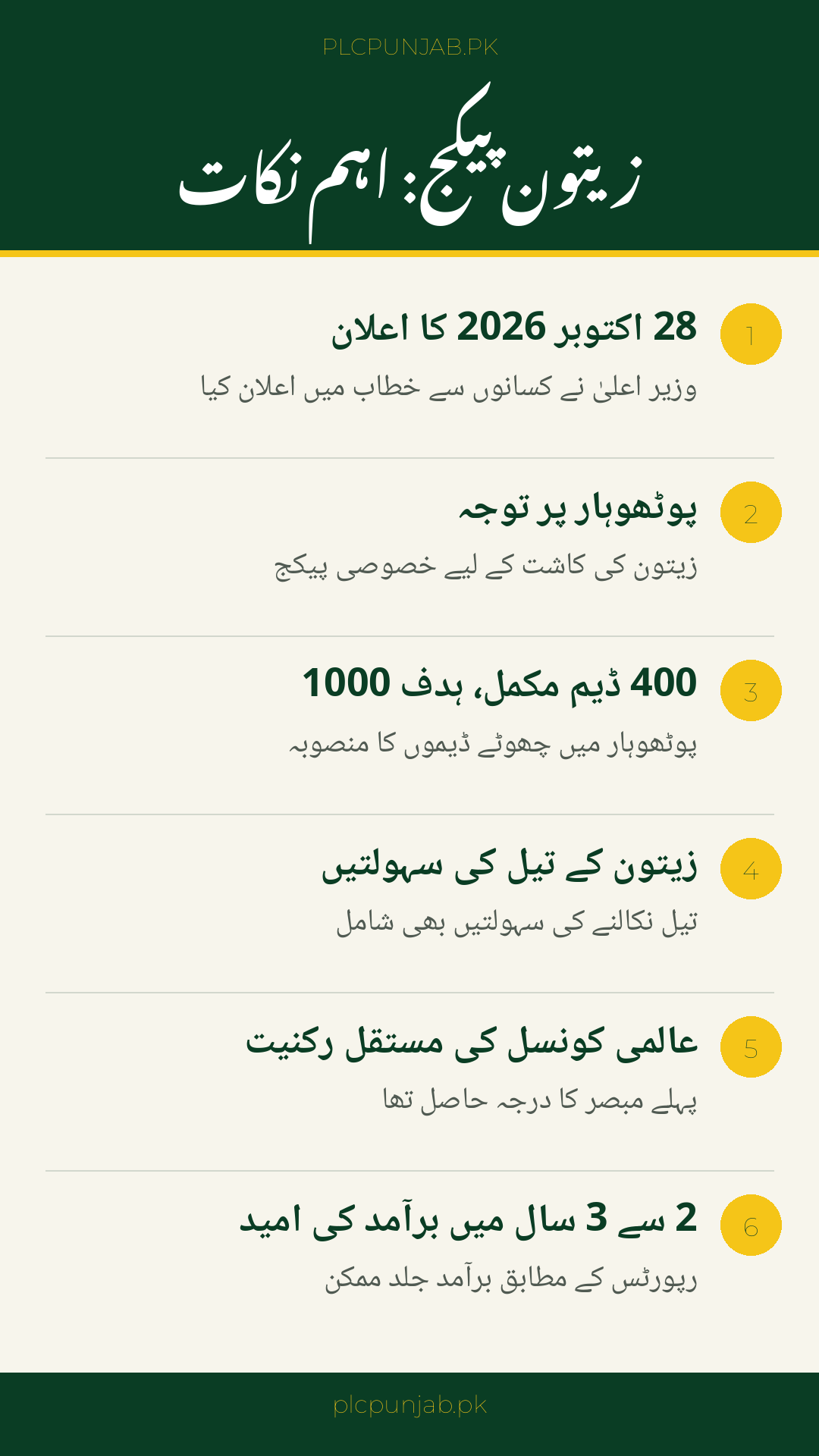
Chief Minister Maryam Nawaz announced a special package for olive cultivation in Potohar at a farmers’ meeting on 28 October 2026, putting the region’s olive sector at the centre of Punjab’s agricultural plans. The package offers subsidies to promote olive farming, facilities for extracting olive oil, and a wider transformation plan for Potohar. With Pakistan now a permanent member of the International Olive Council, the announcement signals that Punjab’s olives could reach export markets within a few years.
Item
Detail
Announced
28 October 2026, by CM Maryam Nawaz at a farmers’ meeting
Focus region
Potohar, for olive cultivation and olive oil extraction
Mini dams completed
400 in Potohar, with a target of 1,000
International Olive Council
Pakistan now a permanent member, previously observer
Export horizon
Reports say Punjab olives could be ready for export within 2–3 years
What the Package Promises
Special package: A dedicated package and subsidies to promote olive cultivation across Potohar.
Oil extraction facilities: Facilities for extracting olive oil will be part of the Potohar transformation package.
Regional transformation: The package is presented as a broader transformation plan for Potohar, not a single subsidy.
Farmer focus: The announcement was made directly to farmers, underlining that growers are the intended beneficiaries.
Water is the backbone of the Potohar plan. A total of 400 mini dams have already been completed in Potohar, and the target is 1,000. These dams support irrigation in a rain-fed region where reliable water makes the difference between a marginal crop and a commercial one, and they matter for olives just as much as for other crops.
Olive Oil Extraction Facilities
Local processing: Extraction facilities in Potohar mean growers can process olives closer to their farms.
Value addition: Turning fruit into oil locally keeps more of the value with growers instead of raw produce traders.
Quality control: Nearby facilities make it easier to press olives quickly, which protects oil quality.
Market readiness: Local extraction capacity is a necessary step before any serious export push.
Pakistan and the International Olive Council
Pakistan has moved from observer status to permanent membership of the International Olive Council. That change gives the country a formal seat in the world body that sets olive and olive oil standards, and it strengthens the case for Punjab’s olives in international markets. Reports suggest Punjab olives could be ready for export within 2–3 years, a timeline that depends on orchards maturing and processing capacity keeping pace.
What Is Not Published Yet
Subsidy rates: The rates of subsidy under the package have not been published.
Application route: No olive application route has been published so far.
Eligibility details: Who exactly qualifies for the subsidies has not been set out publicly yet.
Loan figures excluded: Loan-tier figures circulating in reports conflict with each other, so this guide deliberately omits them until an official figure is published.
What Farmers Should Do Now
Wait for the official route: Do not apply through any agent or unofficial form until the government publishes the application route.
Prepare your land record: Keep your land and crop records in order so you are ready when the route opens.
Follow official announcements: Watch for the subsidy rates and eligibility rules from official Punjab government channels.
Guard against fraud: Anyone demanding payment for olive package registration before an official route exists should be treated with suspicion.
The same 28 October announcement also touched farming beyond olives. It set the wheat support price at Rs4,500 per maund and announced agro-parks in Sargodha, Bhakkar, Khanewal and Okara. Those measures are noted here briefly because they came in the same announcement, but the olive package for Potohar remains the centrepiece for growers in the region.
Measure
Announced detail
Olive package
Special package and subsidies for Potohar olive cultivation
Mini dams
400 completed, target 1,000
Wheat support price
Rs4,500 per maund
Agro-parks
Sargodha, Bhakkar, Khanewal and Okara
Conclusion
The 28 October 2026 olive package gives Potohar growers a clear direction: subsidies for cultivation, local oil extraction facilities, 400 mini dams already built towards a 1,000 target, and permanent membership of the International Olive Council behind a possible export push within 2–3 years. Until subsidy rates and an application route are published, farmers should prepare their records and wait for official details rather than trusting unofficial claims.
FAQs
What did the Punjab government announce for olive farmers? A special package and subsidies to promote olive cultivation in Potohar, including facilities for extracting olive oil.
How many mini dams have been completed in Potohar? 400 mini dams have been completed, with a target of 1,000.
Is Pakistan a member of the International Olive Council? Yes, Pakistan is now a permanent member, after previously holding observer status.
Can farmers apply for the olive subsidy yet? No application route has been published yet, and subsidy rates are also not published. Farmers should wait for official details.
Shahzad Sahil is the editor of plcpunjab.pk, covering Punjab government schemes including the Livestock Card, eligibility, registration and latest updates, with information verified from official sources for readers across Punjab.
After you apply for a driving licence in Punjab, the hardest part is the wait. You do not need to visit a licensing office just to ask where your card has reached. DLIMS licence tracking lets you follow your application from home, using only your CNIC number, on the official Driving License Issuance Management System…
Punjab took the formal first step of its biggest economic plan in years on Friday, 30 October 2026, when Chief Minister Maryam Nawaz Sharif launched the Punjab Innovation for Value, Opportunity and Transformation (PIVOT) programme in Lahore. The launch ceremony brought together the State Bank governor, the Pakistan Business Council, investors and leading industrialists, and…
Young people who want to start or expand a business can get a loan from the federal government at low or zero markup. The PM Youth Business Loan Scheme 2026 — formally the Prime Minister’s Youth Business and Agriculture Loan Scheme — offers up to Rs 7.5 million in three tiers, starting with Rs 0.5…
The Benazir Income Support Programme (BISP) installment for 28 October 2026 has been released for 62 districts across the country, divided into six clusters and handled by six partner banks. A total of 3,992,489 beneficiaries are covered under today’s release list, making it one of the largest single-day district releases of the October–December 2026 quarter….
Sanitation billing under the Suthra Punjab programme started in October 2026, and paper bills are now reaching homes and shops in urban areas across Punjab. The billing was announced on 1 October 2026, and physical delivery of the paper bills began on 2 October 2026. The Punjab Excise, Taxation and Narcotics Control Department is collecting…
Students across Punjab have been asking one question since mid-October: has a new round of laptops and scholarships actually opened? The short answer is that a launch has been announced, but the details students need most — dates, eligibility and an application link — have not yet been published. The CM Punjab Laptop and Scholarship…