Saudi riyal rate in Pakistan today, 3 November 2026, starts from the State Bank of Pakistan’s closing of Rs 73.73 per riyal. According to the State Bank’s Monday rates, the Saudi riyal came down by 1 paisa on 2 November 2026, while the US dollar closed at Rs 276.72 and the UAE dirham stayed unchanged at Rs 75.34.
This article gives today’s Saudi riyal rate in Pakistan for 3 November 2026, bank and open-market levels, conversion examples, and what overseas workers and Umrah travellers should check before exchanging riyals.
Saudi Riyal Rate (3 November 2026)
Price (PKR)
SBP closing (2 November):
Rs 73.73 per SAR
Tuesday morning reference:
Around Rs 73.80
NBP buying (Karachi, 2 November):
Rs 73.34
NBP selling (Karachi, 2 November):
Rs 74.22
Daily change:
Down 1 paisa
Today’s Riyal Rate in Detail
SBP reference: Rs 73.73, the State Bank’s closing rate for Monday, 2 November 2026.
Morning reference: Early Tuesday references sit near Rs 73.80, effectively steady.
Bank buying: The National Bank of Pakistan listed the riyal at Rs 73.34 for buying in Karachi on Monday.
Bank selling: The same NBP list showed Rs 74.22 for selling, a spread of 88 paisa.
Open market: Licensed dealers generally trade close to the bank range, with small differences by city and amount.
Why small moves matter: For large remittances, even a few paisa per riyal changes the total by hundreds of rupees.
Dollar peg: The Saudi riyal is pegged to the US dollar at 3.75 riyals per dollar, so its rupee rate follows the dollar-rupee rate closely.
Simple relationship: Dividing the dollar rate by 3.75 gives the riyal’s approximate reference; Rs 276.72 divided by 3.75 is about Rs 73.79.
Bank spreads: Banks buy below and sell above the reference, which is why buying and selling rates differ.
Demand from remittances: Pakistan receives large remittances from Saudi Arabia, and heavy remittance days can tighten dealer spreads.
Travel demand: Umrah and Hajj travel seasons raise demand for riyals and can push selling rates up slightly.
What Moves the Riyal Rate
Dollar-rupee movement: Almost all riyal movement comes from the dollar’s movement against the rupee.
Oil prices: Oil affects Saudi revenues and the dollar, and through it, the riyal’s rupee value.
Remittance flows: Strong inflows support the rupee and can soften the riyal’s selling rate.
Seasonal travel: Ramadan and Hajj months typically see higher demand for riyals in Pakistan.
Exchange-company competition: When several dealers compete on a busy remittance day, selling spreads can narrow slightly.
Bank policy: Individual banks adjust their spreads with their own currency positions.
Riyal to Rupee Conversion Examples
The conversions below use the SBP reference of Rs 73.73. Banks and dealers will apply their own buying or selling rate, so the amount actually received or paid will differ slightly.
Saudi Riyals
Pakistani Rupees (at Rs 73.73)
1 SAR:
Rs 73.73
10 SAR:
Rs 737.30
100 SAR:
Rs 7,373
500 SAR:
Rs 36,865
1,000 SAR:
Rs 73,730
Who Needs the Riyal Rate Most
Two groups watch the riyal rate most closely: Pakistani workers in Saudi Arabia sending money home, and families preparing for Umrah or Hajj. For workers’ families, the riyal rate decides how many rupees arrive each month; for pilgrims, it decides the cost of accommodation, transport and spending money in Saudi Arabia. Both groups benefit from comparing dealer rates on the day rather than relying on a single remembered figure.
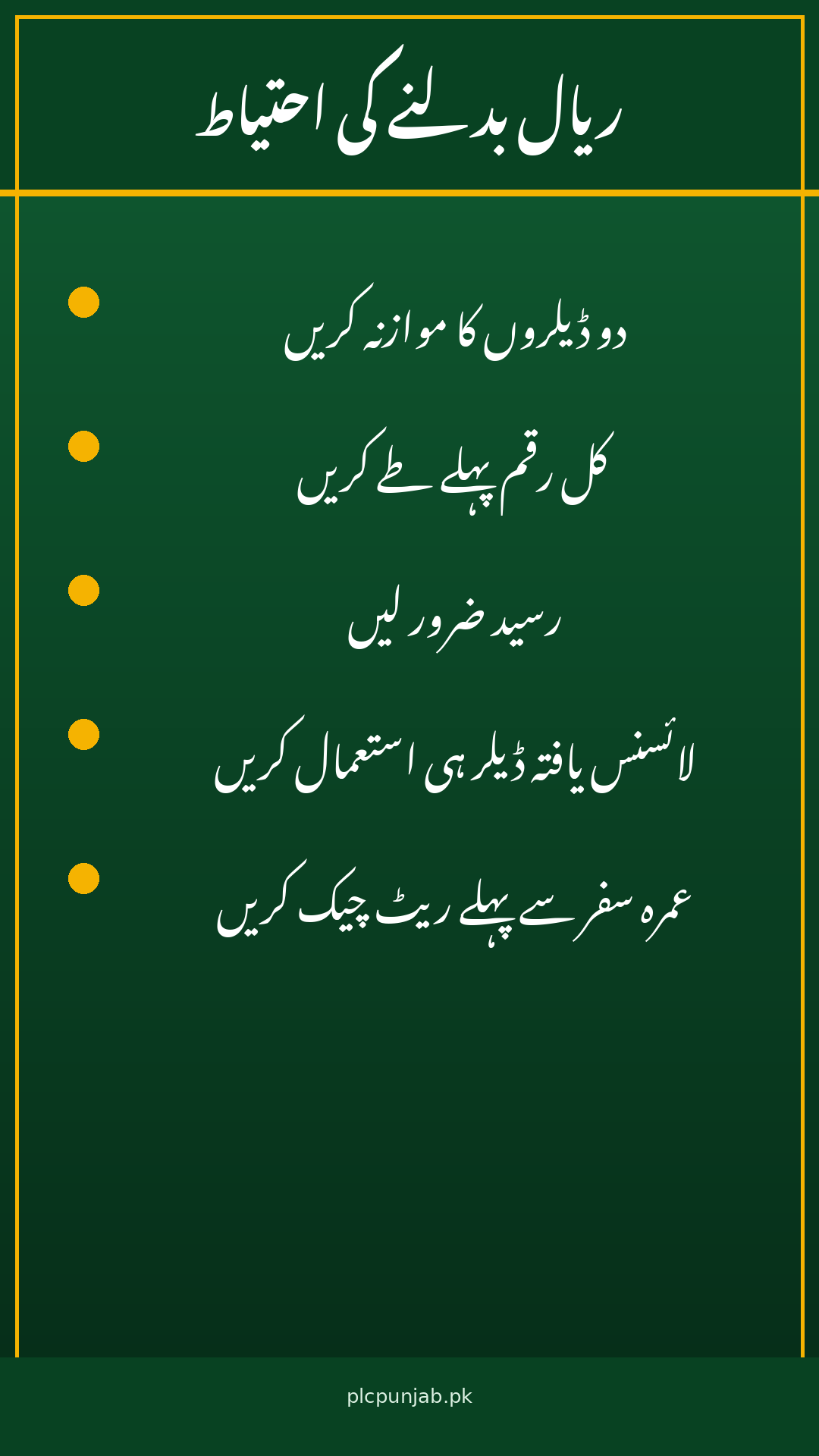
How to Verify Before Exchanging
Check the SBP reference: Start from the State Bank of Pakistan‘s closing rate, then compare dealer rates against it.
Compare two dealers: Licensed exchange companies display buying and selling rates; compare at least two.
Confirm the total: Ask for the total rupees you will receive or pay, including any service charge, before dealing.
Keep the receipt: A proper receipt matters for large amounts and for any later dispute.
Use licensed dealers only: Unlicensed street dealing carries fraud and counterfeit risks.
Important Cautions
Rates change daily: This article records the position on 3 November 2026; the next SBP close will replace it.
Online converters differ: Some websites show mid-market estimates that can differ from dealer rates by a few paisa.
Cash costs more: Selling rates at dealers run above the reference rate; buying rates run below it.
No forecast: A 1-paisa daily move does not indicate where the riyal is headed next.
Remittance channels differ: Bank transfers, exchange-company transfers and cash dealing can each apply a different effective rate, so compare the final rupees delivered, not just the headline rate.
Conclusion
The Saudi riyal starts 3 November 2026 at Rs 73.73 on the State Bank’s reference, effectively steady after a 1-paisa fall on Monday, with bank selling rates near Rs 74.22. Anyone exchanging riyals should confirm the dealer’s rate on the day and compare at least two licensed dealers. Banks and dealers update their rates through the day, so the morning rate may not be the rate available in the afternoon.
FAQs
What is the Saudi riyal rate in Pakistan today? For 3 November 2026, the latest SBP reference is Rs 73.73 per riyal, with morning references near Rs 73.80.
How much is 100 Saudi riyals in Pakistani rupees? Rs 7,373 at the SBP reference of Rs 73.73, before dealer margins.
Why does the riyal follow the dollar? The riyal is pegged to the US dollar at 3.75 per dollar, so its rupee rate moves with the dollar-rupee rate.
Where can I check the official riyal rate? The State Bank of Pakistan publishes the daily reference, and banks publish their own buying and selling rates.
Does the riyal rate change every day? Yes. It moves with the dollar-rupee rate, so each day’s SBP close gives a new reference.
Shahzad Sahil is the editor of plcpunjab.pk, covering Punjab government schemes including the Livestock Card, eligibility, registration and latest updates, with information verified from official sources for readers across Punjab.
A domicile certificate proves that you belong to a particular district in Punjab, and it is required for government jobs, admissions and many official applications. This Punjab domicile certificate guide explains the three ways to apply, the Rs 200 fee, the documents you need, and how long delivery takes. What Is a Domicile Certificate? A…
Lahore’s biggest public housing project is opening its next ballot, and buyers have until 3 December 2026 to join it. The LDA City Pine Executive and Pine Access Balloting December 2026 will allot residential and commercial plots through a ballot on 10 December 2026, with a two-year payment plan for the residential plots. The Lahore…
After a death in the family, one document becomes urgent for almost every later step: the death certificate. Banks, pension offices and property matters all ask for it. In Punjab, the Punjab Death Certificate is issued by the Union Council, and under the 2025 rules it is free for up to seven years. Families can…
The CM Punjab Free Solar Panel Scheme remains one of the most searched programmes in Punjab, and for good reason: the government promised up to 100,000 free solar systems to low-consumption households. But as October 2026 ends, the question most families are asking has changed. It is no longer how to apply — it is…
Silver rate in Pakistan today, 3 November 2026, is anchored by the latest association market rate of Rs 5,488 per tola. According to rates reported from the All-Pakistan Gems and Jewellers Sarafa Association (APGJSA), silver rose Rs 100 per tola on Monday, 2 November 2026, recovering part of the previous session’s fall. This article gives…
The federal government has announced a major relief for wheat farmers. The wheat support price 2026-27 has been fixed at Rs 4,500 per 40 kilograms, up Rs 1,000 from the previous Rs 3,500 benchmark. The announcement was made on 23 October 2026 and was reported by Radio Pakistan, citing the Prime Minister’s Office. With wheat…