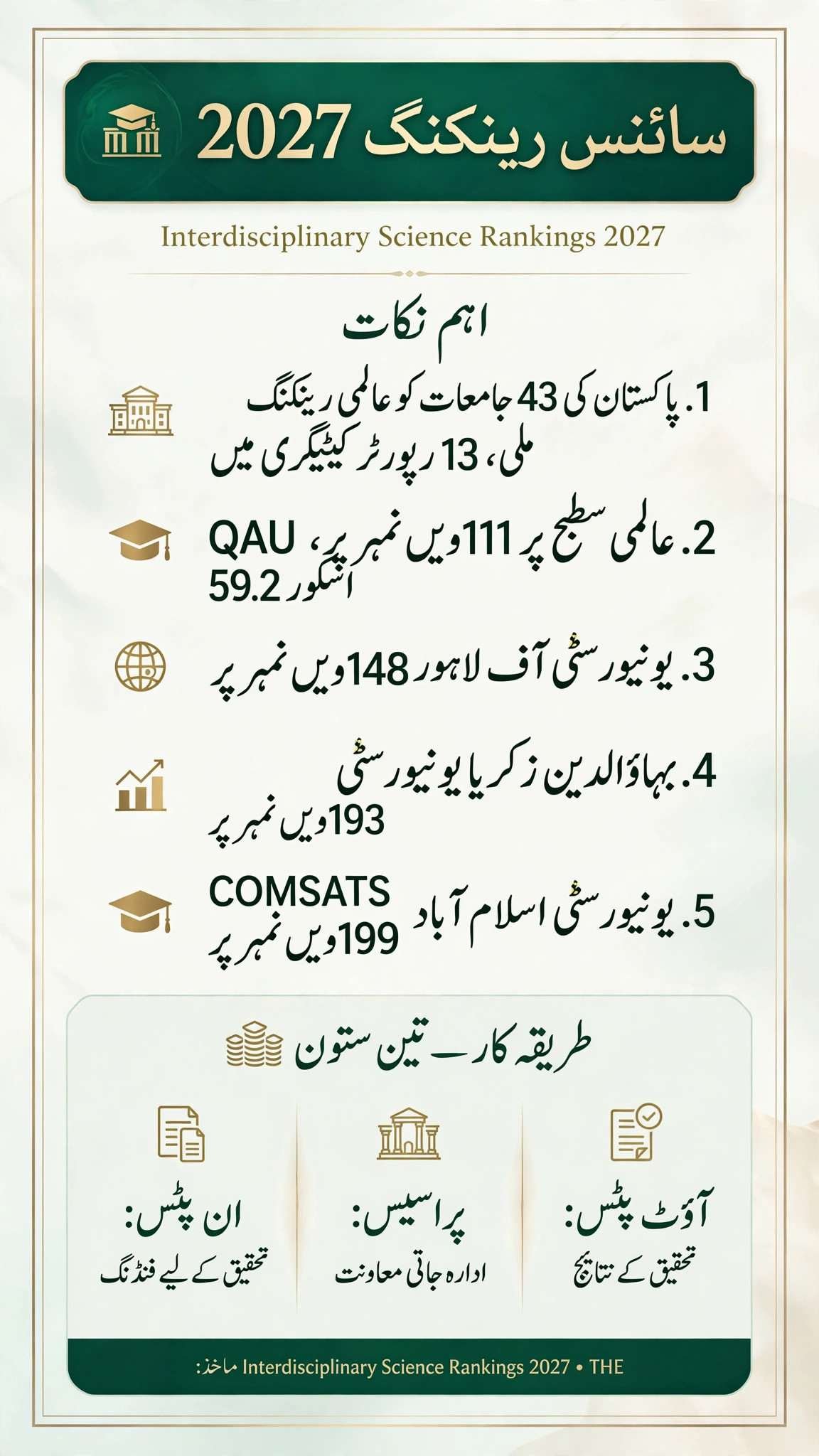
The Times Higher Education (THE) Interdisciplinary Science Rankings 2027 have been released, and Pakistan has recorded its strongest showing yet in this young global ranking. A total of 56 Pakistani institutions appear in the 2027 edition, with 43 receiving official global rankings and 13 placed in the Reporter category. Quaid-i-Azam University leads the national list at 111th in the world, followed by the University of Lahore at 148th. Announced on 18 November 2026, the results show how quickly Pakistani universities are building interdisciplinary research strength.
The 2027 edition of the ranking is the largest so far, and Pakistan’s presence in it has grown sharply. The ranking measures how well universities support science that crosses traditional subject boundaries, rather than judging single disciplines in isolation.
Release date: The Interdisciplinary Science Rankings 2027 results were announced on 18 November 2026.
Global scale: 1,058 institutions from 102 countries and territories are included, up from 911 from 94 in 2026.
Pakistan’s total: 56 Pakistani institutions are listed in the 2027 edition, and 43 of them received official global rankings.
Reporter institutions: 13 Pakistani institutions appear in the Reporter category, which is explained in detail below.
National leader: Quaid-i-Azam University stands at 111th in the world, the highest position ever achieved by a Pakistani university in this ranking.
Ranking partner: The ranking is a project in association with Schmidt Science Fellows, and it was launched in 2024, which makes the 2027 edition its fourth year.
Top Pakistani Universities in the Interdisciplinary Science Rankings 2027
Four Pakistani universities sit inside the global top 200, and another 13 appear in the 201–350 range. The table lists the four highest-ranked, with exact positions and overall scores.
Global Rank
University
Overall Score
111th
Quaid-i-Azam University
59.2
148th
University of Lahore
55.2
=193rd
Bahauddin Zakariya University
51.5
=199th
COMSATS University Islamabad
51.1
Quaid-i-Azam University’s pillar scores show where its strength lies: inputs of 46.5, process of 33.3 and outputs of 69.3, so its research outcomes carry the highest weight. The University of Lahore follows with inputs of 39.0, process of 33.3 and outputs of 65.3, while COMSATS University Islamabad, ranked joint 199th, records outputs of 67.4.
The remaining ranked Pakistani universities fall into three bands, and their names are listed below.
Band
Pakistani Universities
201–250
Government College University Faisalabad, Government College University Lahore, National University of Sciences and Technology (NUST), University of Gujrat, University of Sargodha, University of Veterinary and Animal Sciences Lahore
251–300
Air University, Khwaja Fareed University of Engineering and Information Technology, The Islamia University of Bahawalpur, University of Education Lahore, University of Management and Technology
301–350
Information Technology University of the Punjab, Mehran University of Engineering and Technology Jamshoro
201–250 band: Six Pakistani universities appear in this band, including NUST and both Government College Universities of Faisalabad and Lahore.
251–300 band: Five Pakistani universities appear in this band, including Air University and the University of Education Lahore.
301–350 band: Two Pakistani universities appear in this band, namely the Information Technology University of the Punjab and Mehran University of Engineering and Technology Jamshoro.
Students and parents can read more about the wider education landscape in Punjab, including the Punjab Smart Syllabus for Classes 9 to 12, which shapes what students study before they reach university.
What the Bands Mean
The ranking does not give every university an exact number. It uses exact positions for the strongest performers and bands for the rest, so a band must not be misread as a precise rank.
Top 300 rule: Only the top 300 universities receive exact positions and overall scores, which is why Quaid-i-Azam University, the University of Lahore, Bahauddin Zakariya University and COMSATS University Islamabad have precise ranks and scores.
Band system: Universities below the top 300 are placed in bands of 50, such as 201–250, 251–300 and 301–350, so a university in the 201–250 band could sit anywhere inside that range.
Equal sign: A rank written with an equals sign, such as =193rd or =199th, means two or more universities share the same position because their scores are tied.
Reporter status: Reporter universities submitted data but did not meet all the eligibility requirements for an official ranking, so they appear in the list without a rank or score.
Not the lowest rank: Reporter status is not the lowest rank in the table; it is a separate category for institutions that took part but were not eligible for a ranked position this year.
How the Rankings Are Calculated
The ranking is built on three pillars, each measuring a different stage of interdisciplinary science. A university must perform across all three to climb the table.
Inputs: This pillar measures interdisciplinary research funding, showing how much money a university directs toward research that crosses subject boundaries.
Process: This pillar measures institutional support, including the structures, facilities and administrative support a university provides for interdisciplinary work.
Outputs: This pillar measures research outcomes, including the quality and reach of the interdisciplinary research a university produces.
QAU example: Quaid-i-Azam University’s outputs score of 69.3 is far above its inputs score of 46.5, which shows that its research outcomes are stronger than its funding base.
UoL example: The University of Lahore shows the same pattern, with outputs of 65.3 against inputs of 39.0, while both universities share an identical process score of 33.3.
COMSATS example: COMSATS University Islamabad records outputs of 67.4, the second-highest outputs figure among the top Pakistani universities named in the results.
The full methodology and the complete results are published on the official Times Higher Education announcement page, which is linked in the contact section below.
Pakistan’s Position in the Global Picture
Pakistan is now one of the most represented countries, and Asia dominates the upper reaches of the table.
Asia leads the top 100: A total of 47 universities from Asia sit in the global top 100, compared with 29 from North America and 16 from Europe.
Asian growth: 565 Asian institutions are ranked in 2027, up from 478 in 2026, the largest regional increase.
Most represented countries: India leads with 102, followed by Turkey with 89, the United States with 52, and Pakistan with 43 officially ranked.
Global top 10: The Massachusetts Institute of Technology (MIT) holds 1st place for the third year in a row, followed by the National University of Singapore in 2nd, up from 8th last year, and Stanford University in 3rd.
Rest of the top 10: Caltech is 4th, Carnegie Mellon University is 5th, Duke University is 6th, Nanyang Technological University Singapore and the University of Hong Kong share =7th, Wageningen University and Research is 9th, and the University of California, Berkeley is 10th.
What it means for Pakistan: With 43 ranked institutions, Pakistan stands beside the world’s largest higher-education systems in this table, and its leading universities now compete in the same ranking as MIT, Stanford and Caltech.
Interdisciplinary Science Rankings vs World University Rankings and QS Asia
Three different rankings have carried similar names and headlines in recent weeks. They measure different things, cover different numbers of universities, and were released on different dates.
Different ranking: The Interdisciplinary Science Rankings 2027 is a separate ranking from the THE World University Rankings 2027, and the two must not be confused.
World University Rankings 2027: The THE World University Rankings 2027 were released in October 2026, cover 108 Pakistani universities, and place Quaid-i-Azam University in the 551–600 band.
QS Asia Rankings 2027: The QS Asia Rankings 2027 were released on 5 November 2026, cover 90 Pakistani universities, and place NUST at 76th and Quaid-i-Azam University at 111th in Asia.
Same number, different meaning: Quaid-i-Azam University’s 111th place in the Interdisciplinary Science Rankings is a global position, while its 111th place in the QS Asia Rankings is a regional Asian position, so the two figures describe different things.
Different focus: The Interdisciplinary Science Rankings measure science that crosses subject boundaries, while the World University Rankings judge universities across broader measures, and the QS Asia Rankings compare universities within Asia only.
Different counts: The three rankings list 43, 108 and 90 Pakistani universities respectively, which is why the same university can appear at very different positions in each one.
All queries about the rankings, the methodology and the full results go through the official Times Higher Education page linked above.
Helpline
No helpline has been verified for this topic, so none is listed here.
Conclusion
The Interdisciplinary Science Rankings 2027 give Pakistan a result worth noting. With 56 institutions listed and 43 officially ranked, the country now stands among the most represented nations in a ranking that only began in 2024. Quaid-i-Azam University at 111th, the University of Lahore at 148th, Bahauddin Zakariya University at joint 193rd and COMSATS University Islamabad at joint 199th show that Pakistani research is earning global recognition where subjects meet. The strong outputs scores suggest the research itself is already competitive, and the next step is to match it with stronger funding and institutional support. Students choosing a university now have one more trusted table to consult, as long as they remember it measures interdisciplinary science alone and not a university as a whole.
FAQs
Q1: What are the THE Interdisciplinary Science Rankings 2027? They are a global ranking by Times Higher Education that measures how well universities support and produce science crossing traditional subject boundaries, in association with Schmidt Science Fellows.
Q2: When were the Interdisciplinary Science Rankings 2027 released? The results were announced on 18 November 2026, covering 1,058 institutions from 102 countries and territories.
Q3: Which Pakistani university ranked highest in 2027? Quaid-i-Azam University ranked highest among Pakistani universities at 111th in the world, with an overall score of 59.2.
Q4: How many Pakistani universities are in the 2027 rankings? A total of 56 Pakistani institutions are listed, with 43 receiving official global rankings and 13 placed in the Reporter category.
Q5: What does Reporter status mean in these rankings? Reporter status means a university submitted data but did not meet all the eligibility requirements for an official ranking, so it appears without a rank or score, and it is not the lowest rank.
Q6: How are the Interdisciplinary Science Rankings calculated? They are calculated from three pillars: inputs, which measure interdisciplinary research funding; process, which measures institutional support; and outputs, which measure research quality and reach.
Q7: What is Quaid-i-Azam University’s overall score? Quaid-i-Azam University scored 59.2 overall, with inputs of 46.5, process of 33.3 and outputs of 69.3.
Q8: Which universities lead the global top 10? MIT is 1st for the third year running, the National University of Singapore is 2nd after rising from 8th, and Stanford University is 3rd, followed by Caltech, Carnegie Mellon and Duke.
Q9: How is this ranking different from the THE World University Rankings 2027? The World University Rankings 2027 were released in October 2026, cover 108 Pakistani universities, and place QAU in the 551–600 band, while this ranking covers 43 ranked Pakistani universities with QAU at 111th.
Q10: How is this ranking different from the QS Asia Rankings 2027? The QS Asia Rankings 2027 were released on 5 November 2026, cover 90 Pakistani universities, and place NUST at 76th and QAU at 111th in Asia, a regional position rather than a global one.
Source Table
Source
Details
Times Higher Education
Interdisciplinary Science Rankings 2027 results announced (official announcement page — link given once in the Contact table above)
ProPakistani
Coverage of the Interdisciplinary Science Rankings 2027 results for Pakistani universities
Shahzad Sahil is the editor of plcpunjab.pk, covering Punjab government schemes including the Livestock Card, eligibility, registration and latest updates, with information verified from official sources for readers across Punjab.
Pakistan’s PhD admissions are heading for a major change. The Higher Education Commission has established a national test, the Higher Education Aptitude and Achievement Test (HAAT), that will be mandatory for admission to PhD programmes across Pakistan. The decision was taken at a subject committee meeting of more than 250 experts from 81 universities, where…
Female students in Lahore can now learn scooty riding for free. The Lahore Free Scooty Training Female Students programme has been launched by Lahore Traffic Police for female students at educational institutions, to promote women’s independence and road safety. It was formally launched at a road-safety seminar at the University of Central Punjab (UCP), where…
Avicenna Medical College Lahore Admissions 2026 are now open for students who want to build a career in nursing and allied health sciences. The college has announced admissions for four undergraduate programmes, offered through the Avicenna Institute of Allied Health Sciences and Gulfreen Nursing College, Lahore. Merit-based scholarships of up to 50% are available for…
Class 10 students in Punjab have a new syllabus to follow. The Punjab Education, Curriculum, Training and Assessment Authority (PECTAA) has issued the Revised Smart Syllabus Class 10 2027 for the 2027 annual examinations, replacing the syllabus announced nine days earlier. It covers both Matric General and Matric-Tech students, with fresh pairing schemes and model…
The Punjab Boards Committee of Chairpersons (PBCC) has announced the complete schedule for the Matric First Annual Exams 2027, covering admission fee dates, the exam start date and the result date. The notification, dated 10 November 2026, applies to all nine Boards of Intermediate and Secondary Education in Punjab. The Matric First Annual Exams 2027…
The Honhaar Scholarship Phase 4 closes on 19 November 2026. If you are a Punjab-domiciled undergraduate student who has not applied yet, the portal is open until 19 November 2026. The programme offers 50,000 scholarships in this phase, with 100% of the defined tuition fee paid directly to the university for the full length of…