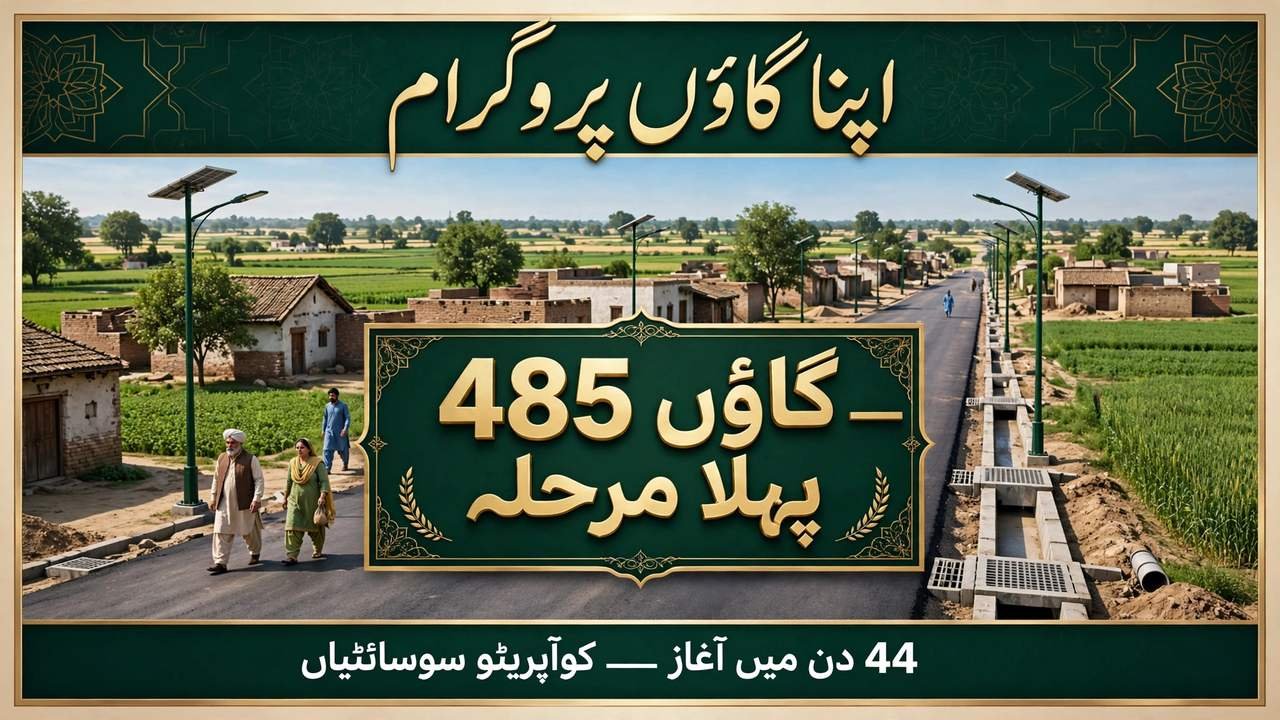
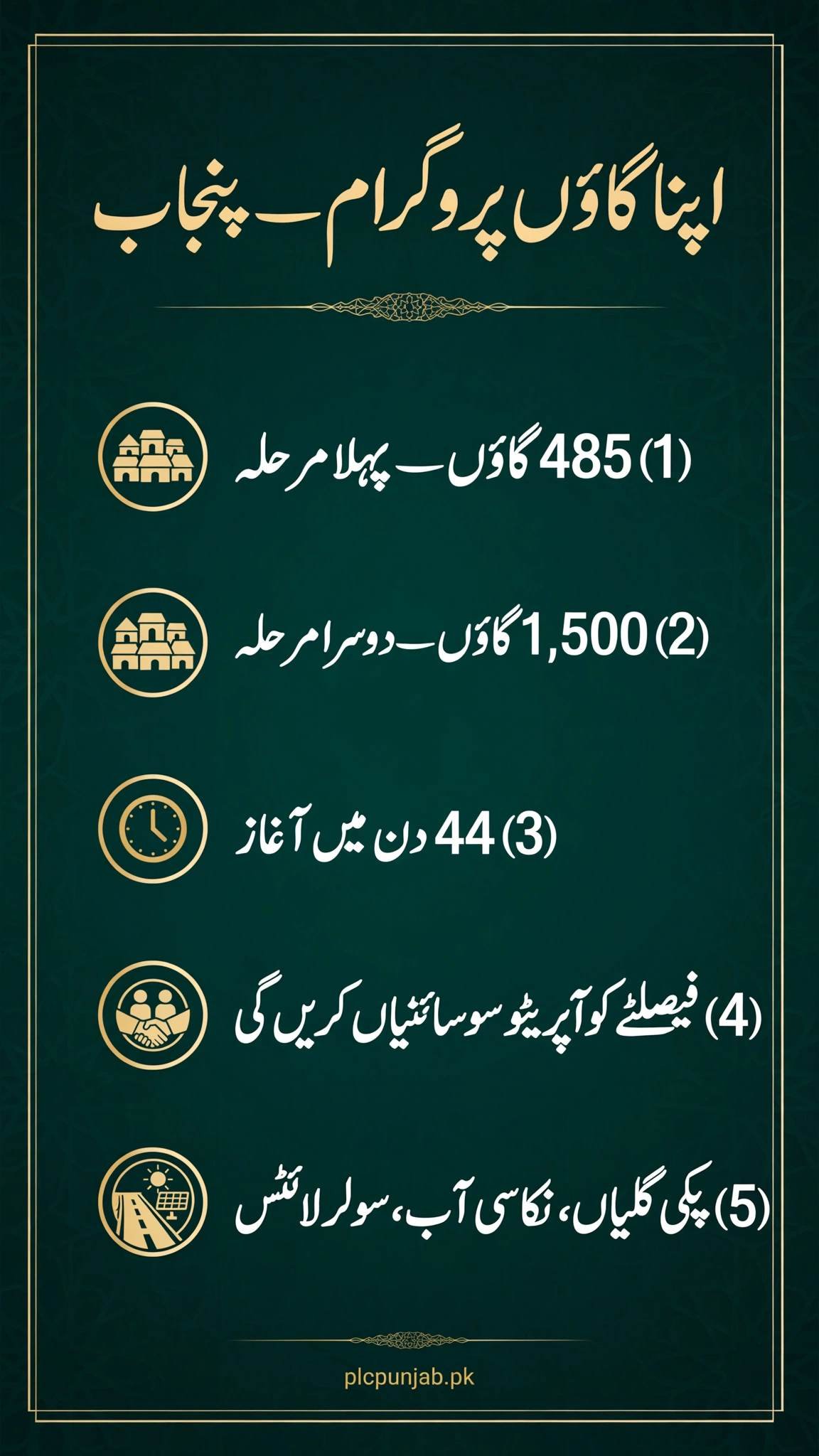
Punjab’s villages are about to get a development plan they run themselves. On Monday, 17 November 2026, Chief Minister Maryam Nawaz Sharif decided to launch the Apna Gaon Programme, a village-development drive that hands planning and execution to residents through cooperative societies. In the first phase, cooperative societies will be set up in 485 villages, with 1,500 more villages to follow in the second phase, and the Chief Minister has set a 44-day deadline for the launch. Paved streets, modern drainage, wastewater ponds and solar streetlights are the works at the centre of the plan.
17 November 2026, by Chief Minister Maryam Nawaz Sharif
First phase
Cooperative societies in 485 villages
Second phase
1,500 more villages
Launch deadline
44 days from the announcement, around 31 December 2026
What it builds
Paved streets, modern drainage, wastewater disposal ponds, solar streetlights
Who decides
Village residents, through cooperative societies
Oversight
Five-member tehsil monitoring committee headed by the assistant commissioner; five-member management committee in each society
Background funding
Rs50 million per village approved 14 November 2026 for 475 villages, Rs23.85 billion in total
What the Apna Gaon Programme Will Deliver
The Apna Gaon Programme has a narrow, practical focus: the everyday infrastructure that shapes life in a village. The works named in the announcement are the same ones villagers ask for first, and they will be delivered village by village rather than through a distant department.
Paved streets: every street in each covered village will be paved, replacing lanes that turn to mud in the rains.
Modern drainage: a proper drainage system will be built in each village, so rainwater and household water have somewhere safe to go.
Wastewater disposal ponds: suitable ponds will be built to dispose of wastewater in an organised way, replacing open drains and stagnant pools.
Solar streetlights: solar-powered streetlights will light village streets at night, without adding to electricity bills.
Less migration to cities: the government says better village facilities should reduce the pressure that pushes families to move to cities for basic services.
Cooperative Societies to Run the Work
The most important part of the announcement is not the list of works but who controls them. Under the Apna Gaon Programme, residents of each village will make all decisions about development, construction and repairs in their own village, working through a cooperative society. The Chief Minister said she wanted to put the people of each village in charge of its development, so that projects follow local priorities instead of decisions made far away.
Residents decide priorities: each village’s cooperative society will choose which development projects come first, according to the village’s own needs.
Five-member management committee: every society will have a management committee of a president, vice president, general secretary, treasurer and executive member.
Five-member monitoring committee: a tehsil-level committee headed by the assistant commissioner, including the assistant director of local government, will oversee how the societies function.
Transparent use of funds: the two committees are meant to ensure the money is spent properly and the work is actually completed.
Grassroots democracy: the Chief Minister said the model should make rural development long-term and sustainable, while encouraging self-reliance at village level.
44-Day Deadline and the 29-Year Ban Lift
The Chief Minister has set a 44-day deadline for the launch of the Apna Gaon Programme, which means the programme should be running by around 31 December 2026. The deadline is deliberately tight: it is meant to force the machinery to move quickly from announcement to work on the ground, rather than letting the plan sit in files for months.
To make the cooperative-society model possible, it was also agreed to partially lift a ban on cooperative societies in Punjab that has been in place for nearly 29 years. The ban had blocked the very structure the programme depends on, so lifting it is a necessary first step before societies can be formed in the 485 first-phase villages. The government has also set up an administrative structure to run the programme transparently and effectively, with the monitoring and management committees described above.
From Khushhal Dehat Approval to Apna Gaon Launch
Today’s announcement is the launch plan for a village-development drive that has moved in three clear steps in less than a month. Readers should note that one major outlet, Dunya News, reported today’s announcement under the name Khushhal Dehat Programme, while the state news agency report calls it the Apna Gaon Programme. Both reports describe the same decision, the same 485 villages and the same 44-day deadline, so this article treats them as one programme with two names in circulation.
20 October 2026 — pilot approved: 120 model villages approved, with the Khushhal Dehat Act 2026 to be introduced.
14 November 2026 — phase 1 funded: Rs50 million per village approved for 475 villages, Rs23.85 billion allocated, first instalment to be released in November 2026.
17 November 2026 — launch plan decided: Apna Gaon Programme announced with cooperative societies, a 44-day launch deadline and a partial lift of the 29-year ban on cooperative societies.
Stage
Villages
What Was Decided
Pilot project
120 model villages
Approved 20 October 2026; Khushhal Dehat Act 2026 decided
Phase 1 funding
475 villages
Rs50 million per village approved 14 November 2026; Rs23.85 billion allocated; first instalment November 2026
Launch plan
485 villages (phase 1), 1,500 villages (phase 2)
Apna Gaon Programme decided 17 November 2026; cooperative societies; 44-day launch deadline; 29-year ban on cooperative societies partially lifted
One figure needs care. The 14 November approval covered 475 villages, while today’s announcement puts the first phase at 485 villages, and the second phase at 1,500 villages rather than the 2,000 villages mentioned on 14 November. No reason for the change was given in today’s announcement, so this article reports both figures as announced and uses the latest ones — 485 and 1,500 — for the launch plan. The funding figure of Rs50 million per village comes from the 14 November approval; no new funding figure was announced today.
What This Means for Villagers
For families in the first-phase villages, the promise is concrete and visible: paved streets, working drainage and light at night. But the bigger change is who gets to decide. Under the cooperative-society model, villagers will not wait for a department to choose their projects — they will choose them, and the committees will answer to them.
Easier daily life: children can walk to school without wading through mud, and elders can move around the village safely after dark.
Better health: closed drains and proper wastewater ponds cut the waterborne disease that open drains spread.
Local voice: villagers can raise problems directly with their own society’s management committee instead of travelling to a distant office.
Accountability close to home: the tehsil monitoring committee gives residents a clear place to complain if work is slow or money is misused.
What is still unknown matters as much as the confirmed details. No list of the 485 first-phase villages has been published, no per-village project list has been announced, and the text of the Khushhal Dehat Act 2026 has still not been published. The 44-day deadline tells us when the launch should happen, but the date work actually begins in any given village is not yet known.
No village list yet: the 485 first-phase villages have not been named, so no one can yet check whether their village is included.
No individual application: funding and works go through village cooperative societies, so villagers do not need to apply as individuals.
No portal or helpline: no official portal or helpline for the programme has been announced.
No new funding figure today: the Rs50 million per village figure is from the 14 November approval, not from today’s announcement.
Beware of fraud: anyone asking for a fee to register a village or a household should be treated with caution, and claims should be checked against official announcements.
Conclusion
The Chief Minister’s decision on 17 November 2026 gives Punjab’s village-development drive a name, a model and a deadline. The Apna Gaon Programme will reach 485 villages in its first phase and 1,500 more in the second, with cooperative societies letting residents decide their own development priorities, a 44-day deadline for the launch, and a partial lift of the 29-year ban on cooperative societies that makes the model possible. It builds on the 14 November approval of Rs50 million per village for 475 villages, with the first instalment due in November. The next step to watch is the publication of the 485-village list and the first cooperative societies being formed.
Frequently Asked Questions
What is the Apna Gaon Programme?
A Punjab government village-development programme announced by Chief Minister Maryam Nawaz Sharif on 17 November 2026. It will provide paved streets, modern drainage, wastewater disposal ponds and solar streetlights, with village residents deciding development priorities through cooperative societies.
How many villages are covered in the first phase?
Cooperative societies will be established in 485 villages in the first phase, and the second phase will extend the programme to 1,500 more villages.
When will the Apna Gaon Programme launch?
The Chief Minister has set a 44-day deadline for the launch, which means the programme should be running by around 31 December 2026.
Who will decide the development work in each village?
Village residents, through a cooperative society in each village. Each society will have a five-member management committee, and a five-member tehsil monitoring committee headed by the assistant commissioner will oversee the societies.
Do villagers need to apply or register?
No individual application has been announced. Funding and works go through village cooperative societies, so villagers do not need to apply as individuals, and no official portal or helpline has been announced.
Is the Apna Gaon Programme the same as the Khushhal Dehat Programme?
Yes, as far as the announcements show. The village-development drive was approved as the Khushhal Dehat Programme on 14 November 2026, with Rs50 million per village for 475 villages, and Dunya News reported today’s announcement under the Khushhal Dehat name, while the state news agency report calls it the Apna Gaon Programme. Both reports describe the same decision, the same 485 villages and the same 44-day deadline.
Shahzad Sahil is the editor of plcpunjab.pk, covering Punjab government schemes including the Livestock Card, eligibility, registration and latest updates, with information verified from official sources for readers across Punjab.
Children of BISP Kafaalat beneficiaries can receive a quarterly education stipend from the government. The BISP Taleemi Wazaif 2026 programme pays stipends for classes 1 to 12, gives girls a higher amount than boys, and adds a one-time bonus when a girl completes primary school. This guide explains the stipend amounts, who is eligible, and…
Punjab Chief Minister Maryam Nawaz Sharif met a delegation of farmers’ representatives in Lahore on Wednesday, 28 October 2026, and told them that Rs400 billion had been provided to farmers through the Kisan Card scheme over the past two years, benefiting around one million farmers across the province. The meeting, covered live by Aaj News…
The Federal Board of Revenue (FBR) has made sales tax invoices mandatory for registered taxpayers on advance payments received against future supplies. The new procedures, notified through SRO 2063(I)/2026 on 5 November 2026, change when sales tax on an advance must be declared, and require every advance to be documented with its own invoice. Invoice…
For an industrial worker, a visit to the doctor usually means a lost day of wages. You travel to a hospital, wait in a long queue, and return home tired with a small paper slip in your hand. The Punjab Social Security Mobile Health Programme tries to change that daily struggle. Launched in Lahore on…
Punjab has taken a major step towards specialised healthcare in its capital, with the Provincial Development Working Party approving the establishment of the Nawaz Sharif Medical District in Lahore at an estimated cost of Rs18.786 billion. The approval came at the PDWP’s 11th meeting of the current financial year, chaired by Planning and Development Board…
Lahore is the pilot city for Punjab’s first electric taxi programme. Under the CM Punjab E-Taxi Scheme, 1,100 electric taxis are being distributed in the first phase — 1,000 to fleet owners and 100 to individual drivers — on interest-free instalments, with the government covering the markup, vehicle registration and token tax. Backed by Rs…