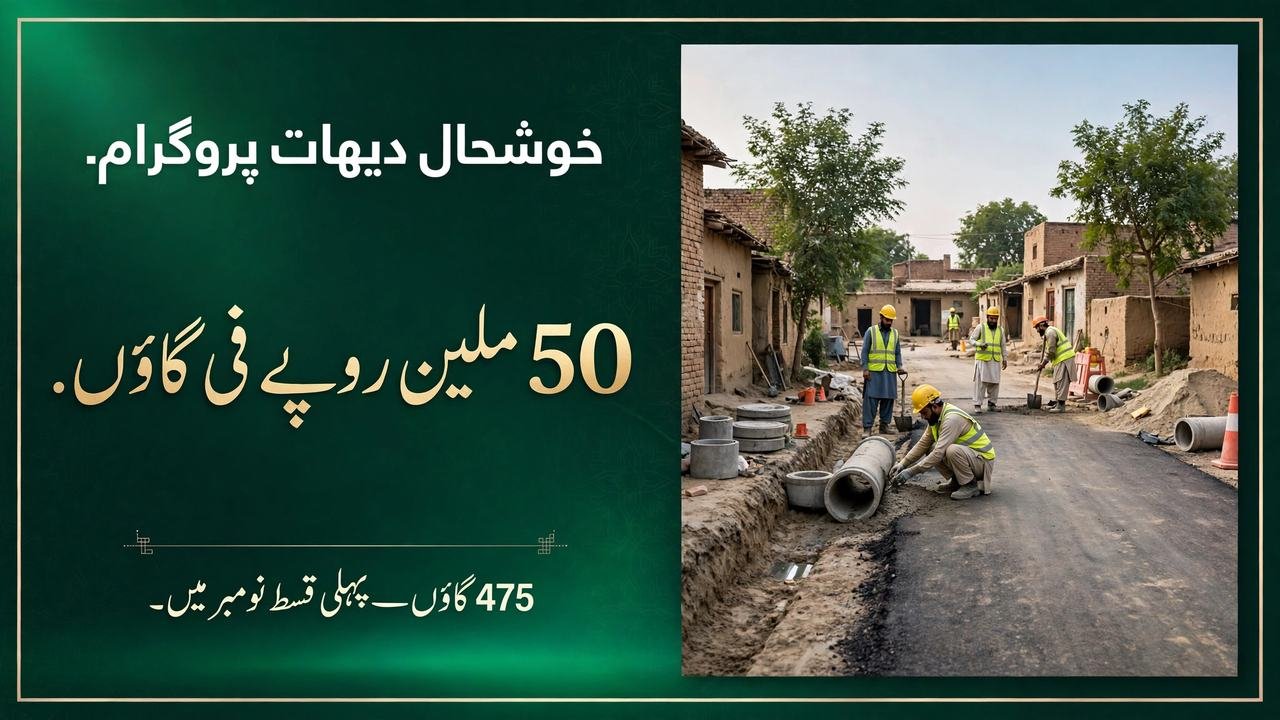
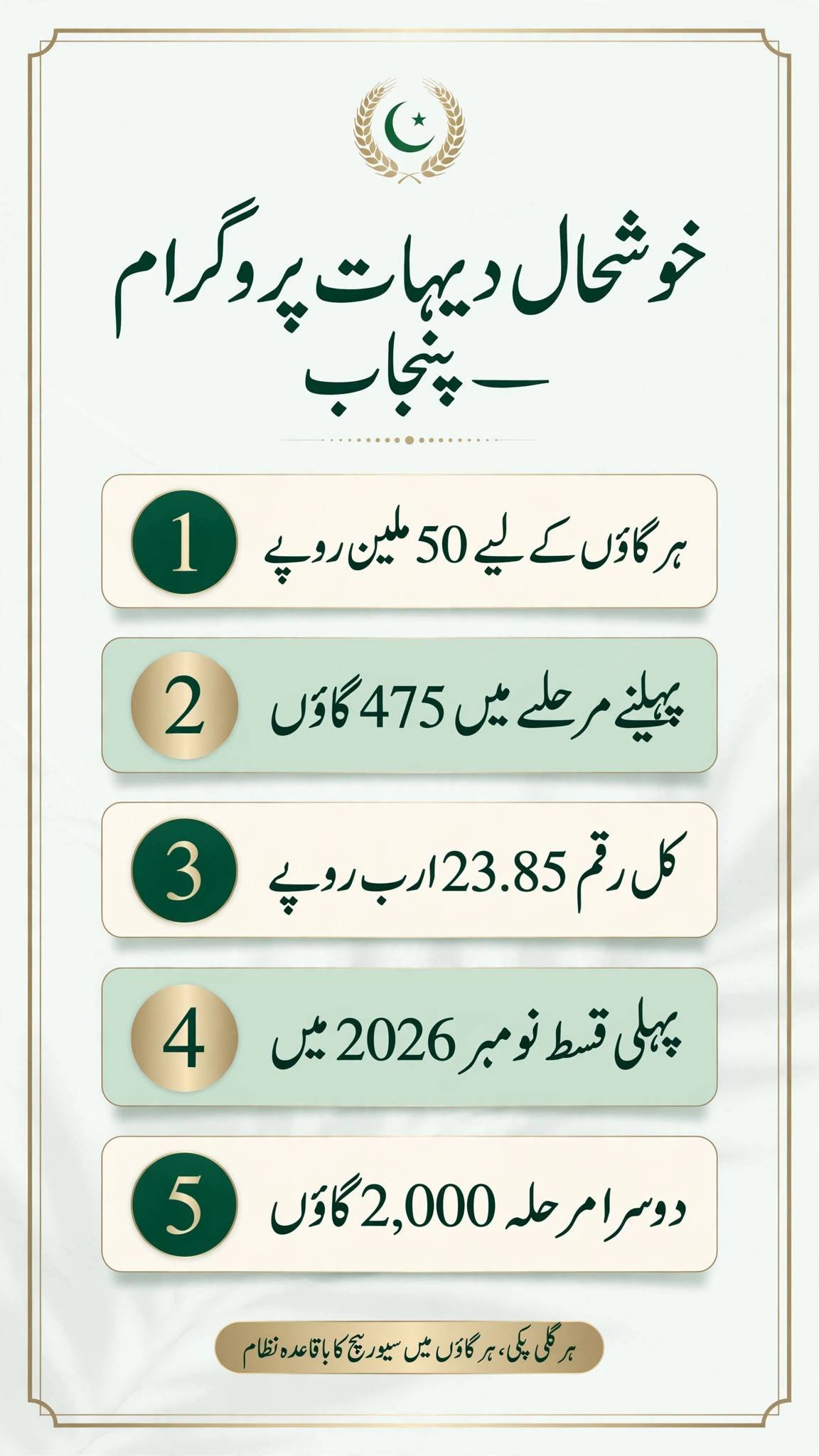
Punjab’s villages are about to get the paved streets and proper sewerage that cities have long taken for granted. On Saturday, 14 November 2026, Chief Minister Maryam Nawaz Sharif approved Rs50 million of development funding for every village in the province under the Khushhal Dehat Programme, with 475 villages covered in the first phase and Rs23.85 billion allocated for it. The first instalment is to be released to village committees in November, so work on the ground is expected to begin within weeks.
Detail
Confirmed Information
Programme
CM Punjab Khushhal Dehat Programme
Approval date
14 November 2026, by Chief Minister Maryam Nawaz Sharif
Funding per village
Rs50 million for development of every village
Phase 1 coverage
475 villages across Punjab
Phase 1 allocation
Rs23.85 billion
First instalment
To be released in November 2026
Who supervises
Khushhal Dehat Committee, headed by the Additional Deputy Commissioner (Social Services)
Phase 2
Development plan sought for 2,000 villages
What the Chief Minister Approved
The approval came at a meeting in Lahore, where the Chief Minister gave in-principle approval for the programme’s first funded phase. It turns a pilot approved on 20 October 2026 — 120 model villages, with the Khushhal Dehat Act 2026 to follow — into a province-wide programme with a fixed per-village amount and a dated first instalment.
Reaffirming her vision, the Chief Minister said she is determined to ensure paved streets and proper sewerage in every village — “Har gali pakki, har gaon mein sewerage ka baqaida nizam” — and that development will now be uniform, with no political affiliation allowed to create hurdles.
How the Money Will Be Spent
The programme has a narrow, practical focus: the everyday infrastructure that shapes life in a village. The money goes to village committees for works, not to individuals — there is no cash transfer, no application form and no per-person eligibility test.
Paved streets: every street in each covered village will be paved, replacing lanes that turn to mud in the rains.
Formal sewerage system: a proper sewerage system will be built in each village, replacing open drains.
Drainage: drainage work is part of the same package, so rainwater has somewhere safe to go.
Committee-led execution: projects will be executed under the Khushhal Dehat Committee in each district, not to a distant department.
First instalment in November: the first grants reach committees in November 2026.
Who Will Run the Work in Each Village
Development projects will be executed under the supervision of the Khushhal Dehat Committee, headed by the Additional Deputy Commissioner (Social Services) of the district. The committee includes five government officials and four private members, along with Union Council chairmen and the respective sub-engineers. This builds on the pilot-stage village committees, constituted with local public representatives, with the Deputy Commissioner supervising them.
From 120-Village Pilot to 475-Village Phase 1
The programme has moved in three clear steps in less than a month — and the jump from pilot to funded phase is the real news.
20 October 2026 — pilot approved: 120 model villages approved; Khushhal Dehat Act 2026 to be introduced.
Early November 2026 — district work begins: district administrations began supervising model-village projects.
14 November 2026 — phase 1 funded: Rs50 million per village approved for 475 villages, Rs23.85 billion allocated, first instalment in November.
Stage
Villages
Status
Pilot project
120 model villages
Approved 20 October 2026; Khushhal Dehat Act 2026 decided
Phase 1
475 villages
Rs50 million per village approved 14 November 2026; Rs23.85 billion allocated; first instalment November 2026
Phase 2
2,000 villages
Development plan sought; no funding figure announced yet
What This Means for Villagers
For families in the 475 first-phase villages, the promise is concrete and visible: paved streets and a working sewerage system.
Easier daily life: children can walk to school without wading through mud.
Better health: closed sewers instead of open drains cut waterborne disease.
Local voice: villagers can raise problems with the Union Council chairman and private members on the committee.
What Is Not Announced Yet
What is still unknown matters as much as the confirmed figures. No list of the 475 first-phase villages has been published, no per-village project list or completion deadline has been announced, and the text of the Khushhal Dehat Act 2026 has not been published yet.
No individual application: funding goes to village committees, so villagers do not need to apply.
No portal or helpline: no official portal or helpline for the programme has been announced.
Beware of fraud: anyone asking for a fee to register a village or household should be treated with caution.
Conclusion
The Chief Minister’s approval on 14 November 2026 turns the Khushhal Dehat Programme from a 120-village pilot into a funded first phase covering 475 villages, with Rs50 million for every village and Rs23.85 billion allocated in total. The first instalment is due in November, Khushhal Dehat Committees will supervise the work, and a second phase of 2,000 villages is already planned.
Frequently Asked Questions
What is the Khushhal Dehat Programme?
A Punjab government programme launched by Chief Minister Maryam Nawaz Sharif, funding paved streets, drainage and sewerage in villages across Punjab.
How much money will each village get?
Rs50 million per village covered; the total first-phase allocation for 475 villages is Rs23.85 billion.
Which villages are included in the first phase?
The first phase covers 475 villages across Punjab, but the official list of those villages has not been published yet.
Do villagers need to apply or register?
No. Funding goes to Khushhal Dehat Committees for infrastructure work, so there is no individual application form, registration portal or eligibility test.
Who supervises the development work?
The Khushhal Dehat Committee, headed by the Additional Deputy Commissioner (Social Services), with Union Council chairmen and sub-engineers as members.
What will the second phase cover?
The Chief Minister has sought a development plan for a second phase covering 2,000 villages. No funding figure or start date has been announced yet.
Shahzad Sahil is the editor of plcpunjab.pk, covering Punjab government schemes including the Livestock Card, eligibility, registration and latest updates, with information verified from official sources for readers across Punjab.
Apni Zameen Apna Ghar Registration Next Phase 2026: How to Apply for Free Plot — Complete Guide If you are hoping to register for a free plot, you deserve a straight answer first. Registration for Apni Zameen Apna Ghar is closed right now, and the government has not announced any date for the next phase….
Dollar rate in Pakistan today, 3 November 2026, starts from the State Bank of Pakistan’s interbank closing of Rs 276.72 per US dollar. According to the Forex Association of Pakistan, the rupee appreciated by 3 paisa against the US dollar in interbank trading on Monday, 2 November 2026, closing at Rs 276.72 compared with the…
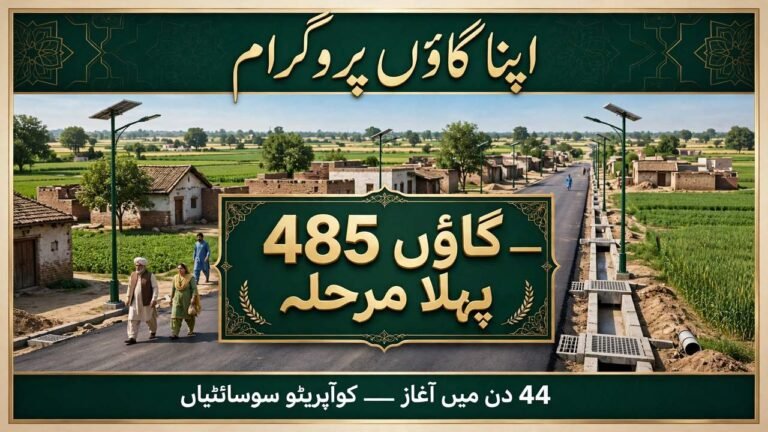
Punjab’s villages are about to get a development plan they run themselves. On Monday, 17 November 2026, Chief Minister Maryam Nawaz Sharif decided to launch the Apna Gaon Programme, a village-development drive that hands planning and execution to residents through cooperative societies. In the first phase, cooperative societies will be set up in 485 villages,…
Petrol now costs Rs 322 per litre after the 21 November 2026 revision, and the PM Fuel Relief Scheme is still active — in fact, on 20 November 2026 the Prime Minister directed that the relief must continue despite falling international oil prices. Announced on 13 September 2026, the scheme gives you Rs 100 off…
Getting a domicile certificate in Punjab is about to change for good. The Punjab government has begun implementing a new online system for issuing domicile certificates in phases, and once the change is complete, every domicile certificate in the province will be issued through the online system alone. The Punjab Online Domicile System gives citizens…
Students across Punjab have been asking one question since mid-October: has a new round of laptops and scholarships actually opened? The short answer is yes — distribution is now under way. The CM Punjab Laptop and Scholarship Scheme Phase 2 2026 was announced on 18 October 2026, when Punjab Information Minister Azma Bokhari said Chief…