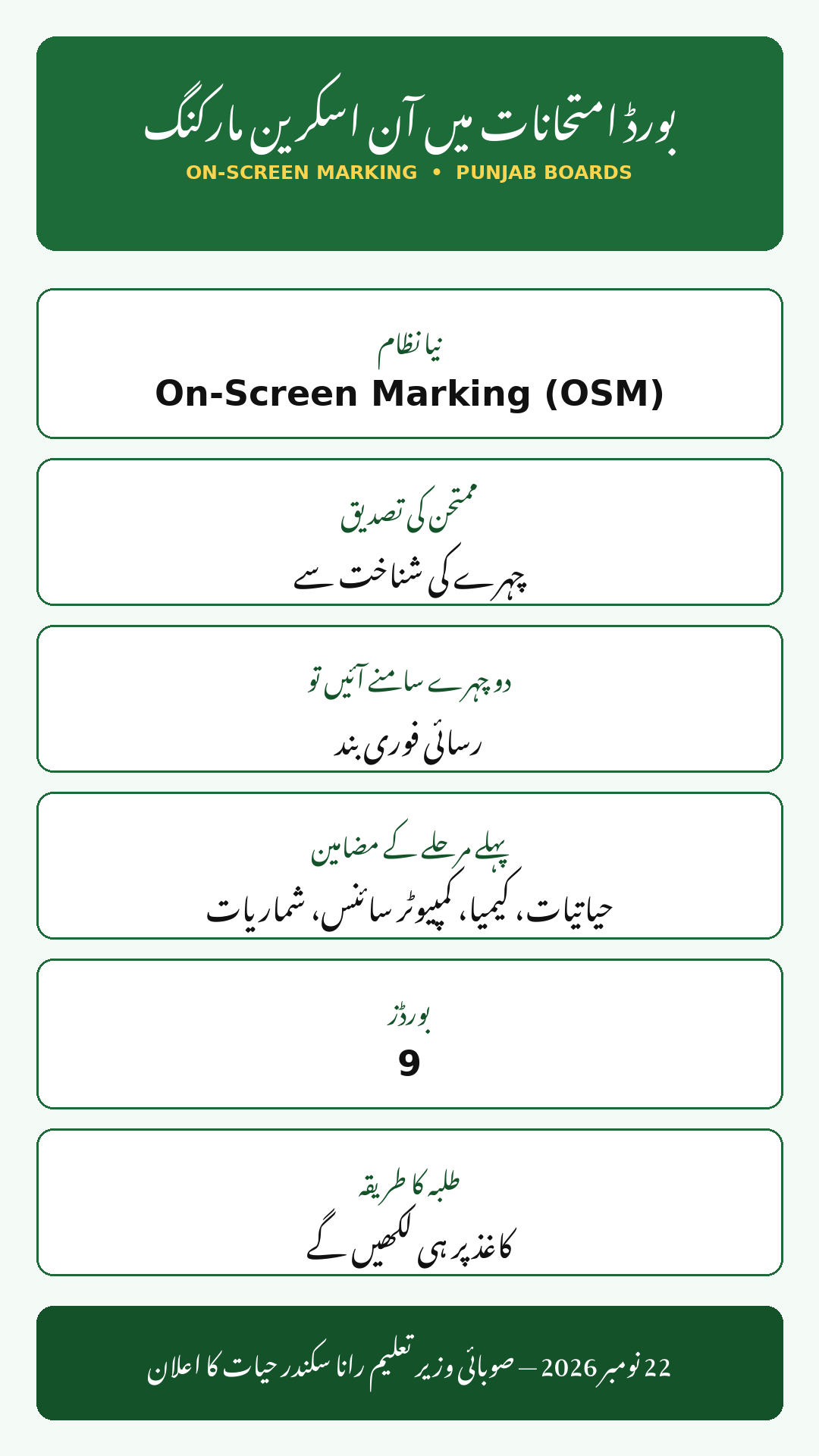
Punjab On-Screen Marking Board Exams 2026 is now moving from announcement to action, after Provincial Education Minister Rana Sikandar Hayat shared a live demonstration of the new digital marking system on 22 November 2026. Answer sheets will be scanned and checked online, and examiners must verify their identity through facial recognition before marking.
The demonstration featured the system of the Board of Intermediate and Secondary Education (BISE) Bahawalpur: answer sheets fed into a high-speed scanner, appearing on a real-time dashboard where examiners check them on screen. The government says the change will reduce marking errors, improve consistency and make examinations more transparent — part of wider reforms the nine boards’ chairpersons agreed earlier this month, including e-sheets for four science subjects from next year.
On-Screen Marking (OSM) is a digital method of checking answer sheets. Instead of physical bundles being sent to examiners’ homes and marked by hand, completed scripts are scanned, converted into a digital record and made available on an electronic assessment platform, where the examiner marks each answer on screen.
The idea is not new to Punjab. The Express Tribune reported in October 2026 that the Lahore Board of Intermediate and Secondary Education (BISE) was already moving towards digital assessment, with four subjects selected for the first phase. What is new is the public, live demonstration — including the facial-recognition check that controls who can mark.
For students, the key point is simple: the way they sit their papers does not change. They will still write answers on paper, in examination centres, with a pen. The change happens after the paper is collected — the answer sheet is scanned, and marking that used to happen on a physical copy now happens on a screen.
How the New System Works
The live demonstration showed the full journey of an answer sheet through the new system.
Scanning: Answer sheets are fed into a high-speed scanner, which converts every page into a digital image.
Dashboard: Scanned pages appear on a real-time dashboard, where examiners access their assigned papers.
Examiner login: Before marking begins, each examiner verifies their identity through facial recognition, so only the registered examiner can open the papers.
Single-face rule: The examiner proceeds only when a single matching face is detected.
Two-face lock: If two faces appear at the same time, the system locks access immediately.
On-screen marking: The examiner reads each answer on screen and awards marks digitally.
AI-assisted checking: The dashboard includes an AI-assisted checking feature alongside the examiner’s marking.
Live tracking: The dashboard tracks marking progress in real time, so the board can see delays early.
The Facial Recognition Lock: How Examiner Identity Is Checked
The most talked-about detail is the facial-recognition check. In the old system, a bundle of answer books could be marked by anyone who held it. The new system closes that gap at the point of login.
Before marking begins, the examiner sits in front of a camera and the system matches the face against the registered record. It proceeds only when a single matching face is detected; if two faces appear, it locks access. The examiner cannot hand the paper to someone else, and a second person cannot sit beside them and influence the marking.
This matches what the minister had already announced: manual checking would be replaced by on-screen assessment from 2027, with digital identification and QR code-based arrangements. The facial-recognition lock is that digital identification, shown working in Bahawalpur. Note what the system does not do — it does not mark the paper by itself. AI-assisted checking works alongside the examiner.
BISE Bahawalpur Live Demonstration: What the Video Showed
The video shared by Minister Rana Sikandar Hayat featured the BISE Bahawalpur system: a high-speed scanner taking in whole sets of answer sheets, scanned pages appearing on a real-time dashboard, facial recognition before marking with the two-face lock, live tracking of marking progress, and AI-assisted checking alongside the examiner’s work. The choice of Bahawalpur matters — the system is not limited to Lahore, and students of all nine boards should expect the same process.
Four Science Subjects and E-Sheets: What Was Decided Earlier
The demonstration follows a decision taken earlier in November 2026 by the chairpersons of Punjab’s nine boards, who met in Lahore under the Punjab Boards Committee of Chairmen (PBCC) on 11 November 2026, chaired by Lahore Board Chairman Professor Badrul Salam. They decided four science subjects would be examined on e-sheets from next year, and finalised the subjects for on-screen marking in matric and intermediate exams.
The e-sheet is the paper side of the same reform: a scan-friendly answer sheet with barcode headers, bubble fields and boxed spaces for each question, so scanners capture every response accurately. Students still write with a pen — only the layout changes to suit the scanner. Our guide explains it step by step: Punjab Board eSheet Guide 2026.
BISE Lahore had already moved first. The Express Tribune reported that the Lahore board selected four subjects — biology, chemistry, computer science and statistics — for the initial phase, with the Intermediate Second Annual examinations beginning on 3 November 2026 as the first test, and district-wise training workshops during October across Lahore, Kasur, Sheikhupura and Nankana Sahib. The schedule is here: Inter 2nd Annual Exams 2026: 11th Class Papers 17–28 Nov — Date Sheet.
Timeline: From October Announcement to the November Demo
Date
What Happened
October 2026
Minister directs all boards to launch online screen marking on a pilot basis; BISE Lahore letter (7 Oct) announces the move, with four subjects first; examiner workshops held.
3 November 2026
Intermediate Second Annual examinations begin; four subjects are marked on screen in the BISE Lahore pilot.
11 November 2026
All nine boards’ chairpersons meet in Lahore (PBCC); four science subjects to be examined on e-sheets from next year.
22 November 2026
Minister shares a live demonstration (BISE Bahawalpur), including the facial-recognition check and AI-assisted checking.
2027
Manual checking to be replaced by on-screen assessment from 2027; full subject list to come in official circulars.
What Changes for Students
Answer sheet layout: In the four science subjects, students will write on e-sheets with barcode headers, bubble fields and boxed spaces. Filling the sheet correctly matters more, because the scanner reads the layout.
Fairer checking: Marks are awarded on screen by a verified examiner, with work tracked centrally — reducing errors and inconsistent marking.
No lost bundles: Papers are scanned at a central point and stored digitally, so a whole bundle can no longer go missing on its way to an examiner.
Faster results: Real-time tracking should help boards compile results sooner — though no board has yet announced a shorter result date.
What Stays the Same for Students
Pen and paper: Students still sit in examination centres and write answers by hand. On-screen marking does not mean typing answers on a computer.
Syllabus and paper pattern: Nothing changes in what students must study or how many marks each question carries. The 2027 syllabus position is here: Punjab Smart Syllabus Class 10 and 12, 2026.
Human examiner: A registered human examiner still awards the marks. AI-assisted checking supports the examiner; it does not replace them.
Board responsibility: Each board still sets, conducts and results its own examinations. Students must follow their own board’s instructions.
Why Punjab Is Making This Change
The government and the boards give three reasons: fewer marking errors, more consistent marking, and a more transparent process. The old manual system had known weaknesses — bundles travelled to examiners’ homes and marks were totalled by hand. A scanned, centrally tracked system fixes all three.
The Federal Board of Intermediate and Secondary Education (FBISE) has brought in an online question paper system at 35 centres to stop paper leaks, as reported here: FBISE Introduces Online Question Paper System at 35 Centres to Stop Paper Leaks. Punjab’s marking reform is the checking-side companion to that push. One caution remains — the full rollout has not been announced in detail, and any claim that all subjects will be marked on screen from a specific date is unconfirmed until the student’s own board says so.
What Students and Parents Should Do Now
Learn the e-sheet: If your paper is in one of the four science subjects, practise filling the e-sheet layout before the exam — our guide covers it: Punjab Board eSheet Guide 2026.
Write clearly: Scanners read handwriting as an image, so clear writing inside the boxed spaces helps the examiner read your answers.
Follow your own board: The nine boards may roll the system out on different schedules. Check your own board’s website and notices.
Do not pay anyone: No fee has been announced, and no agent can change how your paper is marked. Anyone demanding money for marking favours is a scam.
Frequently Asked Questions
1. What is Punjab On-Screen Marking for board exams? Answer sheets are scanned and checked online by examiners on a computer screen, instead of physical answer books being marked by hand. The Punjab On-Screen Marking Board Exams 2026 system was demonstrated live by Education Minister Rana Sikandar Hayat on 22 November 2026.
2. Will students now type their answers on a computer? No. Students will still write answers on paper, with a pen, in examination centres. Only the marking has gone digital.
3. What is the facial recognition check in the new system? Before marking begins, the examiner verifies their identity through facial recognition. It proceeds only when a single matching face is detected, and locks access if two faces appear.
4. Which subjects will use on-screen marking first? Biology, chemistry, computer science and statistics. BISE Lahore used on-screen marking for them in the Intermediate Second Annual exams from 3 November 2026.
5. What is an e-sheet? A scan-friendly answer sheet with barcode headers, bubble fields and boxed spaces for each question, so scanners capture every response accurately.
6. Which boards are covered by the reform? All nine Punjab boards — Lahore, Gujranwala, Multan, Rawalpindi, Faisalabad, Sargodha, Bahawalpur, DG Khan and Sahiwal.
7. Does AI mark the papers now? No. AI-assisted checking works alongside the examiner’s marking. Final marks are still awarded by a registered human examiner.
8. When will manual checking end completely? The minister has announced manual checking will be replaced by on-screen assessment from 2027. The full subject list and schedule will come in official board circulars.
9. Will results come faster under on-screen marking? Real-time tracking should help boards compile results sooner, but no board has yet announced a shorter result date. Follow your own board’s result schedule.
10. Where can I get official updates about on-screen marking? From your own board’s official website and notices, and from the Punjab School Education Department. Do not trust agents who demand money or promise changes in marking.
BISE Lahore digital marking for four subjects; Inter Second Annual exams from 3 November 2026; October training workshops; manual checking to end from 2027.
October 2026
Eduvision
Nine boards agreed the system; four science subjects on e-sheets next year; on-screen marking subjects finalised.
November 2026
Result.pk (PBCC report)
PBCC meeting in Lahore decided e-sheets for four science subjects from 2027.
11 November 2026
Conclusion
The live demonstration on 22 November 2026 turned Punjab’s on-screen marking plan from a policy announcement into a working system: answer sheets going into a scanner, appearing on a dashboard, and being marked by an examiner whose face has been verified before a single mark is awarded. With four science subjects already tested and the nine boards committed to e-sheets from next year, the Punjab On-Screen Marking Board Exams 2026 reform is the clearest sign of how board examinations will be checked in 2027. Students need not change how they write — but they should learn the e-sheet layout, write clearly, and follow only their own board’s official notices.
Female students in Lahore can now learn scooty riding for free. The Lahore Free Scooty Training Female Students programme has been launched by Lahore Traffic Police for female students at educational institutions, to promote women’s independence and road safety. It was formally launched at a road-safety seminar at the University of Central Punjab (UCP), where…
A total of 90 Pakistani universities have secured a place in the QS Asia University Rankings 2027, according to the latest rankings published by Quacquarelli Symonds (QS). The QS Asia University Rankings 2027 place the National University of Sciences and Technology (NUST) at the top of the Pakistani list, with an Asia rank of 76….
The Times Higher Education (THE) Interdisciplinary Science Rankings 2027 have been released, and Pakistan has recorded its strongest showing yet in this young global ranking. A total of 56 Pakistani institutions appear in the 2027 edition, with 43 receiving official global rankings and 13 placed in the Reporter category. Quaid-i-Azam University leads the national list…
If your son or daughter studies in a private medical college, the fee you pay may have been higher than the law allows. The National Assembly Standing Committee on Health was told on 11 November 2026 that 45 private medical colleges were charging students more than the officially prescribed fee, with some demanding up to…
Parents and teachers across Punjab are adjusting to a school day that starts later than it did in summer, and some private schools are now facing action for ignoring the change. According to the latest official notification, the Punjab Winter School Timings for 2026 set a single-shift start of 8:45 in the morning, in force…
If your child is appearing in the Matric exams in March 2027, the fee has gone up. The nine Punjab boards have set the new admission fee at Rs 6,200 for regular students and Rs 6,300 for private candidates. The last date to pay with single fee is 11 December 2026, which is less than…