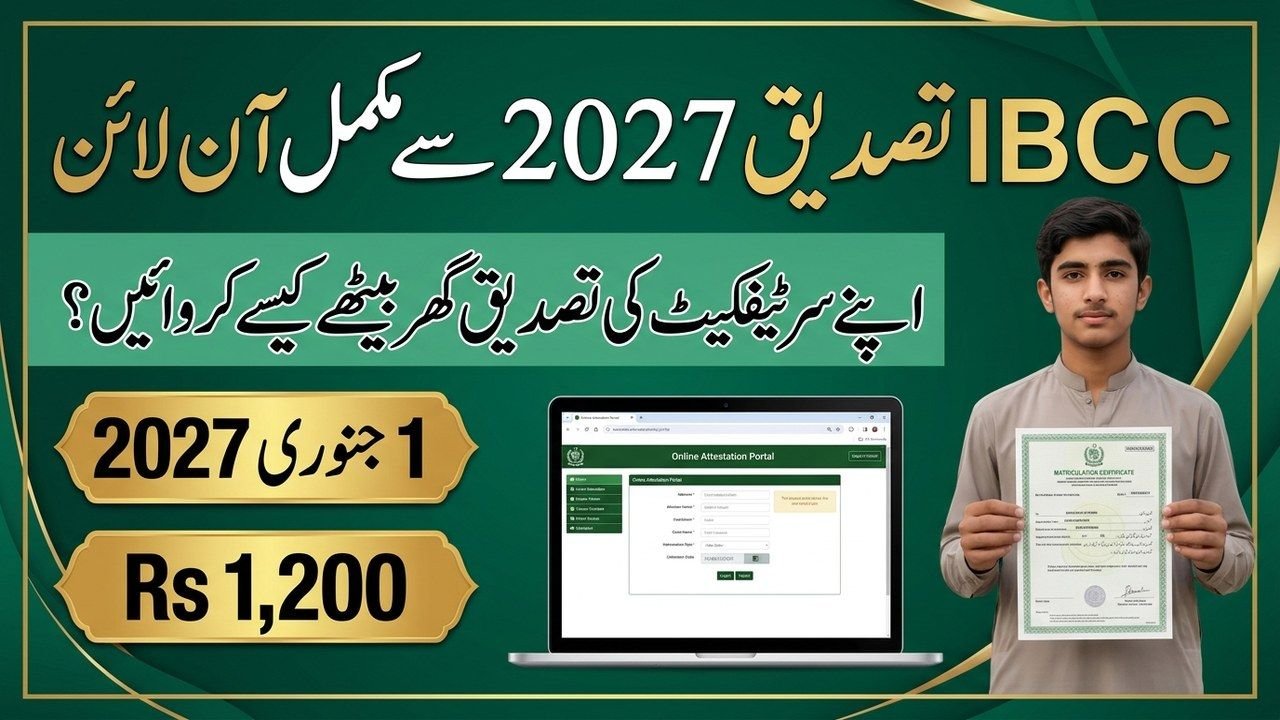
The IBCC Online Attestation 2027 change will remove the last reason most students ever visit an attestation office. The Inter Boards Coordination Commission (IBCC) will launch a fully online attestation service on 1 January 2027, ProPakistani reported on 22 November 2026, so students can get matric and intermediate certificates attested without travelling to an IBCC office or carrying sealed envelopes.
The announcement matters to every student who needs an attested certificate — for admission abroad, a scholarship, a job overseas, or equivalence. Until now, attestation has meant appointments, courier bookings, and waiting. From 1 January 2027, the whole process is reported to run online. This guide explains what is changing, what the current process looks like, what it costs, and what students should do before the new service starts.
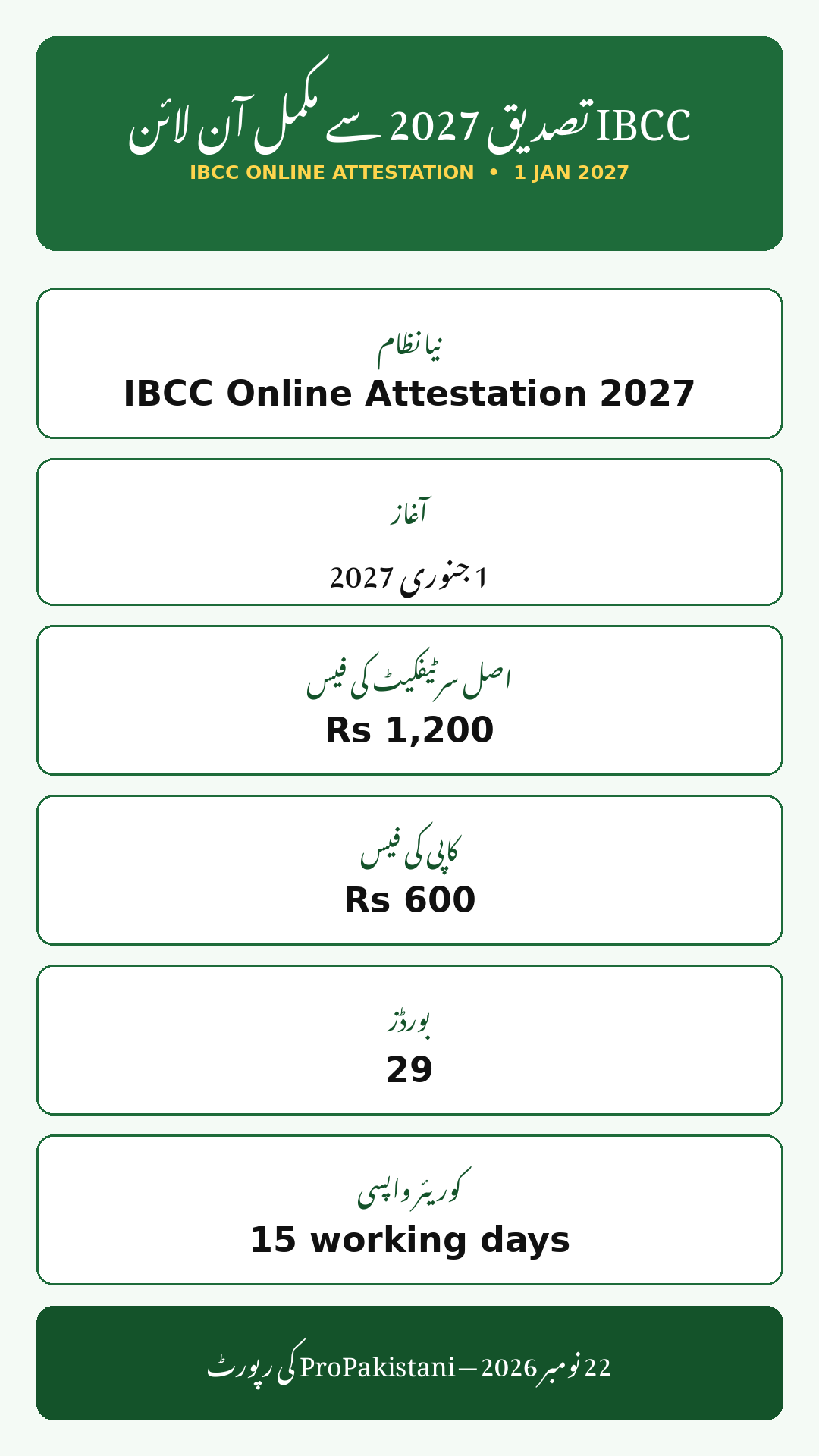
The headline change is simple: IBCC attestation becomes fully online. ProPakistani reported on 22 November 2026 that the Inter Boards Coordination Commission will launch a fully online attestation service on 1 January 2027, allowing students to complete the process from home. The report is the first public date for a change IBCC has been building towards under its Vision 2030 plan, which aims for a fully digital and visitor-free service.
What “fully online” means in practice is that students will apply, pay, and track their attestation through an online portal instead of visiting an IBCC office in person. IBCC has not yet published the full step-by-step procedure for the new portal, and students should check ibcc.edu.pk as 1 January approaches for the official link and instructions.
The change covers the certificates IBCC is responsible for — matriculation and intermediate certificates up to Higher Secondary School Certificate level. Degree attestation is handled by the Higher Education Commission (HEC), which already runs a fully online, paperless system. Students should not confuse the two: IBCC attests school-level certificates, HEC attests university degrees.
Who Needs IBCC Attestation
Because attestation is a gateway step — nothing else moves until the certificate is attested — any delay delays admission, a visa, or a job. That is why the move to a fully online system matters: it removes travel, queues, and the sealed-envelope step that used to slow everything down.
Students going abroad for study: Universities and visa offices ask for attested matric and intermediate certificates before admission or a visa is finalised.
Job seekers going overseas: Employers and foreign ministries require attested educational documents as proof of qualification.
Equivalence applicants: Students with foreign qualifications, including O and A Level certificates, need IBCC equivalence, which also depends on verified documents.
Students staying in Pakistan: Most do not need it for local admission or jobs, but anyone planning to go abroad later should keep originals safe — and check the Punjab Smart Syllabus Class 10 and 12, 2026 for the reduced 2027 syllabus.
How Attestation Works Today
IBCC currently offers three submission modes for attestation, listed on its official website. Students can book an appointment and visit an IBCC office, send the application with documents through courier, or choose the express service, which is available in the evening at the Islamabad and Lahore offices only.
By appointment: Book a date and time in the application, then visit the IBCC office with original documents.
By courier: Send the application with documents by courier; processed and returned within fifteen working days.
Express service: An evening service at the Islamabad and Lahore offices only.
For students of the Federal Board and the Lahore, Rawalpindi, Sahiwal and Bahawalpur boards, the sealed envelope requirement is already gone: they verify through the board’s online portal first, then apply to IBCC. The fully online service launching on 1 January 2027 is the next step.
Current Process vs the New Online Service
Step
How It Works Today
From 1 January 2027 (As Reported)
Application
Book an appointment, visit an office, or send documents by courier.
Fully online application through the IBCC portal.
Board verification
Already digital for all 29 boards; sealed envelopes abolished.
Digital verification continues; no change expected.
Fee payment
Paid through 1Bill, mobile banking, Easypaisa, JazzCash or National Bank.
Online payment continues; any fee change will be announced by IBCC.
Document return
Courier return within fifteen working days, or collection from the office.
Return method to be confirmed by IBCC.
Office visit
Needed for appointment and express modes.
No visit needed under the visitor-free model.
Board verification is already digital, so the 1 January change completes a half-finished process. IBCC has not announced any fee or return-method change, so treat the current fee and courier timelines as the position until IBCC says otherwise.
Fees: What Students Pay Now
The IBCC attestation fee is charged per document. In a written response to the Senate, the Federal Minister for Education and Professional Training stated that IBCC charges Rs 1,200 for each original certificate and Rs 600 for each copy, while HEC charges Rs 3,000 for each original degree.
IBCC original certificate: Rs 1,200.
IBCC copy: Rs 600 per copy.
HEC original degree: Rs 3,000 (HEC, not IBCC).
Courier return: A Rs 300 deposit covers the return courier fee for courier applications, paid with the IBCC fee through 1Bill, mobile banking, Easypaisa, JazzCash or National Bank.
IBCC has also given students one fee relief already: verification of the result card and the certificate is now done under a single fee, instead of two separate fees, on all boards in Pakistan. No new fee has been announced for the fully online service, and students should beware of anyone claiming a new charge — the only reliable source for fees is ibcc.edu.pk.
How to Apply Online
The exact steps for the new fully online service will be published by IBCC before 1 January 2027. The current online process works as follows.
Verify first: Get your certificate verified by your board through the board’s online portal. For FBISE and the Lahore, Rawalpindi, Sahiwal and Bahawalpur boards, no sealed envelope is needed.
Create your application: Open the IBCC attestation portal and complete the application form with your personal and educational details.
Upload documents: Upload scanned copies of your identity document and academic certificates as the portal asks.
Pay the fee: Pay the IBCC fee and, for courier applications, the Rs 300 return-courier deposit through 1Bill, mobile banking, Easypaisa, JazzCash or bank.
Track and receive: Courier applications are returned within fifteen working days. Keep your tracking details and payment receipt.
Students applying after 1 January 2027 should start at ibcc.edu.pk and look for the new online attestation link rather than booking an office appointment out of habit.
What the Digital Shift Has Already Changed
The IBCC Online Attestation 2027 launch is the latest step in a digital reform programme that has been running for two years. IBCC’s Executive Director, Dr Ghulam Ali Mallah, has said the commission is moving towards a fully digital and visitor-free service under Vision 2030. Attestation for matric and intermediate certificates has already shifted online, the sealed-envelope system has been removed, and verification now happens directly between the board and IBCC through software.
The same reform covers equivalence and verification: online application systems are already in place, certificates carry QR-code authentication, and applicants get real-time SMS and email updates. The HEC, IBCC and the Ministry of Foreign Affairs are also working together on a single digital portal for attestation, so students are not sent between three different offices.
Verify your certificate with your board now: Board verification is a precondition. Do it through your board’s online portal today, so the 1 January application is not held up. If your certificate has an error, get it fixed first — see BISE Multan 11th Class Paper Rechecking 2026 for how board corrections work.
Keep originals safe: Keep original certificates and a clear scanned copy ready. Do not hand originals to any agent.
Do not pay agents: No agent can speed up IBCC attestation, and no new fee has been announced. Anyone demanding extra money for the online service is running a scam.
Check ibcc.edu.pk, not social media: The portal link, the procedure and any fee update will appear on the IBCC website first. Ignore social media posts claiming new charges or deadlines until IBCC confirms them.
Apply early if you have a deadline: If an admission or visa deadline falls in January, do not wait. Apply through the current courier or appointment route now.
Learn the difference between IBCC and HEC: Matric and intermediate certificates go to IBCC; university degrees go to HEC. Applying to the wrong authority wastes weeks — and if your paper is in one of the four science subjects, learn the new answer-sheet layout first: Punjab Board eSheet Guide 2026.
Frequently Asked Questions
1. What is the IBCC Online Attestation 2027 change? IBCC will launch a fully online attestation service on 1 January 2027, ProPakistani reported on 22 November 2026. Students will be able to get matric and intermediate certificates attested online, without visiting an IBCC office.
2. Which certificates does IBCC attest? Matric and intermediate certificates up to Higher Secondary School Certificate level. University degrees are attested by HEC, not IBCC.
3. What is the IBCC attestation fee? Rs 1,200 for each original certificate and Rs 600 for each copy, according to the federal education minister’s written response to the Senate. A Rs 300 deposit covers the return courier fee.
4. Do I still need a sealed envelope from my board? No. IBCC has abolished the sealed-envelope system. All 29 boards now verify certificates online, directly with IBCC through software.
5. How long does courier attestation take now? Courier applications are processed and returned within fifteen working days.
6. Can I apply for IBCC attestation online today? Yes, in part: board verification is already online, and the IBCC portal accepts applications. The fully online service launches on 1 January 2027.
7. What is the difference between IBCC and HEC attestation? IBCC attests school-level certificates (matric and intermediate). HEC attests university degrees, and its fully online paperless system has run since 11 May 2026. The HEC fee is Rs 3,000 per original degree.
8. Do students in Pakistan need IBCC attestation? Usually not for local admission or jobs. It is mainly needed by students going abroad for study or work, or applying for equivalence.
9. Will the fee change on 1 January 2027? No fee change has been announced. Treat the current fee — Rs 1,200 per original, Rs 600 per copy — as the position until IBCC publishes an update on ibcc.edu.pk.
10. Where can I get official updates about the new online service? From ibcc.edu.pk and IBCC’s official notices. Do not trust agents or social media posts claiming new charges or procedures.
All 29 boards on online verification; sealed envelopes abolished; QR-code authentication; single-fee verification.
2025–2026
Conclusion
The IBCC Online Attestation 2027 launch on 1 January 2027 finishes a reform students have waited for: board verification went digital, sealed envelopes were abolished, and now the attestation application itself goes fully online. For students who need attested certificates for admission or work abroad, it means no office visit, no courier queue, and no agent in the middle. Get your certificate verified by your board now, keep originals and scans ready, and watch ibcc.edu.pk for the official portal link.
Parents of medical students in Punjab have won a court battle that could return hundreds of thousands of rupees per family. The Lahore High Court has announced its verdict in the private medical colleges fee case, upholding the fee cap set by the Pakistan Medical and Dental Council (PMDC) and ordering colleges to refund or…
The Punjab School Education Department has approved the next phase of its school outsourcing programme. Under Punjab school outsourcing Phase 4, 6,460 schools will be handed over to private partners, and for the first time the programme includes high schools. Government schools will continue admissions until 31 October 2026, with an admissions ban from 1…
Thousands of young teachers across Punjab are waiting for one list. The STI final merit list 2026 is due on 31 October 2026, and it will decide who joins government schools as School Teaching Interns from 3 November. Interviews were held on 29 and 30 October, and district education authorities are now finalising the lists….
On 18 October 2026, Punjab Information Minister Azma Bokhari announced that Chief Minister Maryam Nawaz Sharif had formally launched the second phase of the laptop and scholarship schemes. For Honhaar students, the useful news is simple: the Phase IV application round has now closed: applications closed on 19 November 2026, after the deadline was extended…
The PM Chromebook Merit List 2026 has been announced for Karachi, giving the Prime Minister’s Youth Chromebook Scheme its first published list of selected students. The Board of Secondary Education Karachi (BSEK) said in a press release issued on 5 November 2026 that the merit list has been uploaded to the board’s official website, so…
Eligible families can now register for free professional training under the Benazir Hunarmand Program, with monthly stipends, certificates and employment support on offer. The Benazir Income Support Programme (BISP) shared fresh details of the programme on 3 November 2026, confirming the training fields, the eligibility rules and the two ways to register — online through…