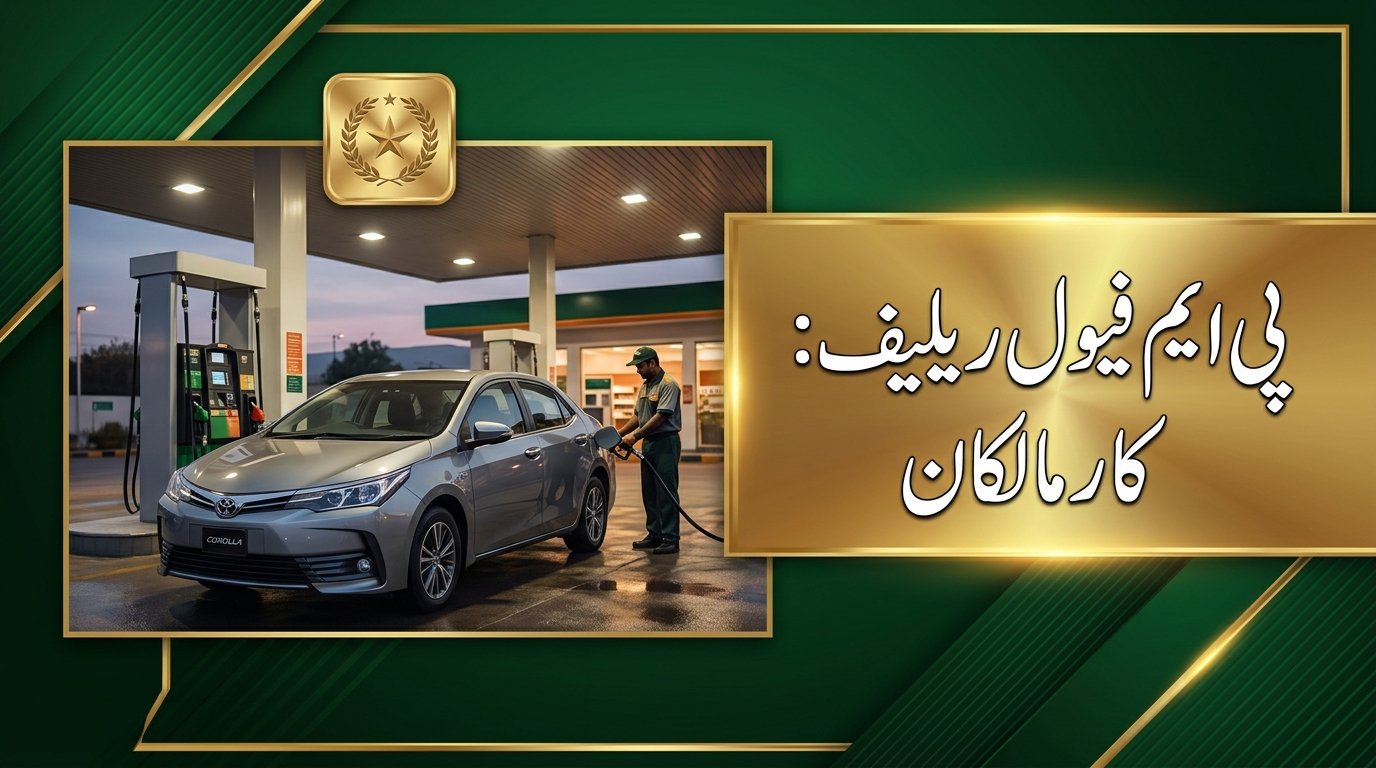
If you drive a small car like the Suzuki Mehran, Alto, or Bolan, the PM Fuel Relief Scheme 2026 has real money in it for you. Owners of cars up to 800cc get 30 litres of discounted petrol every month, worth up to Rs 3,000 in savings. This guide explains the car quota, the own-name rule that trips up many applicants, the token cycle, and how to register without mistakes.
Detail
PM Fuel Relief for car owners
Scheme
PM Fuel Relief Scheme 2026
Covered cars
Up to 800cc (Mehran, Alto, Bolan, and similar models)
Monthly quota
30 litres
Discount rate
Rs 100 per litre
Maximum monthly relief
Rs 3,000
Registration
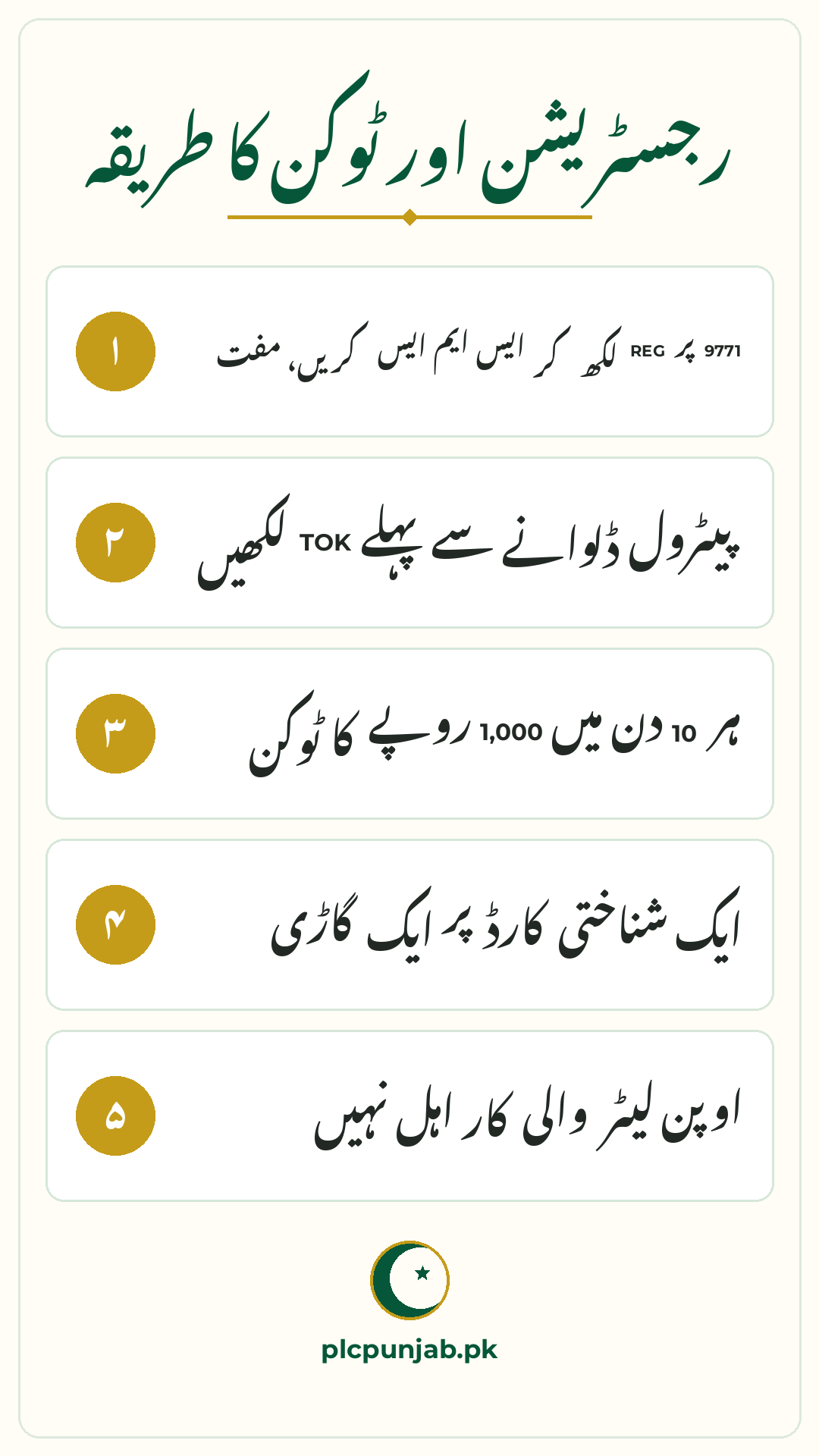
Free, one-time, by SMS to 9771
The Car Quota: 30 Litres, Rs 3,000 a Month
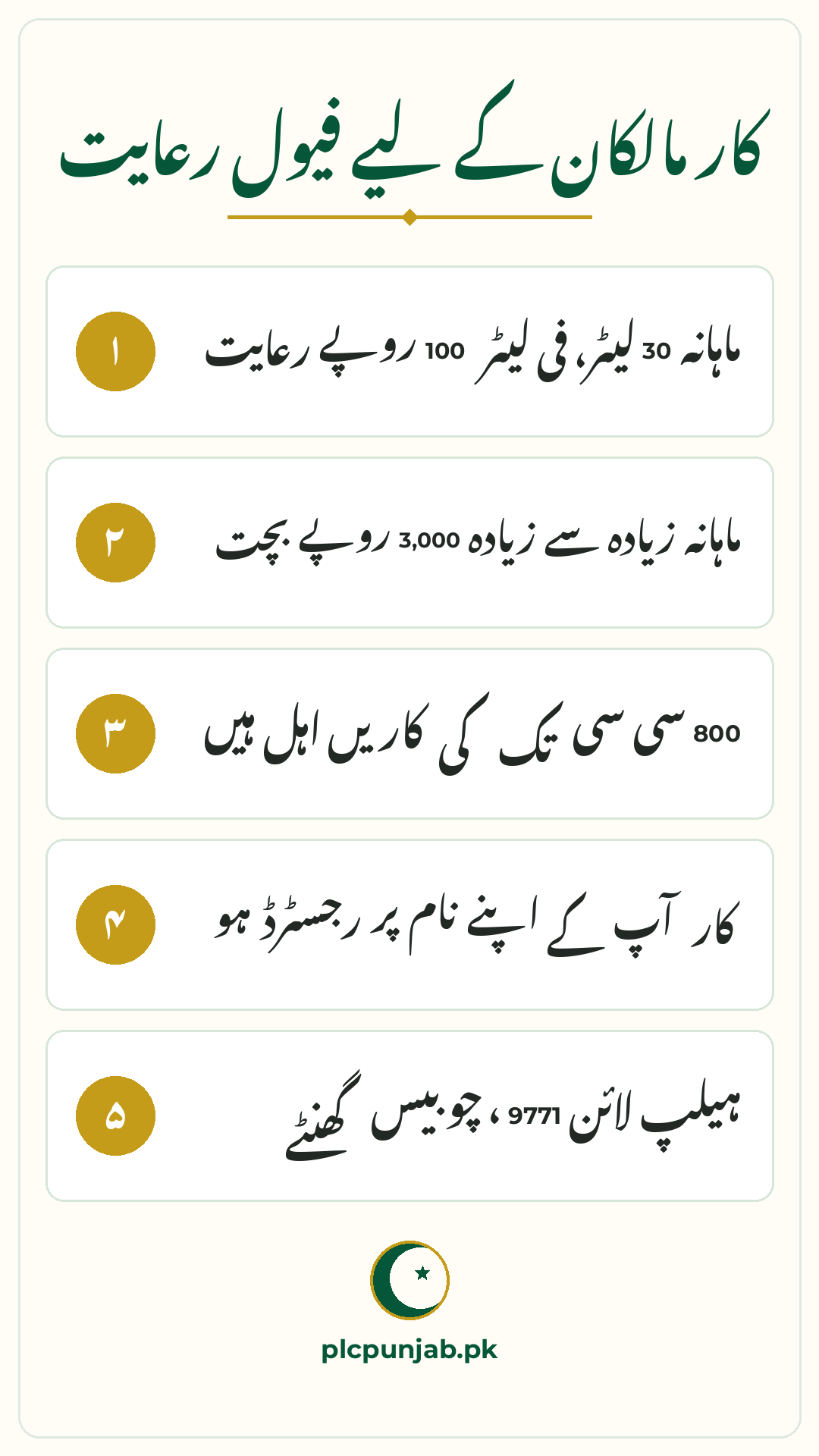
Cars up to 800cc receive 30 litres of discounted petrol per month under the scheme. At Rs 100 off per litre, the maximum monthly benefit is Rs 3,000. The discount is delivered through tokens, not cash. One token gives you Rs 1,000 off for 10 litres, and you can use one token every 10 days, which adds up to the full 30-litre monthly quota. If your car drinks more than 30 litres a month, the extra litres are charged at the normal price.
Over a full year at full quota use, the saving is about Rs 36,000. For a family using a Mehran for school runs and market trips, that is like getting about eight free litres of petrol every month. Remember, the benefit is a discount at the pump, never a cash deposit, and it does not mean petrol itself costs Rs 100 per litre.
Monthly quota: 30 litres with Rs 100 per litre off
Maximum relief value: Rs 3,000 per month
Token cycle: one Rs 1,000 token every 10 days
Token covers 10 litres at a time
Extra fuel beyond the quota is charged at full price
Car owners face stricter rules than bike owners. Your car must be 800cc or below and registered on or after 1 January 2006. It must be for non-commercial use, it must exist in the provincial Excise and Taxation records, and one CNIC can register only one vehicle. Diesel cars are not covered; the scheme is petrol only.
The engine limit is the first filter. A 1000cc car, however old or small it looks, does not qualify, because the scheme was designed for the smallest cars on the road. The registration year is the second filter. Cars registered before 2006 fall outside the scheme, even if they are 800cc or below.
Engine size: 800cc or below (Mehran, Alto, Bolan, and similar models)
Registration year: on or after 1 January 2006
One vehicle per CNIC; non-commercial use only
Petrol only; diesel cars excluded
Record must exist in Excise and Taxation data
The Own-Name Rule That Trips Up Applicants
This is the single biggest difference from the bike rules: an open transfer letter does not work for cars. The car must be registered in your own name. Many car registrations fail for exactly this reason, because the car was bought on an open letter and the transfer was never completed in excise records.
If your car is still in a previous owner’s name, get the transfer completed first, and confirm the transfer has been updated in excise records before trying again. The vehicle record is checked automatically against Excise and Taxation data when you register, so a name mismatch will stop the application no matter how correct the rest of your message is.
Ownership: car must be in the applicant’s own name
Open letters: NOT accepted for cars, unlike bikes
Transfer first: complete the transfer before registering
Record check: excise records must show the updated owner
SIM rule: the SMS must come from a SIM registered in your name
Register Your Car by SMS to 9771
Registration is one-time and free. Send an SMS from a SIM registered in your own name to 9771. Write REG, your CNIC number, your car number without spaces, the first letter of the vehicle’s registration province, and the vehicle registration date. The vehicle record is checked automatically against Excise and Taxation data. If it matches your CNIC, you receive a confirmation SMS. After that, text TOK to 9771 before each fill-up to receive your Rs 1,000 token.
Double-check the date format from your registration book or smart card, and use the car’s registration province for the province letter, not your home address. Wait for the confirmation SMS before texting TOK, because one registration covers your car for the whole scheme once it is confirmed.
Province letter is from the car’s registration, not your home address
Double-check the date format from your registration book or smart card
Wait for confirmation SMS before texting TOK
One registration covers your car for the whole scheme
Tokens: One Every 10 Days
After registration, the token is your key at the pump. Text TOK to 9771 before each fill-up, and you receive a token SMS with a code, your vehicle number, the petrol quantity and the validity period. Show this at the pump, where the attendant enters it into a verification app that applies the Rs 100 per litre discount automatically.
A car token covers 10 litres and stays valid for 10 days, which is why the monthly quota works out as three tokens of Rs 1,000 each. Keep your registration and token SMS messages saved, because they are your proof if a pump or a record is questioned later. If something looks wrong, call the citizen helpline 9771, which works 24 hours a day.
Token value: Rs 1,000 off for 10 litres
Token frequency: one token every 10 days
Monthly total: three tokens, 30 litres, Rs 3,000
Token validity: 10 days per token
Helpline: 9771 for any status question, 24 hours a day
Cars vs Bikes: What Is Different
The scheme covers both, but the two categories are not the same, and mixing them up causes failed applications. Bikes, rickshaws and Qingqis get 20 litres a month, as 5 litres per token once a week, worth up to Rs 2,000 a month. Cars up to 800cc get 30 litres a month, as 10 litres per token every 10 days, worth up to Rs 3,000 a month. Bikes registered from 2011 onward qualify, while cars must be registered from 2006 onward.
The ownership rule is the other big difference. Bikes can be registered on an open transfer letter in some cases, but cars cannot. For cars, the own-name rule is absolute. There is also one honest limit that applies to both: there is no officially confirmed online portal where you enter your CNIC to check your subsidy status. Your real status comes through SMS: the confirmation reply after registration, and the token SMS each time you text TOK. A scheme portal, pmfuelrelief.pk, is named in official coverage and can give scheme guidance, but your actual token and registration replies arrive by SMS.
Bike quota: 20 litres a month, Rs 2,000 maximum relief
Car quota: 30 litres a month, Rs 3,000 maximum relief
Bike token: 5 litres once a week; car token: 10 litres every 10 days
Car own-name rule: absolute, open letters not accepted
Status check: SMS replies only, no confirmed online CNIC portal
Check
Requirement for car owners
Engine size
800cc or below
Registration date
On or after 1 January 2006
Ownership
Must be in applicant’s own name
SIM ownership
Must match applicant’s CNIC
Fuel type
Petrol only
Usage
Non-commercial
Conclusion
Car owners with vehicles up to 800cc, registered in their own name on or after 1 January 2006, can save up to Rs 3,000 a month under PM Fuel Relief. Register free by SMS to 9771, use one Rs 1,000 token every 10 days, and keep your SMS replies as proof. The scheme’s relief continues as announced, and any change to it would come through an official announcement, not a video or a forwarded message.
FAQs
Which cars are covered by PM Fuel Relief?
Cars up to 800cc, such as Mehran, Alto, and Bolan, registered on or after 1 January 2006, in the applicant’s own name.
Can I register a car bought on an open letter?
No. Unlike bikes, cars must be registered in the applicant’s own name. Open transfer letters are not accepted for cars.
How often can I get a car token?
One Rs 1,000 token (10 litres) every 10 days, up to the 30-litre monthly quota of Rs 3,000 relief.
How much can a car owner save in a year?
Up to Rs 36,000 at full quota use, as Rs 3,000 a month over twelve months.
Can I check my subsidy status online by CNIC?
No officially confirmed online CNIC-check portal exists. Status comes via SMS replies and the 9771 helpline.
Shahzad Sahil is the editor of plcpunjab.pk, covering Punjab government schemes including the Livestock Card, eligibility, registration and latest updates, with information verified from official sources for readers across Punjab.
The federal government has announced a major relief for wheat farmers. The wheat support price 2026-27 has been fixed at Rs 4,500 per 40 kilograms, up Rs 1,000 from the previous Rs 3,500 benchmark. The announcement was made on 23 October 2026 and was reported by Radio Pakistan, citing the Prime Minister’s Office. With wheat…
The wait is over for thousands of landless families in Punjab. Phase 1 of Apni Zameen Apna Ghar is now complete, and 2,000 applicants have been awarded free developed 3-marla plots through fair digital balloting. The balloting ran in two stages, from the winner selection in November 2025 to the plot number allotment in February…
Punjab residents can now apply for, renew and manage a driving licence online without repeated visits to a licence office. Applications run through Dastak, the Punjab government’s service delivery platform, while verification and e-licence downloads run through DLIMS. This guide explains the learner permit, the 42-day wait, the driving test, the documents you need and…
Apni Zameen Apna Ghar Registration Next Phase 2026: How to Apply for Free Plot — Complete Guide If you are hoping to register for a free plot, you deserve a straight answer first. Registration for Apni Zameen Apna Ghar is closed right now, and the government has not announced any date for the next phase….
The Gujranwala Yellow Line and Faisalabad Mass Transit projects have a firm deadline: March 2027, with no extension allowed, according to directions from Punjab Chief Minister Maryam Nawaz Sharif. The two systems will give Gujranwala and Faisalabad their first organised mass transit networks, easing daily travel in two of Punjab’s busiest industrial cities. Work is…
Foot-and-mouth disease (FMD) is the biggest threat to cattle in Punjab. One outbreak can wipe out a farmer’s income for months. The good news: free FMD vaccination is now available across Punjab in 2026, including for Livestock Card holders. This guide explains why vaccination matters, the schedule, where the camps are, and how to get…