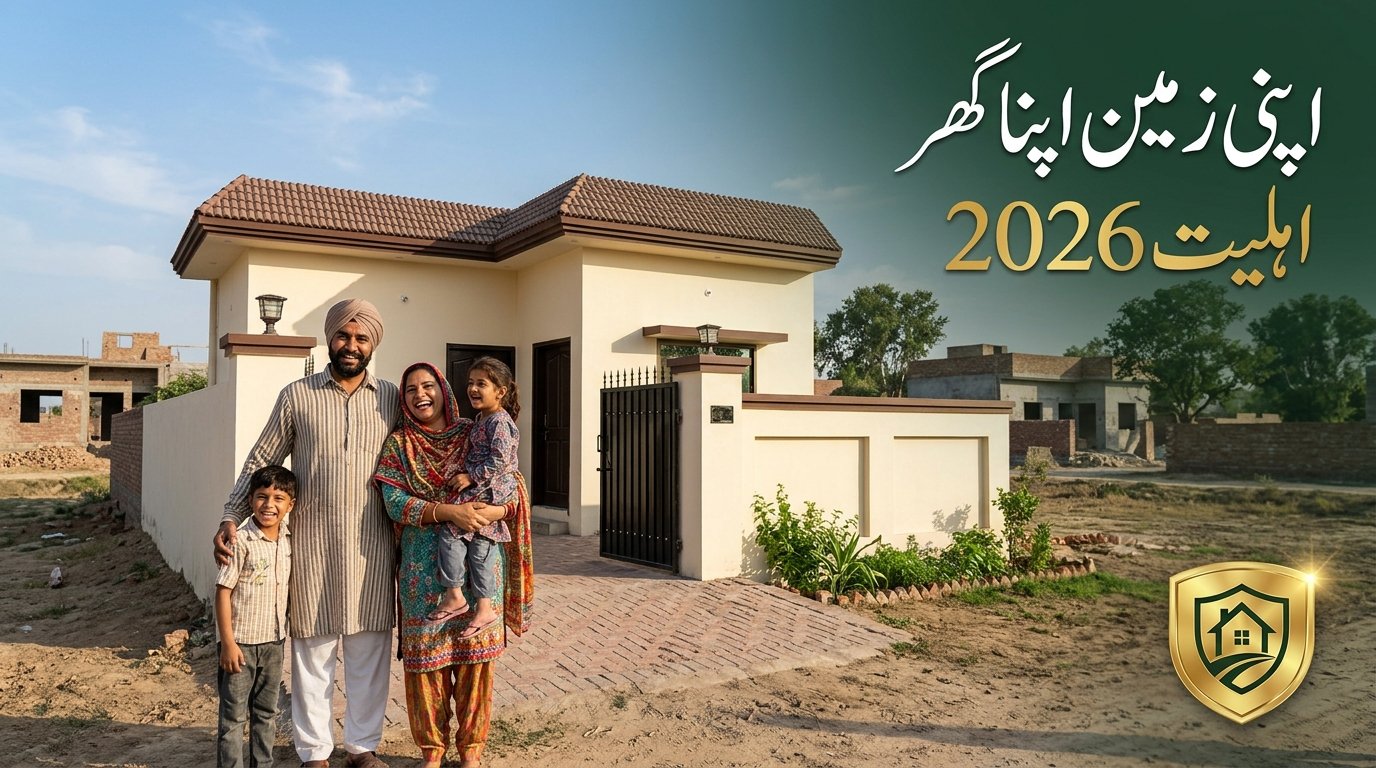
Before you dream about a plot, you must know whether you even qualify for one. The Apni Zameen Apna Ghar eligibility 2026 rules were made for homeless families of Punjab, but not every applicant could enter the balloting, because the government set six clear conditions, checked every file through scrutiny, and only then allowed eligible families to compete for a limited number of plots. This article explains each condition in simple words, the official documents, the district rule, and the mistakes that can disqualify a family, so you can judge your own case honestly before any future window opens.
Eligibility Point
Official Position
Scheme
Apni Zameen Apna Ghar (AZAG), run by PHATA
Benefit
Free 3-marla developed residential plot, completely free of cost
Conditions
Six official conditions, all of which must be met
District rule
Apply only for schemes within your own district
Phase 1 scale
23 schemes in 19 districts, about 2,000 plots awarded by computerised balloting
Phase 1 status
Balloting completed; new registration was reported closed as of September 2026, pending a new window
Construction duty
Start construction within 6 months of possession and complete within 2 years, per the official FAQ
The first two conditions decide who the scheme is for and where that person may apply. Both are checked against official records, so a family cannot simply choose the district that looks most attractive.
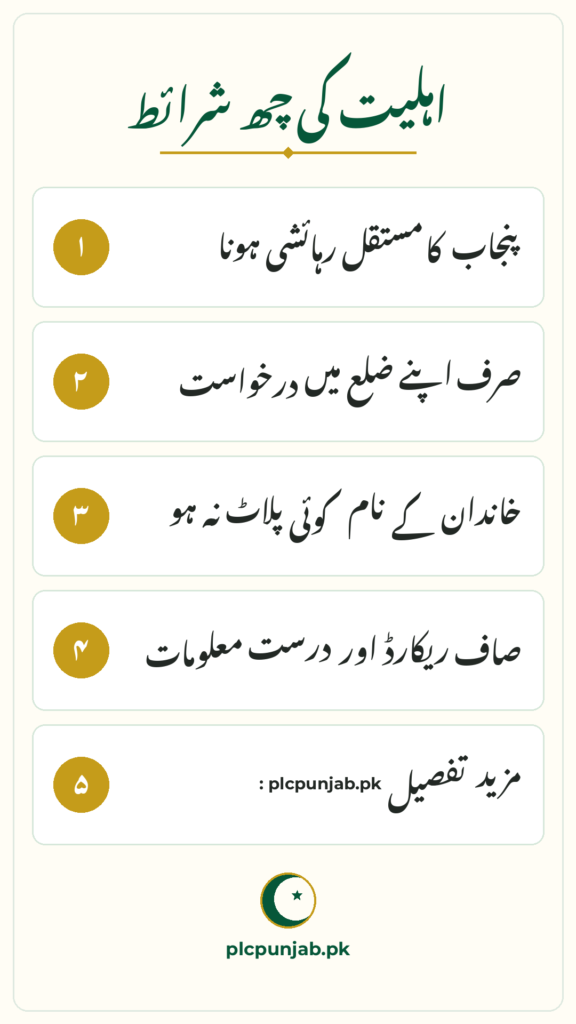
Condition 1, Punjab resident: The applicant must be a permanent resident of Punjab as per a valid CNIC.
Why residency matters: The scheme is funded for the people of Punjab, so a CNIC showing another province does not meet this base condition.
Condition 2, own district only: Applications are allowed only for schemes within the applicant’s own district.
District quotas: Each district had its own quota, so your district decided your competition pool, not a province-wide ranking.
No famous-city choice: You could not choose a famous city or a district with more plots if that was not your own district.
Phase 1 districts: Phase 1 covered 19 districts, including Attock, Bahawalpur, Faisalabad, Jhang, Kasur, Okara, Sahiwal, Sargodha and Vehari, among others.
Check your CNIC address: Before any future window, make sure your CNIC details match your actual district, because a mismatch can damage your file.
The next three conditions are the heart of the scheme. They test whether a family truly has no roof of its own, whether its record is clean, and whether its finances are honest.
Condition 3, no plot or house: The applicant, the spouse, or the dependent children must not own any plot or house anywhere in Pakistan.
Whole family counted: Property in the name of a husband, wife or dependent child counts just as much as property in the applicant’s own name.
Whole country counted: The rule covers every province, not only Punjab, so a small plot in another province still breaks this condition.
Affidavit on oath: Applicants declare on oath that the family owns no property, and PHATA scrutiny checks the file against records.
Hidden property risk: Do not hide a small village plot and hope it will not be found, because one wrong step can end your chance and create legal trouble.
Condition 4, clean criminal record: The applicant must have a clean criminal record, as a serious record problem can stop an application during scrutiny.
Condition 5, no bank default: The applicant must not be a defaulter of any bank or financial institution.
Scrutiny is real: District committees verified applications in Phase 1, which is why demand far exceeded the number of plots that could be awarded.
Honest files first: The scheme rewards a clean, verifiable file, not a cleverly written one, so honesty is the only safe strategy.
True Information and Official Documents
The sixth condition sounds simple, but it controls all the others. Every name, CNIC number, income detail and property statement must be true, because the form is a legal declaration, not a formality.
Condition 6, true information only: All information must be accurate, and false declarations may lead to disqualification.
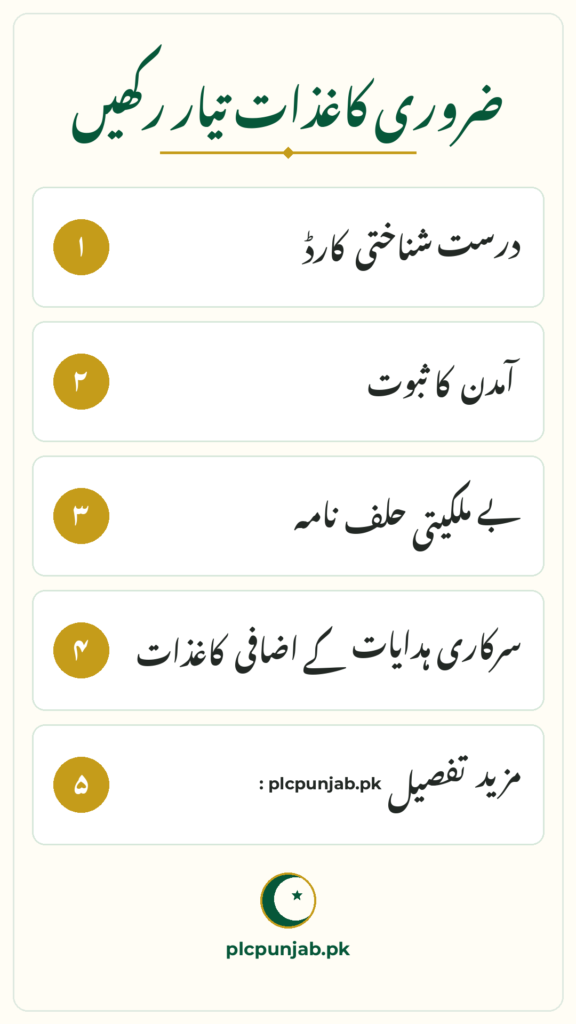
CNIC required: A valid identity card of the applicant is the first official document in the portal FAQ list.
Income proof required: Proof of income is required as a document that supports the income detail given on the form.
No fixed income figure confirmed: The official eligibility list does not state a fixed income figure, so do not trust a fixed monthly limit shared without an official source.
Affidavit required: An affidavit of no property ownership is required, declaring that the family owns no plot or house.
Guideline documents: Any additional documents specified in the official application guidelines may also be required, and only those should be treated as official.
Longer lists unverified: Longer document lists on some websites are not confirmed on the official portal, so check the portal before collecting extra papers.
Wrong CNIC detail: A wrong CNIC detail means your record may not match, and your file can suffer even if you meet every other condition.
Wrong income detail: An income detail that does not match your income proof creates a mismatch that scrutiny is designed to catch.
Never pay for papers: If a person demands money to arrange special papers for this scheme, stop and verify on the official portal first.
After Winning, Rejection and Agent Traps
Eligibility does not end at winning, and rejection does not end at a closed door. Winners carry a construction duty, rejected applicants have an official grievance route, and every applicant must avoid the agent traps that surround a free-plot scheme.
Start construction: A winner must start construction within 6 months of possession, according to the official FAQ.
Complete construction: Construction must be completed within 2 years, because the plot is given so a family builds a home and lives in it.
Not for sitting empty: The plot is not meant to sit empty for years, be held for resale, or be left undeveloped while other homeless families wait.
Grievance route: Rejected applicants could use the PHATA grievance redressal process through the PHATA Grievance Redressal Committee.
Meeting conditions is not a guarantee: Meeting all six conditions did not guarantee a plot in Phase 1, because only about 2,000 plots were available against far larger demand.
Balloting decides winners: Eligible families competed through computerised balloting, so no officer, agent or payment could reserve a plot in advance.
Never share OTP or pay: Never share an OTP, never pay an agent to add your name, and never trust a promise of a guaranteed plot.
Next window warning: As of September 2026, new registration was reported closed, so prepare documents now and watch the official portal for any new phase rather than assuming registration is open.
0800-09100, directory-listed for Punjab housing programmes, as reported in source material
Executing agency
Punjab Housing and Town Planning Agency (PHATA)
Grievance route
PHATA Grievance Redressal Committee, through the official portal process
Department
Housing, Urban Development and Public Health Engineering Department, Punjab
Conclusion
Apni Zameen Apna Ghar eligibility rests on six official conditions: Punjab residency, your own district, no property in the family anywhere in Pakistan, a clean record, no bank default, and true information. Keep your CNIC, income proof and affidavit ready, apply only when an official window is open, and follow the construction rules if you win. A free plot is a life-changing opportunity, and it goes to the family whose file is honest, complete and verifiable.
FAQs
What are the main eligibility conditions for AZAG? You must be a permanent Punjab resident per CNIC, apply only in your own district, own no plot or house anywhere in Pakistan with your spouse and dependent children, have a clean criminal record, and not be a bank defaulter, with all information true.
Is there an official income limit for the scheme? The official eligibility list on the portal does not state a fixed income figure. The portal only asks for income proof as a document. Do not trust fixed income limits shared without an official source.
Which documents are officially required? The official FAQ lists CNIC, income proof and an affidavit of no property ownership, plus any additional documents specified in the application guidelines.
What happens if my information is found false? False declarations may lead to disqualification. Always give true information and never hide property owned by you, your spouse or your dependent children.
Can I apply now for a free plot? Phase 1 balloting is complete and new registration was reported closed as of September 2026. Prepare your documents and watch the official portal for any new phase announcement before applying.
Shahzad Sahil is the editor of plcpunjab.pk, covering Punjab government schemes including the Livestock Card, eligibility, registration and latest updates, with information verified from official sources for readers across Punjab.
For a small shopkeeper, a tailor, a freelancer or a home-based business owner, the CM Punjab Asaan Karobar Card was designed to be the simplest business loan in the province: up to Rs 1 million, interest-free, repayable over three years, issued as a digital card through the Bank of Punjab. But there is one fact…
If you drive a small car like the Suzuki Mehran, Alto, or Bolan, the PM Fuel Relief Scheme 2026 has real money in it for you. Owners of cars up to 800cc get 30 litres of discounted petrol every month, worth up to Rs 3,000 in savings. This guide explains the car quota, the own-name…
BISP has changed how its quarterly money reaches women beneficiaries. Instead of depending only on designated payment centres, payments are now credited to a digital wallet linked to a free Benazir SIM, and the money can be withdrawn from an authorised retailer of a partner bank in any city. This is the new BISP digital…
A domicile certificate proves that you belong to a particular district in Punjab, and it is required for government jobs, admissions and many official applications. This Punjab domicile certificate guide explains the three ways to apply, the Rs 200 fee, the documents you need, and how long delivery takes. What Is a Domicile Certificate? A…
CM Punjab Laptop Scheme Phase 2 Eligibility 2026: Core i7 Laptops, Who Qualifies Every student has one big question about the CM Punjab Laptop Scheme Phase 2: are its free Core i7 13th Generation laptops meant for me? The eligibility rules of the 2026 cycle are clear, but they differ slightly by programme, and many…
Shopkeepers in Lahore are asking the same questions again and again: how much is the fine for littering, what happens if the front of a shop is left dirty, and is burning waste really punished with jail? The Suthra Punjab fine list 2026 answers those questions, but only if you read the current Lahore e-challan…