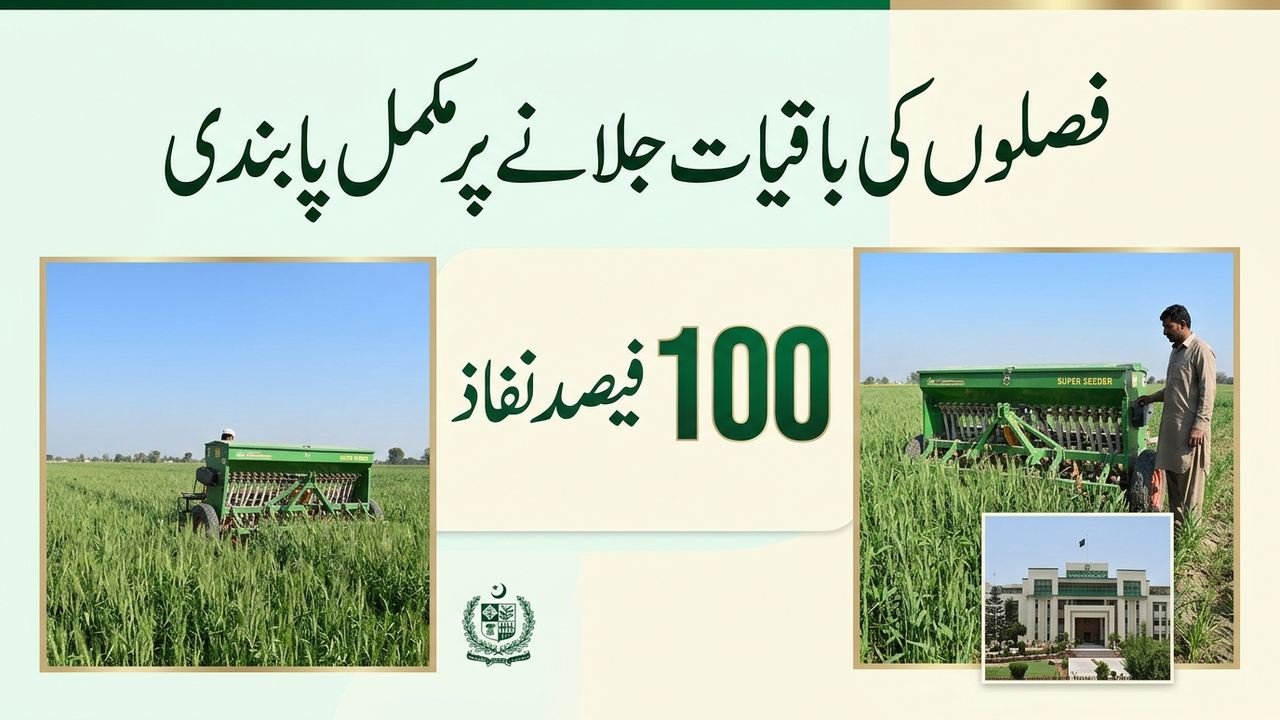
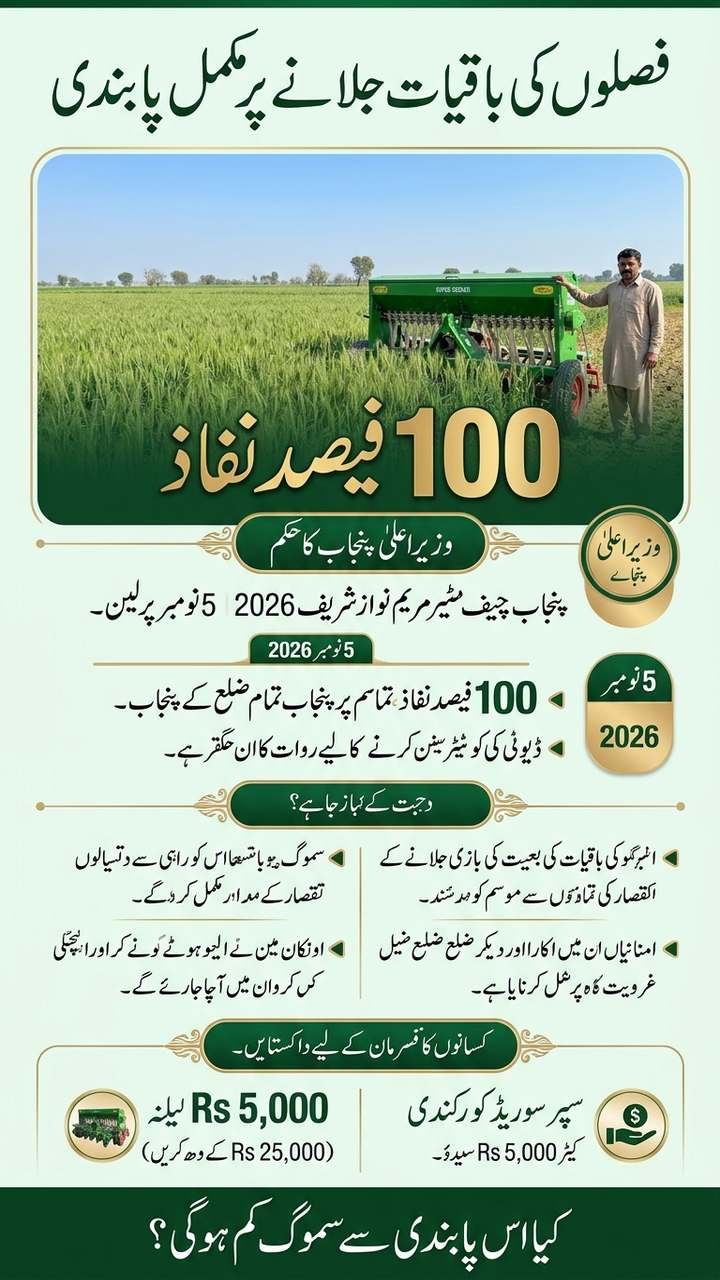
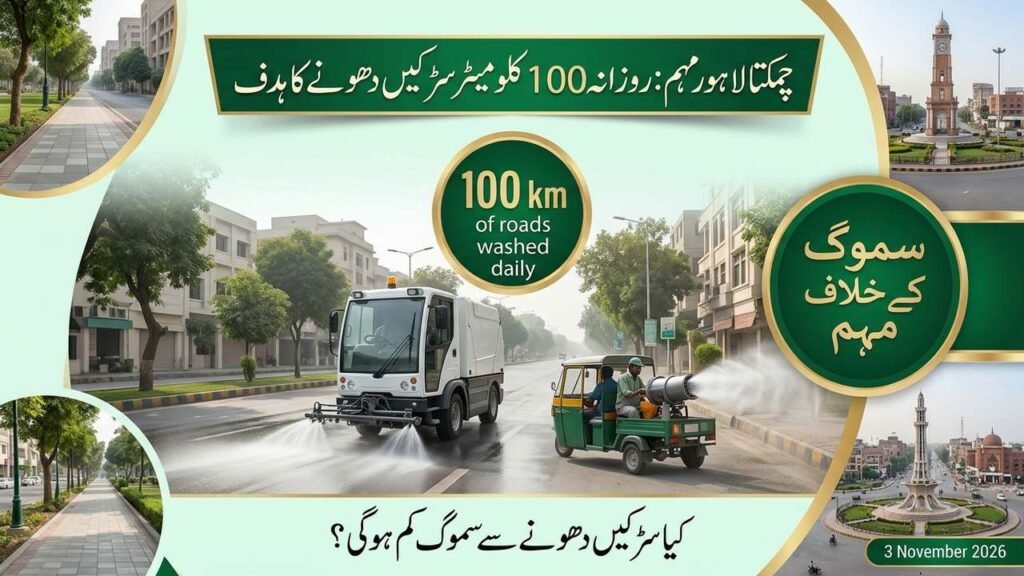
Punjab Chief Minister Maryam Nawaz Sharif has ordered a complete ban on the burning of crop residue across the province, directing all deputy commissioners to ensure 100 per cent enforcement of the ban. The order was issued while she was chairing a meeting on the performance of deputy commissioners in Lahore on Thursday, 5 November 2026, as the government steps up its fight against worsening smog.
Okara warning: The chief minister warned officials in Okara and other districts over their failure to prevent crop-residue burning, and made it clear the practice must come to a complete halt.
In this article: This article explains what the ban covers, how it will be enforced, and the alternatives for farmers.
Crop Residue Burning Ban at a Glance
Detail
Information
Ban ordered by
Punjab Chief Minister Maryam Nawaz Sharif
Ordered on
Thursday, 5 November 2026, at a deputy commissioners’ meeting in Lahore
What is banned
Burning of crop residue (leftover material after harvesting) anywhere in Punjab
Enforcement target
100 per cent enforcement of the ban, as directed by the chief minister
Enforced by
Deputy commissioners of all districts
Districts warned
Okara singled out, along with other districts where burning was not prevented
Reason
Crop burning adds harmful pollutants to the air and worsens Punjab’s smog crisis
Total halt, not a reduction: The chief minister directed deputy commissioners to ensure a complete halt to the burning of crop residue, so the practice is banned outright, not limited to certain hours or areas.
Every district covered: The ban applies across the whole province, and every deputy commissioner must enforce it in their own district.
After-harvest waste included: The ban covers the burning of leftover agricultural material after harvesting, the practice farmers use to clear fields quickly before the next sowing.
Part of the smog fight: The directive is part of the fight against worsening smog, and preventing crop burning is part of the province’s environmental protection strategy.
Why Crop Burning Was Targeted Now
Serious smog crisis: The chief minister said Punjab faces a serious issue of rising smog levels, with crop-residue burning adding further to air pollution.
Harvest season pressure: After harvesting, many farmers burn leftover crop material to clear fields fast, adding much smoke to the air in a short period.
Failure to prevent it: Officials in Okara and other districts were warned over their failure to prevent burning, showing earlier efforts had not stopped it.
Okara singled out: Okara was named among the districts where burning had not been prevented, and a report before the meeting found Okara at the top of Punjab’s crop-fire count.
Winter season focus: Smog settles over Punjab in the colder months, when air pollution becomes a concern across the province.
Enforcement: DCs, Squads and the Okara Warning
DCs are responsible: Each deputy commissioner must ensure farmers in their district do not burn agricultural waste, with violations dealt with under the relevant regulations.
Warning to failing districts: The chief minister warned officials in Okara and other districts over their failure to prevent the practice, putting enforcement responsibility squarely on district officers.
No new fines announced yet: No fines or arrests were announced with Thursday’s warning, so the order relies on district enforcement, not a new penalty regime.
Performance will be checked: The warning was issued during a meeting that reviewed district Key Performance Indicators, so enforcing the ban should become part of how districts are judged.
The Legal Alternative for Farmers: Super Seeder Support
Do not burn, use machines: Instead of burning residue, farmers can use super seeders, which sow the next crop into fields covered with leftover straw.
Subsidy available: Punjab offers a Super Seeder Subsidy of Rs 5,000 per acre, up to Rs 25,000, to help farmers meet the cost of the machines instead of burning.
Why it matters: The subsidy exists because burning is the cheaper, faster option for many farmers, so financial support answers that practical problem.
District agriculture offices: Farmers can approach their district agriculture office for guidance on super seeders and residue-management options in their area.
Contact and Helpline Details
Contact
Details
Government of Punjab portal
punjab.gov.pk — official portal of the Government of Punjab (link not added, portal could not be verified as reachable at the time of writing)
District administration
Report crop burning to the deputy commissioner’s office in your own district
District agriculture office
Contact for Super Seeder Subsidy guidance and residue-management options
The Punjab portal is plain text because it could not be verified as reachable when this article was written. No new helpline or penalty schedule was announced.
Conclusion
Province-wide ban: The Punjab crop residue burning ban, ordered on 5 November 2026, bans the burning of leftover crops across the province, with deputy commissioners told to ensure 100 per cent enforcement.
Okara warned: Okara and other districts were warned for failing to stop it, in response to the smog crisis that worsens every winter.
No new fines yet: No new fines were announced, but violations will be dealt with under the relevant regulations, with the Super Seeder Subsidy of Rs 5,000 per acre as the legal alternative.
Enforcement is the test: Success now depends on district administrations enforcing the ban field by field through the harvest season.
Frequently Asked Questions
Is crop residue burning banned in all of Punjab? Yes. A complete province-wide ban was ordered on 5 November 2026, with 100 per cent enforcement directed.
Who enforces the crop burning ban? Deputy commissioners enforce the ban through their district administrations; violations are dealt with under the relevant regulations.
Why was Okara warned specifically? Okara was singled out where burning had not been prevented; a local report shortly before the meeting put Okara at the top of Punjab’s crop-fire count.
What can farmers do instead of burning crop residue? Farmers can use super seeders to sow the next crop without burning; the Super Seeder Subsidy offers Rs 5,000 per acre, up to Rs 25,000, towards the cost.
Shahzad Sahil is the editor of plcpunjab.pk, covering Punjab government schemes including the Livestock Card, eligibility, registration and latest updates, with information verified from official sources for readers across Punjab.
The Green Tractor Scheme Phase V registration window has closed, and this guide says so plainly at the start so that no farmer wastes time or money chasing a finished round. Registration opened on 23 September 2026 and the last date was 5 October 2026. What follows is the complete step-by-step record of how farmers…
Many families in Punjab know about the Sehat Card, but far fewer know that free diabetes care in Punjab is available every week at government hospitals through dedicated clinics for non-communicable diseases. The Punjab Prevention and Control of Non-Communicable Diseases programme runs screening and follow-up at district and tehsil hospitals in all 36 districts. If…
Registration for the Honhaar Scholarship is open, and the whole process takes place online, so an eligible undergraduate student in Punjab can apply from a mobile phone in a single sitting if the documents are ready. The round open on the portal now is Phase 4, the broadest round yet, and it covers students from…
After you apply for a driving licence in Punjab, the hardest part is the wait. You do not need to visit a licensing office just to ask where your card has reached. DLIMS licence tracking lets you follow your application from home, using only your CNIC number, on the official Driving License Issuance Management System…
On 1 November 2026, Punjab Chief Minister Maryam Nawaz Sharif approved a new CM Language Learning Programme under which courses in 13 languages will be offered for the first time in the province. The decision came at a special meeting on skills training, where the Chief Minister also set a target of training one million…
You fattened your animals with the Livestock Card loan. Now comes the best part — selling them at a great price. The Livestock Connect Portal connects Punjab farmers directly with 88 meat exporters and 34 traders. No middlemen, no unfair prices. Here is how it works and how you can join in 2026. Detail Information…