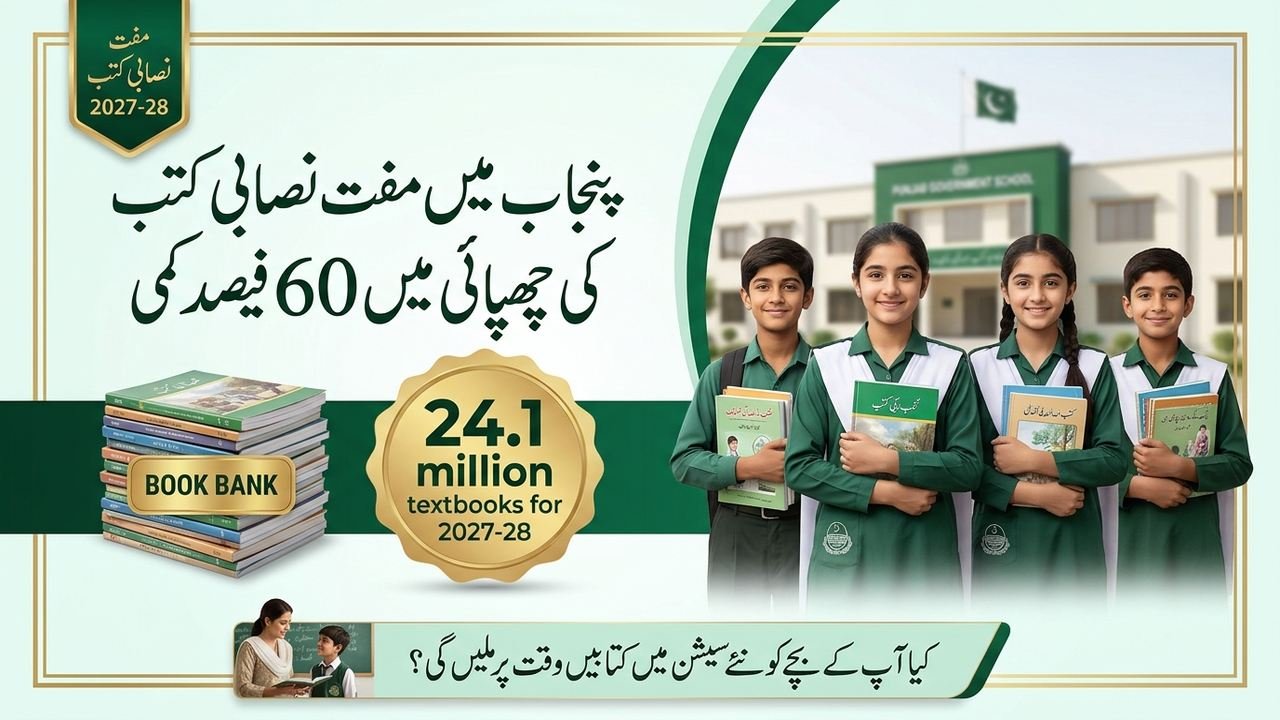
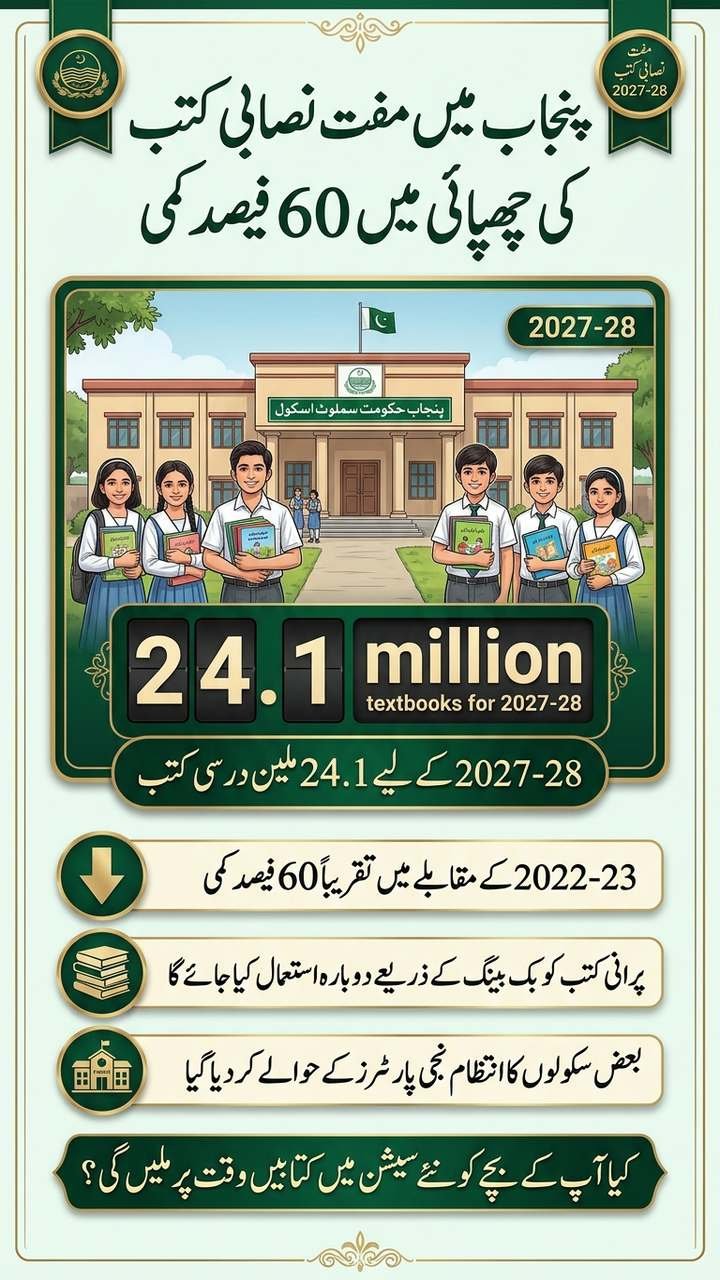
Punjab is planning a cut in the printing of free textbooks in Punjab for government schools, even though officials report that student enrolment has increased. More than 60 million textbooks were printed in 2022-23, but the planned number for 2027-28 has fallen to just 24.1 million copies. That is a cut of around 60 percent, and it raises a question: how will the province meet the needs of millions of students with far fewer new books?
Point
Detail
Textbooks printed in 2022-23
More than 60 million
Planned printing for 2027-28
24.1 million copies
Reported reduction
Around 60 percent
Government school enrolment
Reported to have crossed 10.5 million
Publishing authority
Punjab Education Curriculum, Training and Assessment Authority (PECTA)
Official explanation: Officials from the Programme Monitoring and Implementation Unit (PMIU) say the reduction is being managed through the book bank system and the outsourcing of several government schools.
Book bank system: Schools collect textbooks from students at the end of the year and reuse suitable copies for the next group.
Outsourcing of schools: Under the Public Schools Reorganisation Program, selected schools are managed by private partners, civil society groups and young licensees.
Free education continues: School buildings remain public assets and education stays free, while the government pays operators against verified enrolment.
How the Book Bank System Works
Reuse, not reprint: The book bank system lets schools reuse textbooks instead of printing a completely new set every year.
How books move: A student who finishes a class returns reusable books, which are then issued to students entering that class next session.
Collection and checking: Schools collect usable textbooks at year end, and teachers check their condition before reuse.
Issue first: Old book bank copies go out before new books, and newly printed books fill the remaining gap.
Phase-wise cover: In 2026-27, phase one gave full provision for Nursery to Grade 3 and Grade 10, 80 percent for Grades 4 and 5, and 50 percent for Grades 6 to 9.
Enrolment Crosses 10.5 Million Students
Enrolment total: Enrolment in Punjab government schools is reported to have crossed 10.5 million students.
Minister’s claim: Education Minister Rana Sikandar Hayat has claimed that enrolment has increased by 2.5 million students.
Verified enrolment claim: In July 2026, officials told the Chief Minister that 4.3 million students had enrolled in public schools over two years and four months.
Ghost students found: In July 2025, the Education Department reported finding 1.8 million fake or ghost students after checking records with NADRA data.
Inflated records: The minister then said schools actually enrolled around nine million students, but records showed 10.8 million.
Past Shortages and Why Parents Are Worried
Why it worries parents: Punjab has already faced textbook distribution problems, which is why the lower printing plan has drawn attention.
Recent problems: In September 2026, newly enrolled students faced delays after the summer holidays; in October 2026, a shortage of about 839,000 textbooks was reported.
Official response: Authorities issued extra printing allocations to help address the gap reported in October 2026.
Distribution chain: Books must travel from the central warehouse to district and tehsil offices, then to individual schools, before reaching students.
Risk for 2027-28: Fewer new books means less room for error if reuse falls short, so shortages must be spotted early.
What Students and Parents Should Do Now
No automatic shortage: The reduced printing plan does not automatically mean every student will face a shortage.
What decides it: Officials say the book bank system will help manage demand, but the result depends on how well books are collected, checked, stored and distributed across 52,000-plus public schools.
For parents: Ask the school whether textbooks for the new session have arrived.
For students: Return usable textbooks at the end of the year so other students can use them.
For teachers: Check returned books, keep accurate records, and report shortages early.
For schools: Follow official distribution instructions, use attendance registers, and report gaps early so extra copies can be arranged.
Punjab Education Curriculum, Training and Assessment Authority (PECTA)
First point of contact
Your child’s school head teacher or class teacher
District education office
Contact the District Education Authority office in your district for distribution queries
Conclusion
Punjab plans to print only 24.1 million free textbooks for 2027-28, down from more than 60 million in 2022-23, while reported enrolment has crossed 10.5 million. Officials say the book bank system and school outsourcing explain the fall, and the plan works only if returned books are collected, checked and distributed properly. Parents should stay in touch with the school, students should return usable books, and schools should report shortages early.
FAQs
How many free textbooks will Punjab print for 2027-28? Punjab plans to print 24.1 million textbooks for 2027-28, against more than 60 million in 2022-23.
Why is Punjab printing fewer textbooks? Officials say the book bank system, which reuses collected textbooks, and the outsourcing of some schools have cut demand for new books.
How many textbooks will primary classes receive? Around 14.8 million are planned for primary classes, with 4.3 million for Grades 6 to 8 and 3.2 million for Grades 9 and 10.
What should parents do if their child does not get a textbook? Ask the school head teacher whether the books have arrived, and contact the District Education Authority if the shortage continues.
Shahzad Sahil is the editor of plcpunjab.pk, covering Punjab government schemes including the Livestock Card, eligibility, registration and latest updates, with information verified from official sources for readers across Punjab.
Eligible families can now register for free professional training under the Benazir Hunarmand Program, with monthly stipends, certificates and employment support on offer. The Benazir Income Support Programme (BISP) shared fresh details of the programme on 3 November 2026, confirming the training fields, the eligibility rules and the two ways to register — online through…
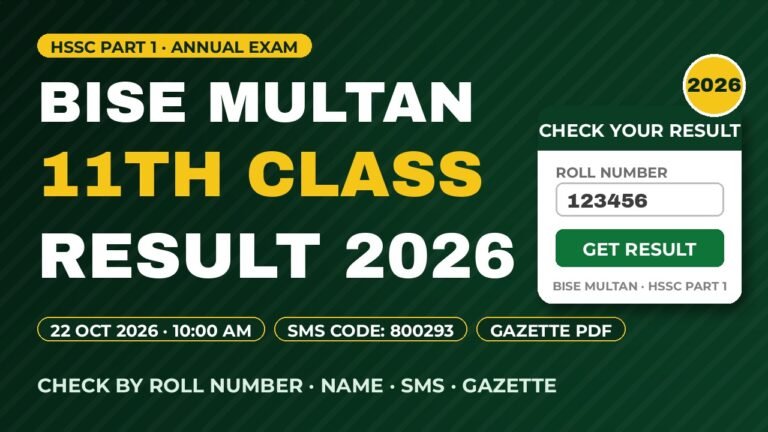
The Board of Intermediate and Secondary Education (BISE) Multan has announced the 11th Class Result 2026 for the HSSC Part 1 Annual Examination today, Thursday, 22 October 2026, at 10:00 AM (PKT) — the result is now LIVE. Students from Multan, Khanewal, Lodhran and Vehari can check their marks on the official website web.bisemultan.edu.pk, by…
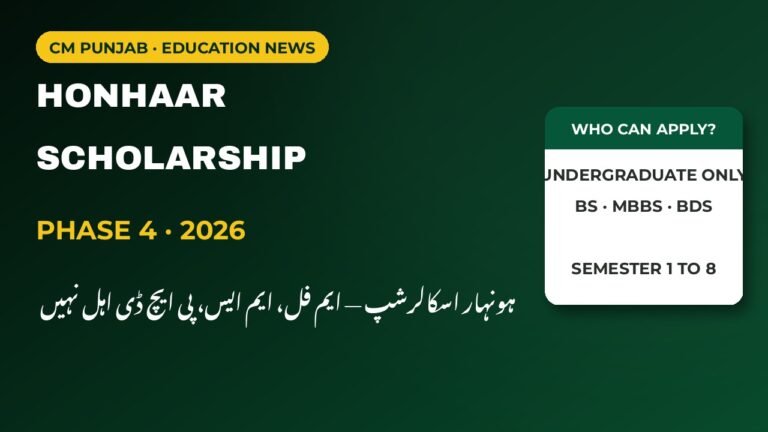
Have you seen the posts claiming MPhil, MS and PhD students can apply for the Honhaar Scholarship this time? They are everywhere on social media, and they are wrong. If you are a postgraduate student, or the parent of one, read this before you waste time on an application that cannot be accepted. Phase 4…
The Honhaar Scholarship Phase 4 After Deadline period begins on 10 November 2026, the day after applications close on 9 November, and it is the stage where many students make avoidable mistakes. According to the latest official announcement, Phase 4 of the Chief Minister Honhaar Undergraduate Scholarship pays 100 percent of tuition fees for eligible…
Punjab Chief Minister Maryam Nawaz Sharif distributed laptops and Honhaar Scholarship cheques among students at a ceremony held at COMSATS University in Attock on Tuesday, 3 November 2026. A total of 6,161 laptops were handed over to students from across the Rawalpindi Division, while 2,590 Honhaar scholarships worth Rs196.97 million were awarded in the division…
Parents and teachers across Punjab are adjusting to a school day that starts later than it did in summer, and some private schools are now facing action for ignoring the change. According to the latest official notification, the Punjab Winter School Timings for 2026 set a single-shift start of 8:45 in the morning, in force…