Rawalpindi has reported 86 confirmed Punjab dengue November 2026 cases so far this season, with 11 patients in hospital, according to the District Health Authority report issued on 2 November 2026. No dengue death has been reported in the district this year. The final weeks of the season are still critical, because health officials expect the peak threat to last until 15 November, so families should keep checking for standing water at home.
Dengue Fact
Detail
Confirmed cases in 2026
86 in Rawalpindi district
Patients in hospital
11, including 4 confirmed cases
Deaths this season
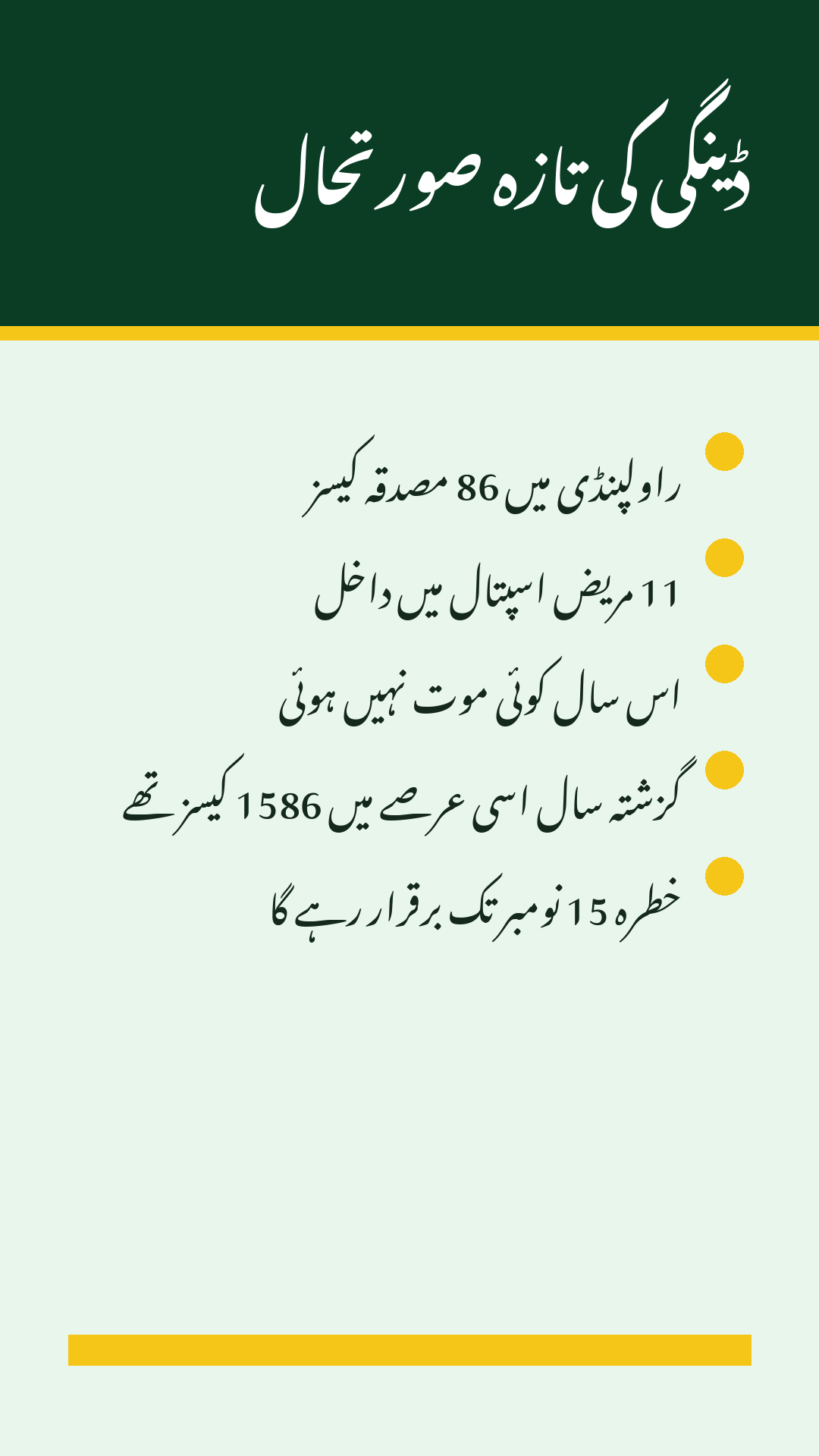
None reported so far
Peak season warning
Threat lasts until 15 November
Same period last year
1,586 cases in Rawalpindi
Rawalpindi Dengue Numbers in November 2026
Latest count: The District Health Authority reported 86 confirmed dengue cases in Rawalpindi this year, up to 2 November 2026.
New cases: Two new cases were reported in the 24 hours before the 2 November report, showing that transmission has not ended yet.
Hospital patients: Eleven patients were in hospital at the time of the report, including four patients with confirmed dengue infection.
Screening scale: Hospitals have screened 6,433 patients so far, of whom 5,905 were classified as suspected dengue cases.
October pattern: In October alone, 51 patients were reported, while 27 were reported in September and none in August this year.
Twin cities total: Together, Rawalpindi and Islamabad had reported 134 cases by late October.
Sharp fall: Rawalpindi recorded 83 confirmed cases up to 30 October, against 1,586 cases in the same period last year.
Household coverage: Health and municipal teams surveyed about 5.875 million households and over two million commercial and public sites this year.
Larvae found: Teams detected and removed dengue larvae at more than 241,000 locations across the district during the season.
Massive inspections: The district’s 1,400 anti-dengue teams inspected 7,902,099 houses, open spaces, tyre shops, junkyards and buildings under construction.
Strict enforcement: After larvae were found, 2,798 first information reports were registered and 690 properties were sealed by the authorities.
Where Dengue Larvae Were Found Most
Top hotspot: The highest larva detection was reported in Dhoke Mangtal, a densely populated area of Rawalpindi city.
City areas: Municipal Corporation Rawalpindi areas also showed high larva detection during the surveillance rounds.
Nearby settlements: Narar Kahuta and Dakhali Kahuta were named among the areas with the highest larva detection this season.
Cantonment zone: Rawalpindi Cantonment was also listed among the areas where larvae were found most often.
Hotspot register: The district monitors 17,859 hotspots registered with the Punjab Information Technology Board for regular checks.
Weekly coverage: Surveillance teams achieved 99 per cent coverage of their assigned areas during the previous week.
How Surveillance Teams Are Working Now
Outdoor teams: The district has deployed 415 outdoor surveillance teams to check streets, drains, parks and open plots.
Indoor teams: Another 985 indoor teams visit homes to check water containers, tanks, coolers and rooftop storage.
Worker contracts: Nearly 2,000 dengue workers whose contracts had expired had their jobs restored for another 90 days.
Return to duty: The restored male and female workers were asked to rejoin duty on 31 October for a further three-month period.
Zero tolerance: The district administration has warned against negligence, absenteeism and fake reporting in the anti-dengue drive.
Geo-tagging rule: Officials have ordered mandatory geo-tagging of field work and rapid clearance of pending response reports.
What Families Should Check at Home
Standing water: Empty water from coolers, flower pots, drums, tyres and any container that has stood for more than a few days.
Tank covers: Keep water tanks and drums tightly covered, because mosquitoes lay eggs on still, open water surfaces.
Weekly routine: Check your home once a week for hidden water, including trays under pots and water left in bathrooms.
Daytime bites: The dengue mosquito bites mainly during the day, so use repellent and cover arms and legs in the morning and evening.
Help the teams: Allow indoor surveillance teams to inspect your home, because one missed container can breed mosquitoes for a street.
When to Seek Medical Help Quickly
Warning signs: High fever with severe headache, pain behind the eyes, joint pain or a rash should be checked by a doctor without delay.
Bleeding signs: Bleeding gums, nosebleeds, vomiting blood or severe stomach pain need emergency hospital care at once.
Do not self-treat: Do not take medicines on your own advice for dengue fever, and follow only the treating doctor’s instructions.
Fluids matter: Patients with fever should drink plenty of fluids and rest, unless the doctor gives different instructions for their case.
Contact Detail
Information
Reporting authority
District Health Authority, Rawalpindi
Emergency response body
District Emergency and Response Committee
Where to go
Nearest government hospital dengue ward
Official portal
No verified dengue portal link published
Conclusion
Rawalpindi’s dengue season in 2026 is far better than last year, with 86 confirmed cases against 1,586 in the same period, and no deaths reported so far. That progress came from millions of household visits and strict action where larvae were found. The job is not finished until the peak threat passes on 15 November, so keep checking for standing water, allow the teams to inspect, and seek hospital care quickly if warning signs appear.
FAQs
How many dengue cases are there in Rawalpindi in 2026? The District Health Authority reported 86 confirmed cases up to 2 November 2026, with 11 patients in hospital.
Has anyone died of dengue in Rawalpindi this year? No, no dengue-related death has been reported in Rawalpindi so far this season.
When does the dengue season end in Punjab? Health officials say the peak threat lasts until 15 November, after which cold weather should reduce mosquito breeding.
Why are cases lower than last year? Intensive surveillance, larvae removal at over 241,000 locations and property sealing kept breeding under tighter control.
Shahzad Sahil is the editor of plcpunjab.pk, covering Punjab government schemes including the Livestock Card, eligibility, registration and latest updates, with information verified from official sources for readers across Punjab.
Students across Punjab have been asking one question since mid-October: has a new round of laptops and scholarships actually opened? The short answer is that a launch has been announced, but the details students need most — dates, eligibility and an application link — have not yet been published. The CM Punjab Laptop and Scholarship…
A birth certificate is the first official identity document for a child in Punjab, and parents no longer need to run between offices to get one. Under the Punjab Birth and Death Registration Rules 2025, registration and the computerised certificate are free for up to seven years. Parents can apply through their Union Council, through…
Saudi riyal rate in Pakistan today, 3 November 2026, starts from the State Bank of Pakistan’s closing of Rs 73.73 per riyal. According to the State Bank’s Monday rates, the Saudi riyal came down by 1 paisa on 2 November 2026, while the US dollar closed at Rs 276.72 and the UAE dirham stayed unchanged…
October 2026 has been a busy month in Punjab’s fields, and this year it has been busy at the bank too. The Punjab Kisan Card has passed through its repayment season: bill messages went out on 15 October 2026, and the payment deadline of 26 October 2026 has now passed. Farmers across the province have…
Any woman in Punjab who faces harassment, violence, a family dispute or a property problem can call one free number for help: the Punjab Women Safety Helpline 1043. The helpline is run by the Punjab Commission on the Status of Women, works around the clock, and connects callers with legal advice, counselling and referrals. Many…
Sanitation billing under the Suthra Punjab programme started in October 2026, and paper bills are now reaching homes and shops in urban areas across Punjab. The billing was announced on 1 October 2026, and physical delivery of the paper bills began on 2 October 2026. The Punjab Excise, Taxation and Narcotics Control Department is collecting…