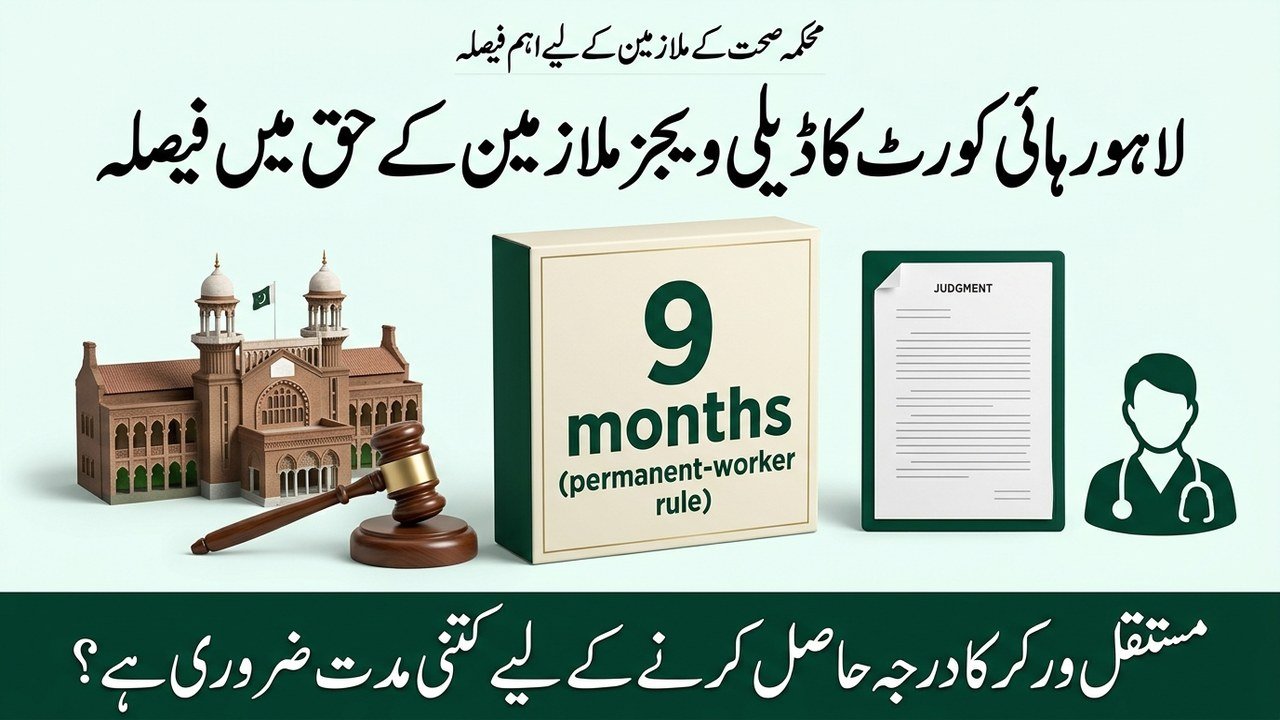
The daily-wage workers permanent status question is now settled for Punjab’s health department. In a 26-page judgment, the Lahore High Court ruled that eligible daily-wage, work-charged and contingency-paid employees of District Health Authorities are permanent workers in law, and it annulled the government’s refusal to regularise them. This article explains the ruling, the nine-month rule, who benefits, and what to do next.
Item
Detail
Case
Muhammad Bilal Raza and others vs Government of Punjab and others (2026 LHC 8384)
Judge
Justice Khalid Ishaq, Lahore High Court
Judgment
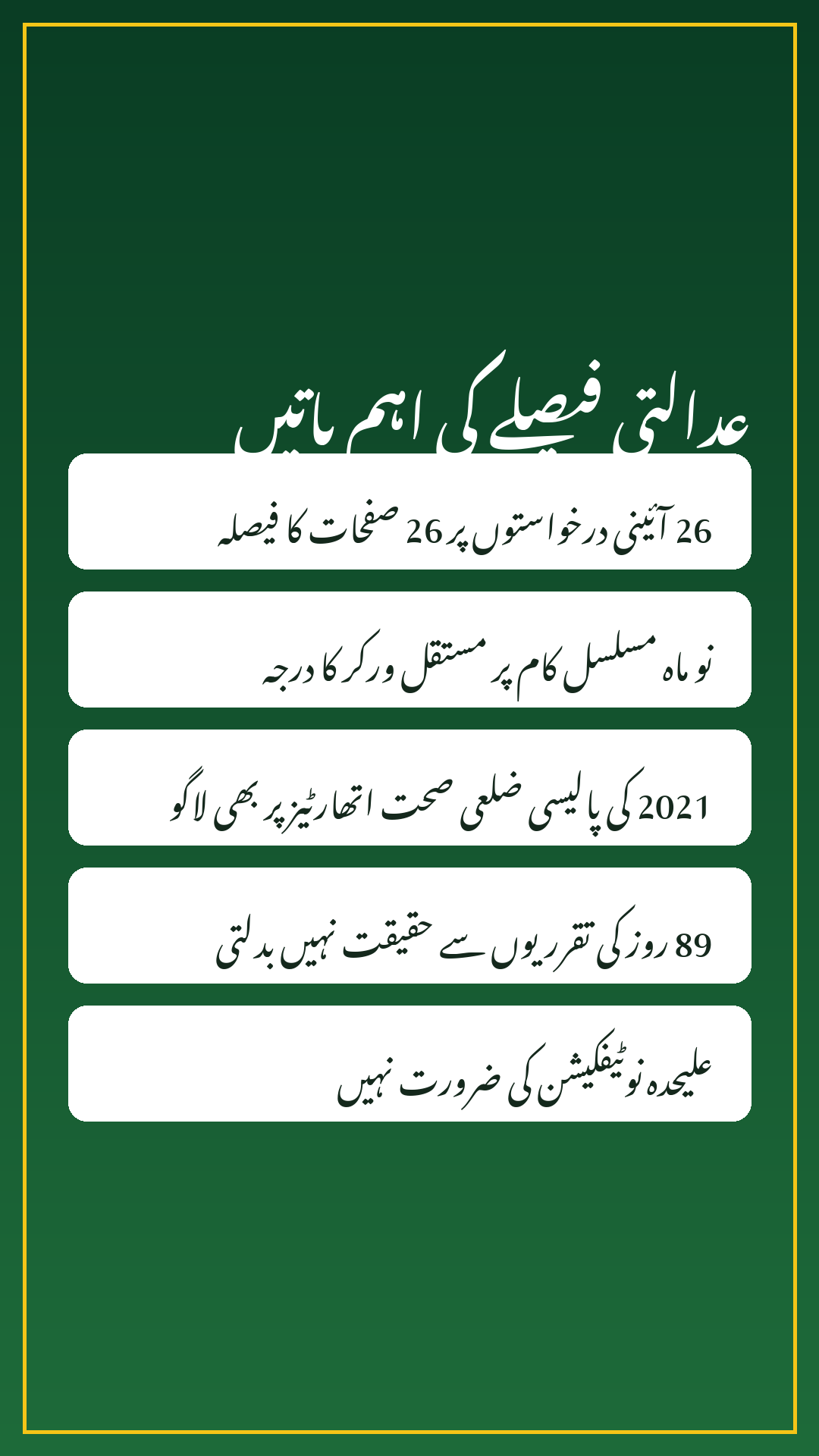
26 pages, on 26 constitutional petitions
Who benefits
Daily-wage, work-charged and contingency-paid staff of Punjab District Health Authorities
Key rule
Permanent worker status after nine months of continuous permanent-nature work
Policy applied
2021 regularisation policy applies to District Health Authorities
What the Court Decided
Permanent status granted: Employees who worked continuously for more than nine months on permanent-nature work are entitled to permanent worker status, the court held.
Refusal annulled: The decision not to regularise eligible employees was declared illegal, and the orders rejecting their requests were set aside.
2021 policy applies: The 2021 policy on daily-wage, work-charged and contingency-paid staff applies to District Health Authorities as well, the court held.
No separate notification needed: The authorities cannot insist on a separate notification before granting permanent worker status.
Chief executive bound: Each authority’s chief executive must implement the standards and policies prescribed by the government.
Article 25 cited: Treating workers differently despite similar conditions can violate Article 25, which guarantees equality before the law.
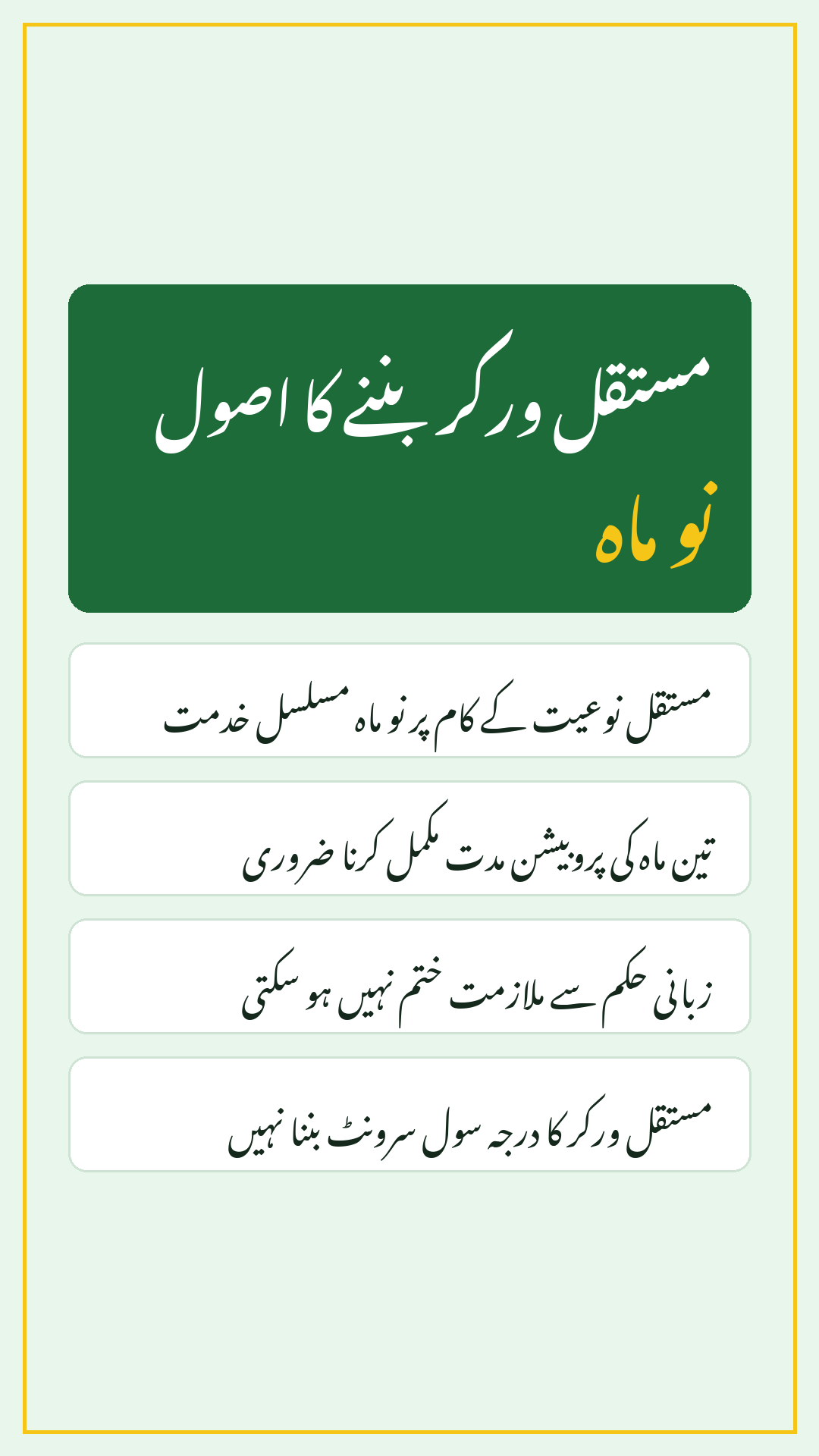
Nine months of service: Under the Industrial and Commercial Employment (Standing Orders) Ordinance, 1968, a worker in permanent-nature work for more than nine months can acquire permanent status.
Three-month probation: A permanent workman is an employee in work likely to last more than nine months who has completed a three-month probation.
Continuous work matters: The work must be of a permanent nature, such as regular duties in a health facility, not a one-off task.
89-day appointments rejected: Repeated 89-day appointments cannot change the reality that the work is permanent in nature.
Supreme Court backing: The court relied on Province of Punjab vs Ahmad Hussain (2013 SCMR 1547), where the Supreme Court recognised the same principle.
Verbal orders not enough: No daily-wage employee can be sacked by a verbal order; written process must be followed.
Who Benefits and Who Does Not
Health authority staff: The ruling covers daily-wage, work-charged and contingency-paid staff of Punjab’s District Health Authorities.
Data entry operators included: The petitions included data entry operators and other daily wagers in health facilities.
Long-serving workers: Workers with nine months or more of continuous service on permanent-nature work benefit most.
Not automatic civil servants: Permanent worker status does not mean becoming a permanent civil servant, the court clarified.
Different legal tracks: Civil service appointments follow the Civil Servants Act, while this ruling works under the 1968 labour ordinance.
Each case on merit: Eligibility depends on each worker’s own record, checked against the nine-month and permanent-nature tests.
Why the Government’s Refusal Was Annulled
Autonomy argument rejected: The authorities said they were autonomous bodies, but the court said that could not avoid the 2021 policy.
Pick-and-choose policy: The court called the selective treatment of workers a flagrant violation of Article 25 of the Constitution.
Policy has legal backing: The judge held that the 2021 policy carries the backing of law and must be applied to the employees it covers.
Past practice noted: The court noted similar employees had been regularised before, which weakened the refusal.
26 petitions together: The court decided 26 constitutional petitions together, including Muhammad Bilal Raza and others.
Orders set aside: The authorities’ orders were set aside as illegal.
What Workers Should Do Now
Collect your record: Gather appointment letters, attendance records, salary slips and duty rosters proving nine months of continuous service.
Check the nine-month test: Count your continuous service on permanent-nature work, and note any breaks the authority may raise.
Approach your authority: Submit a written representation to your District Health Authority, citing the judgment and the 2021 policy.
Keep copies safe: Keep copies of every application and reply; the written record matters if the matter goes further.
Seek legal advice: If refused, consult a labour lawyer or the Punjab Labour Court, which handles permanent workman claims.
No work, no pay: Salaries must be paid on proof of work; no work, no pay applies where no work was done, the court noted.
Contact and Helpline Details
Detail
Information
Judgment
2026 LHC 8384, Justice Khalid Ishaq (2 November 2026)
Concerned office
Your District Health Authority, through its chief executive
Legal forum
Punjab Labour Court for permanent workman claims
Helpline
No dedicated helpline was announced with this judgment
Advice
Rely on the written judgment and the 2021 policy, not on agents
Conclusion
The Lahore High Court has given daily-wage, work-charged and contingency-paid staff of Punjab’s District Health Authorities a clear right: nine months of continuous permanent-nature work brings permanent worker status. The 2021 policy applies, no separate notification is needed, and the refusal has been annulled. Affected workers should collect their service record and file a written claim.
FAQs
Who does the Lahore High Court ruling cover? Eligible daily-wage, work-charged and contingency-paid staff of Punjab’s District Health Authorities who worked continuously for more than nine months on permanent-nature work.
What is the nine-month rule? Under the 1968 Ordinance, a worker in permanent-nature work for more than nine months, after a three-month probation, is treated as a permanent workman.
Does this make daily wagers civil servants? No. Permanent worker status under labour law does not mean becoming a permanent civil servant or automatic regularisation in the civil service.
What was the case number? It is reported as 2026 LHC 8384, in Muhammad Bilal Raza and others vs Government of Punjab and others, decided by Justice Khalid Ishaq.
What should a worker do first? Collect appointment letters, attendance and salary records proving nine months of service, then submit a written representation to the District Health Authority.
Shahzad Sahil is the editor of plcpunjab.pk, covering Punjab government schemes including the Livestock Card, eligibility, registration and latest updates, with information verified from official sources for readers across Punjab.
The federal government has announced a major relief for wheat farmers. The wheat support price 2026-27 has been fixed at Rs 4,500 per 40 kilograms, up Rs 1,000 from the previous Rs 3,500 benchmark. The announcement was made on 23 October 2026 and was reported by Radio Pakistan, citing the Prime Minister’s Office. With wheat…
Punjab took the formal first step of its biggest economic plan in years on Friday, 30 October 2026, when Chief Minister Maryam Nawaz Sharif launched the Punjab Innovation for Value, Opportunity and Transformation (PIVOT) programme in Lahore. The launch ceremony brought together the State Bank governor, the Pakistan Business Council, investors and leading industrialists, and…
Many young people in Punjab want to earn online but do not know where to learn the right skills. e-Rozgaar Punjab is the provincial programme that teaches digital skills and freelancing, so trainees can offer services to clients at home and abroad. The programme has changed a lot since it started, and the biggest change…
The Green Tractor Scheme Phase V registration window has closed, and this guide says so plainly at the start so that no farmer wastes time or money chasing a finished round. Registration opened on 23 September 2026 and the last date was 5 October 2026. What follows is the complete step-by-step record of how farmers…
The Punjab Kisan Card check starts with one small SMS. Send PKC, a space, and your 13-digit CNIC number to 8070, and the system confirms your Kisan Card registration and status. That sounds simple, and it is, but there is a lot of confusion around what this SMS can and cannot do. With the October…
Young people who want to start or expand a business can get a loan from the federal government at low or zero markup. The PM Youth Business Loan Scheme 2026 — formally the Prime Minister’s Youth Business and Agriculture Loan Scheme — offers up to Rs 7.5 million in three tiers, starting with Rs 0.5…