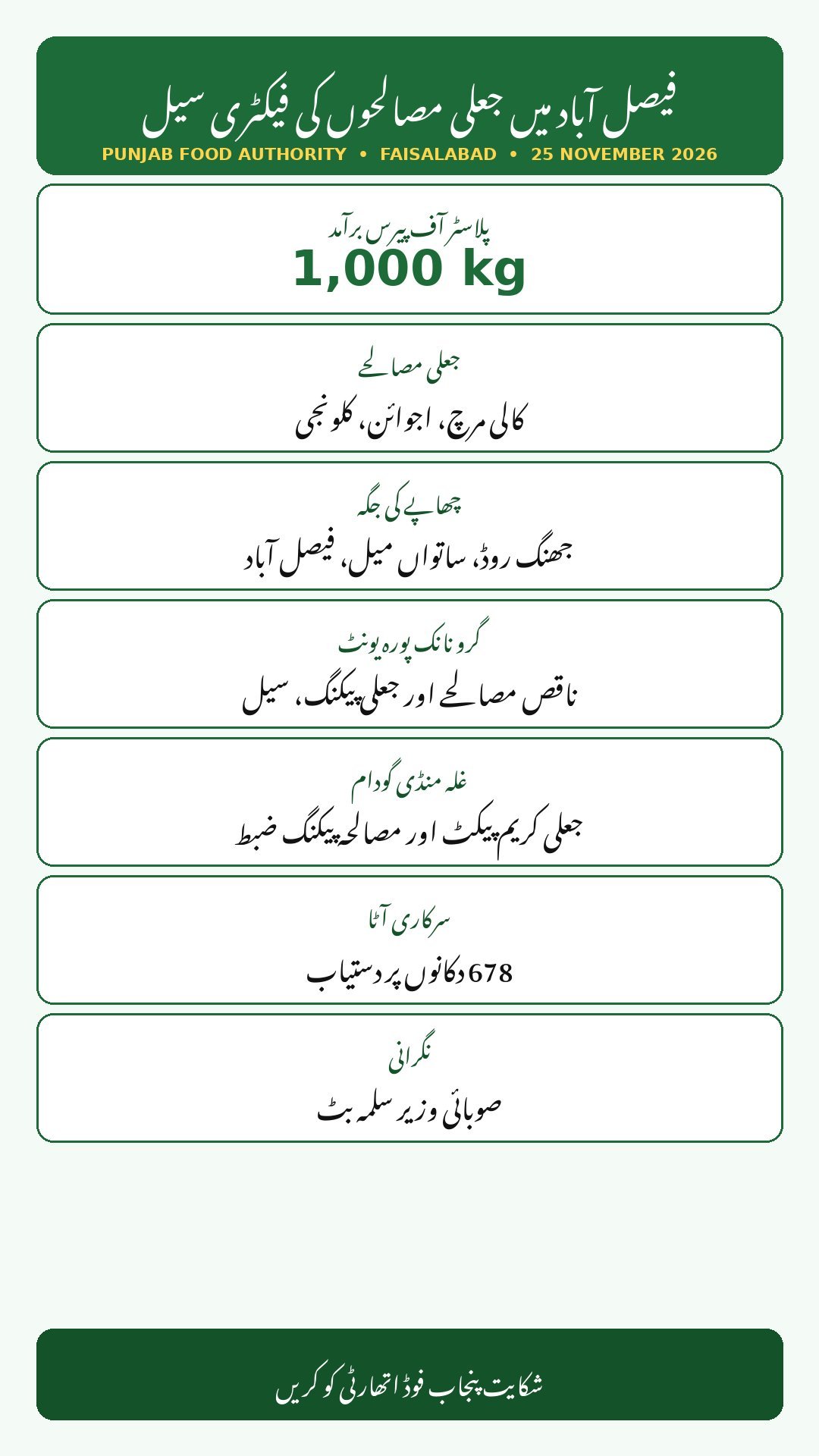
The masala in an ordinary kitchen should be the safest thing in the house. In Faisalabad, the Punjab Food Authority found the opposite. The Fake Spices Plaster of Paris Factory case began when PFA teams raided a spice unit on Jhang Road and found black pepper, celery and kalonji allegedly being made with plaster of Paris, a building material that has no place in food. About 1,000 kg of plaster of Paris was recovered, and the crackdown then spread to two more places in the city.
Punjab Food Security Minister Salma Butt supervised the operation herself, and the Punjab Food Authority registered cases and arrested owners at the sites raided. News reports published on 25 November 2026 called it part of a wider campaign against food adulteration. This article explains what the teams found.
Fake Spices Plaster of Paris Factory: What Happened in Faisalabad
The Punjab Food Authority uncovered the alleged production of fake spices during a crackdown on food adulteration in Faisalabad. ProPakistani reported the raids, and Dawn confirmed the same operation in its report of 25 November 2026. Food Security Minister Salma Butt supervised the operations on the ground.
The central allegation is simple and serious: the factory was making everyday spices from plaster of Paris, the white powder normally used in construction. Black pepper, celery and kalonji are used in almost every Pakistani kitchen, so fake versions could reach many homes before anyone noticed.
What was allegedly made: fake black pepper, celery and kalonji, produced with plaster of Paris instead of real spice.
What was recovered: 1,000 kg of plaster of Paris and other harmful ingredients, according to both ProPakistani and Dawn.
What is not confirmed: the reports do not name the brand whose packaging was allegedly copied.
The production is described as alleged, not proven in court, but the seizure is confirmed: 1,000 kg of plaster of Paris was recovered, and the unit was sealed.
The Three Raids: Jhang Road, Guru Nanakpura and the Grain Market
The operation covered three locations: manufacturing at one place, packing under a known name at another, and storage of fake packets at a third. UrduPoint reported that teams searched three locations and arrested two owners.
Jhang Road factory: fake black pepper, celery and kalonji allegedly made with plaster of Paris; 1,000 kg recovered; case registered.
Guru Nanakpura unit: a unit allegedly producing substandard spices and counterfeit packaging of a well-known brand was sealed; the owner was arrested and a case was registered.
Grain market warehouse: fake cream packets and spice packaging were seized; the owner was arrested.
Counterfeit packaging: the Guru Nanakpura unit was allegedly packing substandard spices under the name of a well-known brand, so shoppers could not tell fake from real by the packet alone.
One place made the fake spice, another gave it a trusted brand’s packing, and a third stored the finished packets.
How Fake Spices Are Made and Why Plaster of Paris Is Dangerous
Plaster of Paris is a fine white powder made from gypsum, used by builders for plasterwork and moulds. It is not a food ingredient and is not approved for eating in any quantity. Mixed into ground spices, it adds weight at almost no cost and hides inside light-coloured powders.
The buyer pays the price of real spice and receives a packet that is partly, or even mostly, a non-food powder. The reports do not say what share of the seized spice was plaster.
Weight fraud: a cheap powder is mixed into expensive spice so a little real spice sells as a full kilogram.
Colour and texture trick: fine white plaster blends into ground spices and is hard to spot without a lab test.
Not a food ingredient: plaster of Paris is made for construction, not for cooking, and it has no place in anything people eat.
Health risk: eating non-food chemicals can upset the stomach and intestines; anyone who feels ill after eating should consult a doctor.
Black pepper and kalonji are bought by families of every income, and a family that buys fake spice loses money twice: once at the shop, and again in harm to its health.
How to Check Your Spices at Home Before You Buy or Cook
No home test can replace a laboratory test. But a few habits can reduce the risk: buy from trusted shops, keep the bill, and report anything suspicious.
Buy packed and sealed: prefer factory-sealed packets from shops you trust over loose powder, and check the seal is unbroken.
Read the packet closely: look for the brand name, dates, weight and licence number, and be suspicious of blurred printing or spelling mistakes.
Compare the price: a packet sold far below the market price of real spice is a warning sign, because genuine black pepper and kalonji are not cheap.
Keep the bill and the packet: if the spice tastes wrong or causes discomfort, keep the packet and the shop bill so the product can be traced and reported.
Shopkeepers also have a duty: a retailer who knowingly sells fake spice shares the offence. Honest shopkeepers should buy only from authorised distributors.
Government Flour in Faisalabad: 678 Shops and One Lab Test
The minister’s visit was not only about spices. She also reviewed government flour: available at 678 shops in Faisalabad, with supplies increasing daily — a figure that matters because subsidised flour is a daily need for low-income families.
One flour sample was sent for laboratory testing after a consumer complaint, with the result expected within 24 hours. When the reports were published, the result had not been announced. Mills supplying substandard flour were warned their licences could be cancelled.
Flour availability: government flour was available at 678 shops in Faisalabad.
Lab test: one flour sample was sent for laboratory testing on a consumer complaint, with results expected within 24 hours.
Test result: not confirmed — no pass or fail is stated here.
Warning to mills: mills supplying substandard flour for government wheat were warned that their licences could be cancelled.
The flour review and the spice raids belong to the same policy: checking what ordinary families actually eat.
Punjab’s Wider Crackdown: Adulterated Milk, Pasteurisation and New Law
The Faisalabad raids were one day’s work in a campaign running across Punjab for the past year. The minister said millions of litres of adulterated milk had been discarded, thousands of cases registered, and fines worth millions imposed. No exact figures were given.
Two longer-term steps were also mentioned: a milk pasteurisation system is being introduced in Punjab, and legislation has been drafted against food adulteration. Neither step has a confirmed start date, so no date is stated here.
Adulterated milk discarded: millions of litres across Punjab over the past year.
Cases registered: thousands of cases registered against food adulteration in the same period.
Fines imposed: fines worth millions of rupees imposed on offenders.
Pasteurisation system: a milk pasteurisation system is being introduced in Punjab.
New legislation: legislation against food adulteration has been drafted, though no passage date is confirmed.
The minister’s message was blunt: no one involved in making adulterated food would get any concession. Enforcement is now reaching the small units and hidden warehouses where much fake food is made.
Item
What Was Found or Announced
Status
Plaster of Paris
1,000 kg recovered at the Jhang Road factory
Confirmed by ProPakistani and Dawn
Fake spices
Black pepper, celery and kalonji allegedly made with plaster of Paris
Case registered
Guru Nanakpura unit
Substandard spices and counterfeit packaging of a well-known brand
Sealed, owner arrested, case registered
Grain market warehouse
Fake cream packets and spice packaging seized
Owner arrested
Government flour
Available at 678 shops in Faisalabad; one sample sent for lab testing
Result not confirmed
Source
Verified Information
ProPakistani
Spice factory sealed; 1,000 kg plaster of Paris recovered at 7th Mile Jhang Road; Guru Nanakpura unit sealed, owner arrested; grain market seizure; flour at 678 shops (25 November 2026)
Dawn
Same raid confirmed: fake black pepper, celery and kalonji made from plaster of Paris; 1,000 kg recovered; Guru Nanakpura unit sealed; grain market seizure (25 November 2026)
UrduPoint
Minister’s briefing: three locations searched, two owners arrested; campaign on Chief Minister Maryam Nawaz’s directions; pasteurisation and legislation drafted (24 November 2026)
Punjab Food Authority (official)
Official body carrying out the enforcement; complaints through its official website pfa.gop.pk (verified reachable, HTTP 200, 26 November 2026)
Conclusion
The Faisalabad operation shows both the problem and the response in one day’s work. A factory allegedly turned plaster of Paris into black pepper, celery and kalonji; a second unit allegedly packed substandard spice under a trusted brand’s name; and a warehouse stored fake cream packets for sale. The authority sealed the units, arrested the owners and recovered 1,000 kg of plaster of Paris.
For families, the lesson is practical: buy sealed packets from trusted shops, read the label, keep the bill, and report anything wrong to the Punjab Food Authority. The next test is whether the promised inspections of small units happen, and whether the pasteurisation system and the new law follow.
Frequently Asked Questions
What happened in the Faisalabad fake spices case?
The Punjab Food Authority raided a factory at the 7th Mile on Jhang Road and found fake black pepper, celery and kalonji allegedly made with plaster of Paris. About 1,000 kg was recovered, and a case was registered.
Who supervised the Faisalabad food raids?
Punjab Food Security Minister Salma Butt supervised the PFA teams at all three sites.
How much plaster of Paris was recovered in Faisalabad?
About 1,000 kg. ProPakistani and Dawn both confirmed the figure.
Which spices were allegedly made with plaster of Paris?
Black pepper, celery (ajwain) and kalonji (black seed). The reports name no other spice in this case.
What happened at the Guru Nanakpura unit?
A unit allegedly producing substandard spices and counterfeit packaging of a well-known brand was sealed, the owner arrested and a case registered.
What was seized from the grain market warehouse?
Fake cream packets and spice packaging were seized, and the owner was arrested.
Is plaster of Paris dangerous to eat?
Yes, never. Plaster of Paris is a building material made from gypsum, not a food ingredient, and eating it can upset the stomach; anyone who feels ill should consult a doctor.
How can I check spices at home?
Buy factory-sealed packets from trusted shops, check the seal, dates, weight and printing, and keep the bill and packet. Only a laboratory test can prove adulteration, so report suspicious packets to the Punjab Food Authority.
What did the minister say about government flour in Faisalabad?
Government flour was available at 678 shops, with supplies increasing daily. One sample was sent for lab testing, results expected within 24 hours, and mills supplying substandard flour were warned of licence cancellation.
What is Punjab doing about food adulteration in the long term?
Millions of litres of adulterated milk were discarded across Punjab over the past year, with thousands of cases and fines worth millions. A pasteurisation system is being introduced and legislation drafted, though no dates are confirmed.
Shahzad Sahil is the editor of plcpunjab.pk, covering Punjab government schemes including the Livestock Card, eligibility, registration and latest updates, with information verified from official sources for readers across Punjab.
If you applied for the CM Punjab E-Bike Scheme, the one update you are waiting for is the Phase 2 balloting. The Punjab government has confirmed 100,000 electric bikes for this round, to be picked through a transparent computerised ballot. The reported 4 November 2026 balloting date has now passed without any ballot or result,…
For Punjab farmers, the best news of this Kisan Card cycle is not about a new form or a new office visit. It is about speed. Once you clear your bill, your next interest-free loan is promised on your card within 48 hours, so the gap between one season and the next is now just…
Chief Minister Maryam Nawaz Sharif has given officials a 15-day deadline for a 100 per cent improvement in cleanliness across Punjab, after expressing dissatisfaction with solid waste management companies. The Suthra Punjab cleanliness deadline was set at a special meeting on Monday 2 November 2026 to review the Suthra Punjab programme, and reported on 3…
Under the Chief Minister’s Punjab Clean Air Programme, rice growers sowing with a super seeder can claim a rental subsidy of Rs 5,000 per acre, up to a maximum of Rs 25,000 per farmer. The Super Seeder Subsidy Punjab scheme is designed to stop farmers from burning rice stubble after harvest, a practice that badly…
Students across Punjab have been waiting for one date since the application window closed, and that date has now been revised. According to the latest official announcement, the Punjab E-Bike Distribution will now begin in December 2026, after the earlier 5 November start was postponed. Chief Minister Maryam Nawaz Sharif announced the revised schedule at…
Fresh IT graduates in Punjab have a big reason to smile. The Chief Minister IT Internship Program (CMITIP) offered more than 4,000 internship positions with leading IT companies across the province, with selected interns receiving a monthly stipend of Rs 50,000 for four months — and registration for the third phase is now underway, Information…