The PM Youth Chromebook Scheme 2026 will distribute 500,000 free Chromebooks to students of government schools across Pakistan, and the first question every student asks is a simple one: am I eligible? The scheme was launched on 23 October 2026 at the Jinnah Convention Centre in Islamabad by Prime Minister Shehbaz Sharif, and it is run by the Inter Boards Coordination Commission (IBCC) under the Prime Minister’s Youth Programme. This guide explains the eligibility criteria in plain words, so that you can check your own status before you start your registration.
Eligibility is not decided by a single rule. It depends on your class, your school type, your marks and your region, and all four conditions must be met together. Registration is free, and only one application is allowed per student, so it is worth checking each condition carefully rather than applying first and discovering a problem later.
The Four Basic Conditions
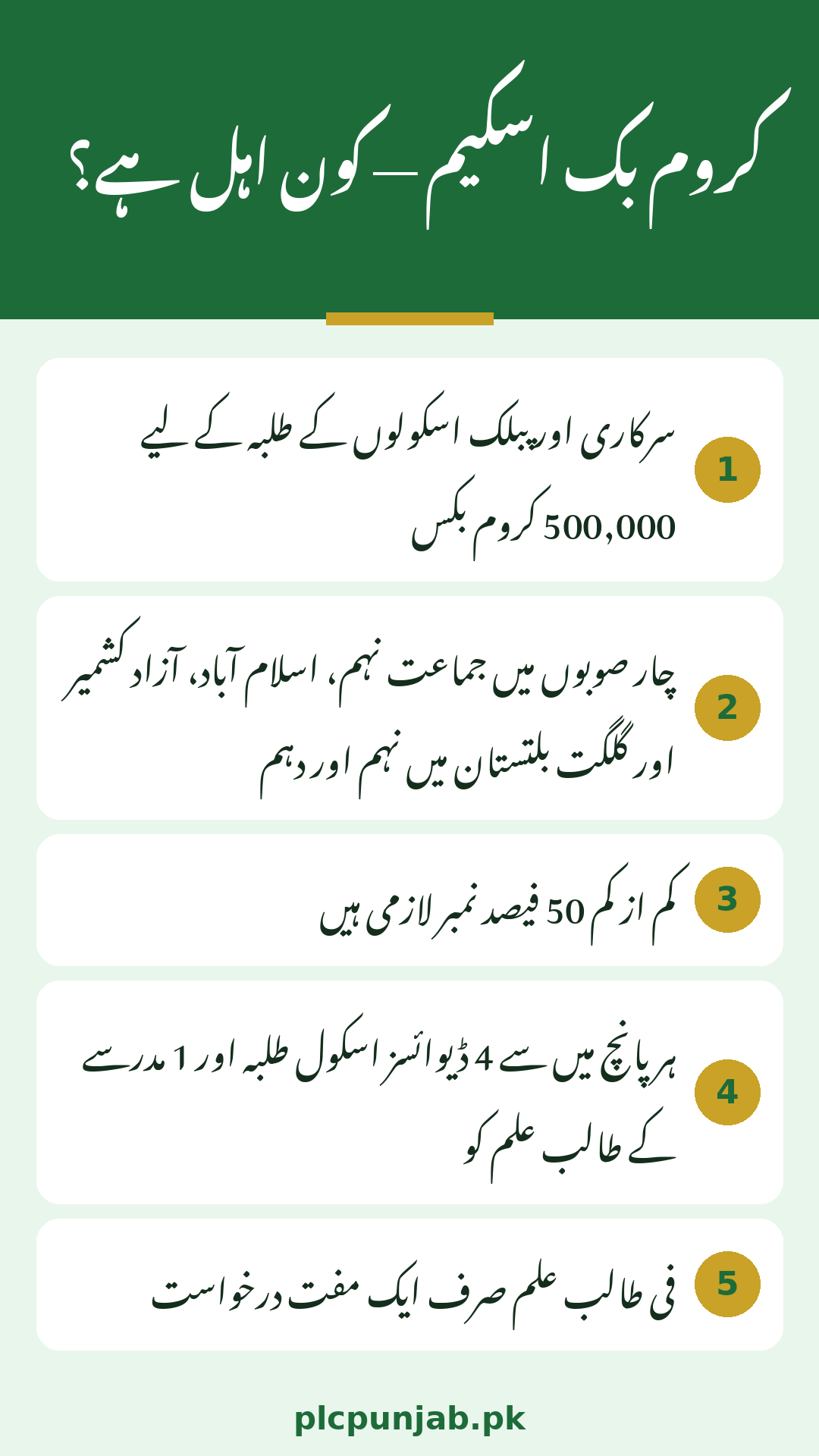
Think of eligibility as four gates, and you must pass all four. First, your class must be covered in your region. Second, your school must be a government or public school. Third, your SSC-I marks must be at least 50 percent. Fourth, you must apply only once, with your own verified record. If any one of these conditions fails, the application does not qualify, even if the other three are met.
Correct class for your province or region.
Government or public school only.
Minimum 50 percent marks in SSC-I.
One free application per student.
It is equally important to know who is excluded, so that no one wastes time on an application that cannot succeed. You cannot apply if you study in a private school. You cannot apply if your SSC-I marks are below 50 percent. You cannot apply if your class is not covered in your region, for example a Grade 10 student in Punjab. You also cannot apply more than once, since only one application per student is allowed. None of these exclusions can be fixed by paying someone or by using another person’s record, and anyone who offers to do so is not genuine.
Private school students are not covered.
Below 50 percent marks does not qualify.
Grade 10 in the four provinces is not covered.
More than one application per student is not allowed.
The class rule is the condition students most often misunderstand, because it differs by region. In the four provinces — Punjab, Sindh, Khyber Pakhtunkhwa and Balochistan — the scheme covers students of Grade 9 only. In Islamabad Capital Territory, Azad Jammu and Kashmir and Gilgit-Baltistan, it covers students of Grade 9 and Grade 10. A Grade 10 student in Punjab is therefore not covered, while a Grade 10 student in Islamabad is covered. Check the rule for your own region, not for another student’s region.
Region
Classes Covered
Punjab
Grade 9
Sindh
Grade 9
Khyber Pakhtunkhwa
Grade 9
Balochistan
Grade 9
Islamabad Capital Territory
Grade 9 and Grade 10
Azad Jammu and Kashmir
Grade 9 and Grade 10
Gilgit-Baltistan
Grade 9 and Grade 10
School Type: Government and Public Only
The scheme is designed for students of government and public schools. Students of private schools are not covered, however strong their results may be. If you are unsure whether your school counts as government or public, ask your school administration before you apply, because this condition cannot be adjusted after submission. The rule exists because the programme targets students who study in the public system, and it is applied strictly.
The 50 Percent Marks Rule
Every applicant must have at least 50 percent marks in the SSC-I result. This is a firm minimum, not a guideline. A student with 49 percent does not qualify, even if every other condition is met. Your marks are verified by IBCC against your board record, so the percentage you enter must match your official mark sheet exactly. If you are unsure about your percentage, calculate it from your mark sheet before you apply, and do not guess.
Minimum marks: 50 percent in SSC-I.
Marks are verified by IBCC from your board record.
The percentage must match your official mark sheet.
Below 50 percent, the application does not qualify.
Seminary Students and Special Cases
Seminary students are included in the scheme, which many students do not realise. Out of every five devices, four go to school students and one goes to a seminary student. Scrutiny of seminary students is carried out through the Director General of Religious Education, so seminary applicants should make sure their record is properly registered with their institution before applying. Apart from this arrangement, the same class, marks and application rules apply. A seminary student who meets the marks condition and whose record is properly registered stands on the same footing as any other applicant, and the one-in-five share is a fixed part of the scheme’s design, not an afterthought.
One timing case also deserves attention. Registration in Sindh opens after all Sindh boards announce their 2026 9th-grade results. A Sindh student whose record is not showing yet is usually waiting for a board result announcement, not facing a technical fault, and should wait for that announcement.
Province / Region
Chromebooks Allotted
Punjab
181,090
Sindh
85,925
Khyber Pakhtunkhwa
51,170
Balochistan
31,815
Islamabad
100,000
Azad Jammu and Kashmir
25,000
Gilgit-Baltistan
25,000
Total
500,000
How Registration Works for Eligible Students
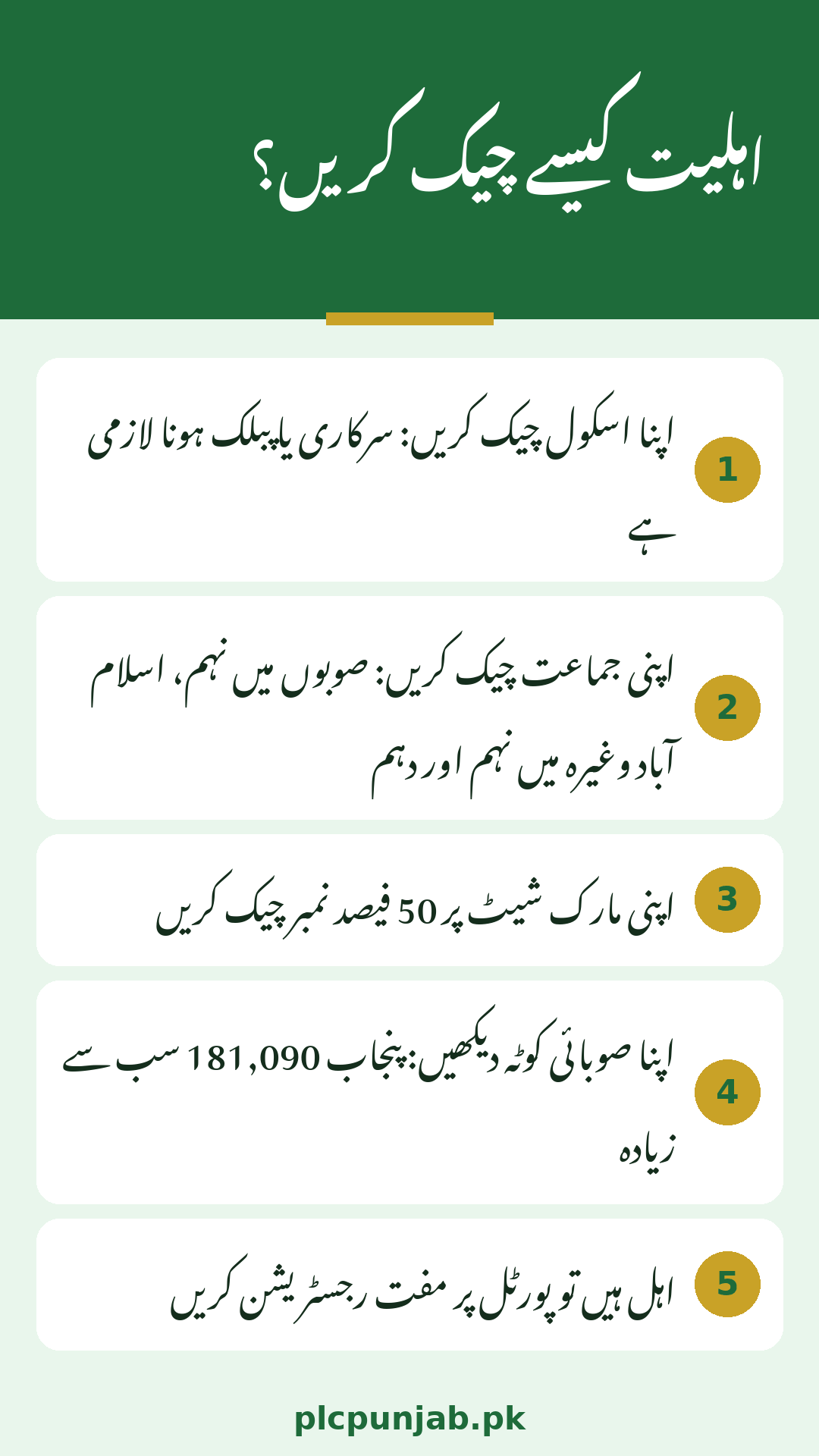
If you meet all four conditions, registration follows a short, clear path. Keep your documents ready first: your photograph, your SSC-I mark sheet, your attested B-Form or CNIC, and your guardian’s attested CNIC, each file 300 KB or smaller. Then visit the official portal, select your board, and find your record using your CNIC or B-Form, your roll or registration number in digits only without dashes, and your date of birth. Check your details carefully, upload your documents, review the complete entry, and then submit. After submission you cannot change your entry, so review before you submit, and save your reference number and download your slip. The review step is the most important minute of the whole process: a single wrong digit in the roll number or a mismatched date of birth can delay or derail an otherwise valid application, while a careful review catches those errors when they are still fixable. For the full step-by-step process, read our PM Youth Chromebook Scheme apply guide.
Conclusion
The eligibility rules are clear: the right class for your region, a government or public school, at least 50 percent marks in SSC-I, and one free application per student. If you meet all four conditions, you can register on the official portal at pmychromebooks.ibcc.edu.pk. Check your class, your school type and your marks before you apply, and keep your reference slip safe after submission.
FAQs
Am I eligible with 49 percent marks?
No. The minimum is 50 percent marks in SSC-I. Students below 50 percent do not qualify.
Can private school students apply?
No. The scheme covers government and public school students only.
Are Grade 10 students in Punjab eligible?
No. In the four provinces the scheme covers Grade 9 only. Grade 10 is covered only in Islamabad, Azad Jammu and Kashmir and Gilgit-Baltistan.
Are seminary students eligible?
Yes. One out of every five devices goes to seminary students, with scrutiny through the Director General of Religious Education.
Shahzad Sahil is the editor of plcpunjab.pk, covering Punjab government schemes including the Livestock Card, eligibility, registration and latest updates, with information verified from official sources for readers across Punjab.
Thousands of students are searching for the PM Youth Chromebook Scheme helpline number, and this article begins with the honest answer: the official portal does not publish any phone helpline number. If a number is circulating on social media or in forwarded messages claiming to be the scheme helpline, it is not official, and you…
Punjab has restored the historic names of six of its oldest public-sector higher education institutions, and the headline change concerns Lahore’s most famous college. The Punjab universities renamed under the Public Sector Universities (Amendment) Act, 2026 include Government College University Lahore, which returns to its historic identity as Government College Lahore after 24 years with…
The PM Youth Chromebook Scheme 2026 will give 500,000 free Chromebooks to government-school toppers, but no application is complete without the right documents. Many students prepare everything else and then stumble at the upload stage, because a file is too large, a copy is not attested, or the wrong paper was scanned. This guide lists…
The Federal Public Service Commission (FPSC) has announced the CSS MPT 2027 Result, and candidates who appeared in the MCQ-Based Preliminary Test (MPT) for the CSS Competitive Examination 2027 can now check whether they have qualified for the next stage. The commission shared the announcement on 4 November 2026, and the result is available on…
As of 20 October 2026, the E-Bike Scheme balloting has NOT been held and no merit list or selected students list has been published. The Punjab government has not announced an official balloting date. Verification of applications is running through October. Any website or video showing a “final selected list” right now is not official….
Students unhappy with their first-year result have only a few days left, because the rechecking window closes on 6 November 2026. The Punjab 11th Class Rechecking 2026 process gives every student of the Intermediate Part-I first annual examination a short chance to ask their board to recheck a paper. The result was announced on 22…