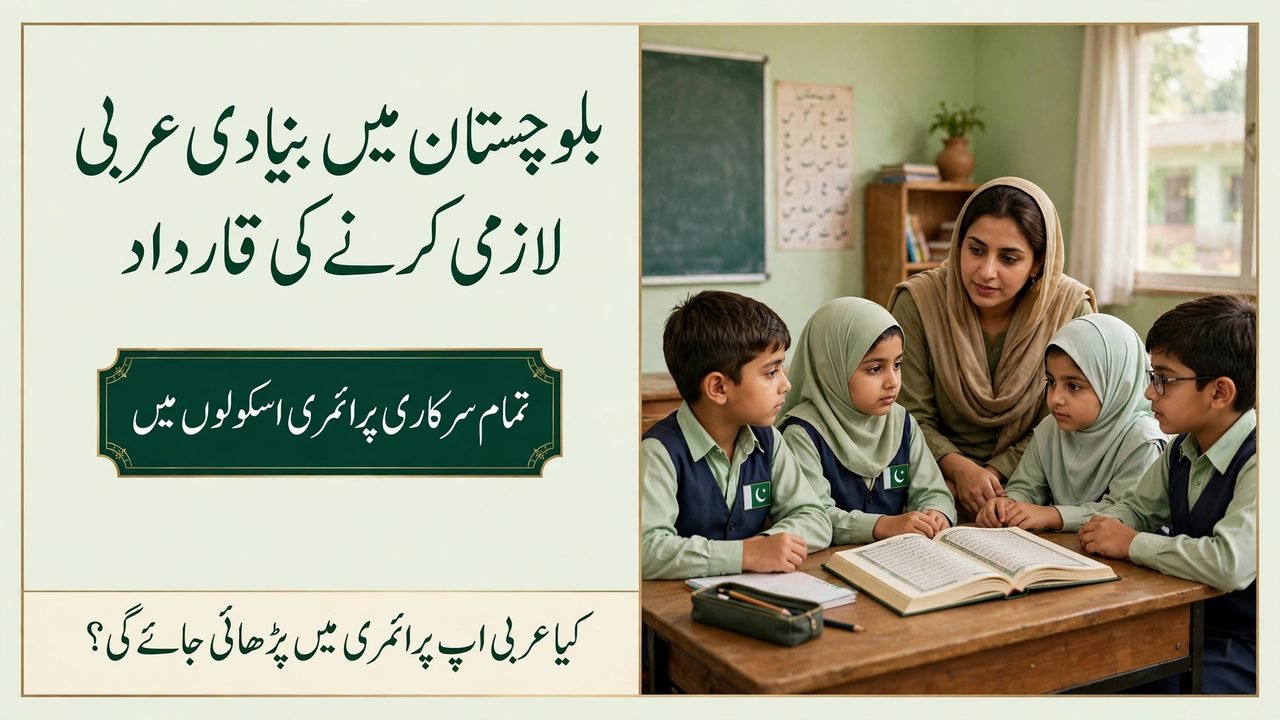
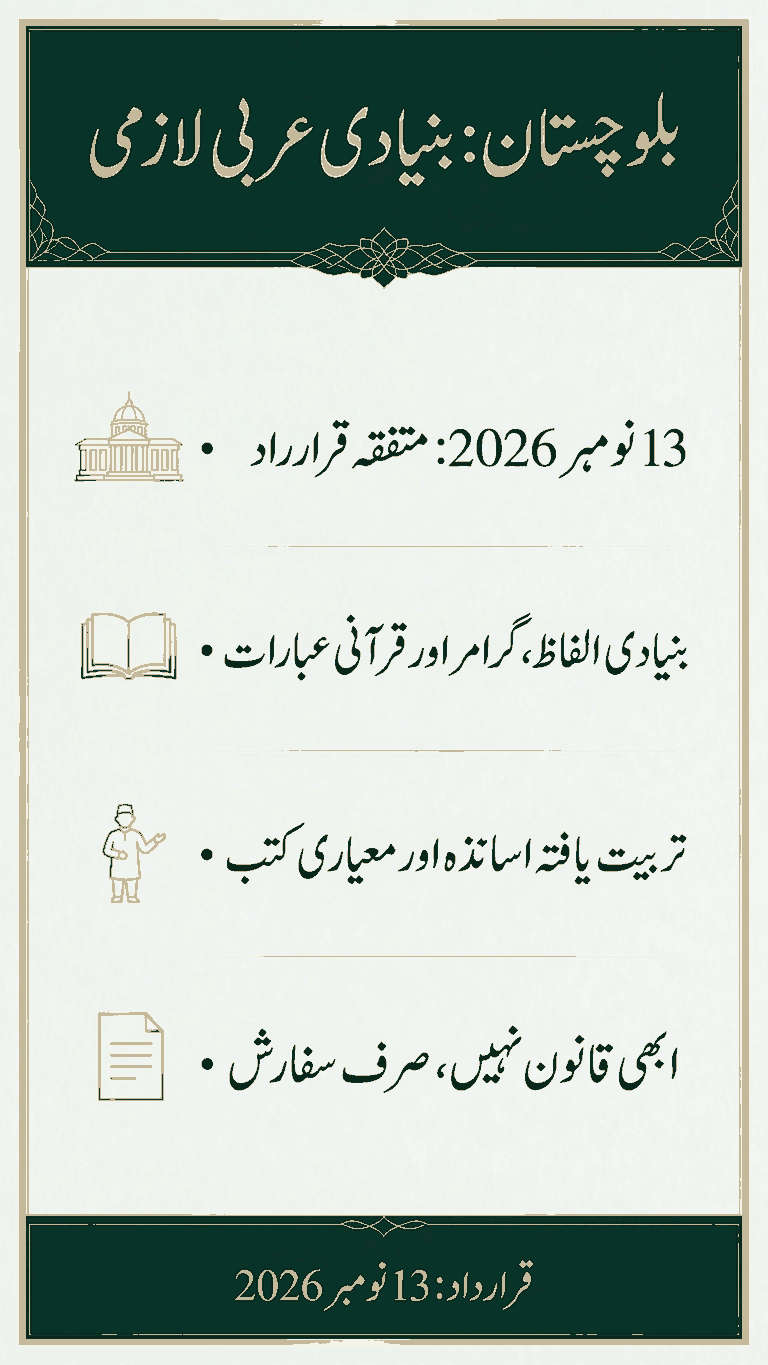
On Friday, 13 November 2026, the Balochistan Assembly unanimously adopted a resolution recommending that basic Arabic become a compulsory subject in all government primary schools across the province. The resolution, moved by JUI-F MPA Shahida Rauf, says teaching basic Arabic in primary schools will help young students understand commonly used Quranic words and their meanings, building a better understanding of the Holy Quran from an early age.
Detail
Balochistan Arabic Resolution
Adopted on
Friday, 13 November 2026
Adopted by
Balochistan Assembly, unanimously
Moved by
Shahida Rauf, MPA (JUI-F)
What it recommends
Basic Arabic as a compulsory subject in all government primary schools
Purpose
Help students understand commonly used Quranic words and meanings
Status
Resolution (recommendation), not a law yet
What the Balochistan Assembly Decided
Unanimous adoption: The resolution was adopted unanimously by the Balochistan Assembly on 13 November 2026, with members across parties supporting it.
A recommendation, not a law: The resolution recommends basic Arabic as a compulsory subject. It asks the provincial government to act, but it is not itself a law or an implemented policy.
Government primary schools: The proposal covers all government primary schools in Balochistan, where the youngest students begin their education.
Focus on understanding: The aim is not fluency in Arabic but a basic understanding of Quranic words and expressions that children already hear and recite.
Basic vocabulary: The resolution calls for a simple, standardised, grade-wise curriculum starting with basic Arabic vocabulary.
Grammar basics: Elementary Arabic grammar suited to young children would form part of the teaching.
Quranic expressions: Commonly used Quranic expressions and their meanings would be taught, connecting classroom learning with recitation.
Grade-wise design: The curriculum would be designed grade by grade, so each class learns only what suits its level.
Teachers, Textbooks and a Phased Programme
Trained teachers: The resolution calls for trained teachers to deliver the Arabic lessons, rather than asking existing teachers to add the subject without preparation.
Quality textbooks: Quality textbooks and appropriate teaching materials are part of the plan, so students learn from proper material.
Phased rollout: The programme would be introduced in phases, taking into account students’ ages, mental abilities and educational needs.
No start date yet: No start date, academic year or grade rollout date has been announced, because the resolution only recommends the step to the government.
What Was Said During the Assembly Discussion
Shahida Rauf’s case: MPA Shahida Rauf, who moved the resolution, said basic Arabic would help students understand the Quranic words they already use, giving them meaning alongside memorisation.
Mother languages raised: During the discussion, MPA Dr Abdul Malik Baloch recalled the 2013 legislation to promote education in mother languages and urged that law to be implemented alongside the Arabic programme.
Existing provisions noted: Education Minister Raheela Hameed Durrani noted that schools already have Nazira Quran provisions and that Arabic is taught at higher levels.
What Happens Next After a Resolution
Government consideration: A resolution is a formal recommendation. The provincial government and the education department must now decide how, and when, to act on it.
Curriculum work needed: Before any classroom teaching begins, a grade-wise curriculum, textbooks and teacher training must all be prepared.
No timeline announced: No timeline has been given for any of these steps, so parents and schools should wait for an official notification.
Watch official announcements: Any real start date will come through the Balochistan education department or the provincial government, not through social media posts.
What This Means for Students and Parents
Nothing changes yet: Because this is a resolution, no subject has been added to any school’s timetable for now.
A first step: The unanimous vote is a strong signal that the government may take the proposal seriously, but the decision to implement it still lies ahead.
Understanding over memorisation: If implemented, the programme’s focus would be on understanding Quranic words, which many parents have long wanted for their children.
Mother languages too: The debate also reminded the assembly of the 2013 mother-languages law, which supporters want implemented at the same time.
Do not pay anyone: No fee or admission is linked to this resolution, so parents should not pay anyone claiming to enrol children in an Arabic programme.
Point
What the Resolution Says
Subject
Basic Arabic, compulsory in government primary schools
Trained teachers with quality textbooks and materials
Rollout
Phased, by age and ability, with regular reviews
Status
Resolution only — no start date announced
Contact and Helpline Details
Information
Body
Balochistan Assembly
For implementation
Government of Balochistan, School Education Department — no notification issued yet
For parents
No change in school timetables for now; wait for an official announcement
Conclusion
The Balochistan Assembly’s unanimous resolution is a clear statement of intent: basic Arabic should be taught in the province’s government primary schools so children understand the Quranic words they recite. The proposal includes a grade-wise curriculum, trained teachers, quality textbooks and a phased rollout, and the debate also revived the call to implement the 2013 mother-languages law. But a resolution is only a recommendation. Until the government issues a notification with a curriculum, teachers and a start date, nothing changes in classrooms.
FAQs
Has Arabic become compulsory in Balochistan’s primary schools? Not yet. The Balochistan Assembly has passed a resolution recommending basic Arabic as a compulsory subject in government primary schools. It is a recommendation to the government, not a law.
When will Arabic teaching start in primary schools? No start date or academic year has been announced. The government must first prepare a curriculum, textbooks and trained teachers.
Who moved the resolution? JUI-F MPA Shahida Rauf moved the resolution, which the assembly adopted unanimously on 13 November 2026.
What would the Arabic curriculum cover? Basic Arabic vocabulary, elementary grammar and commonly used Quranic expressions, taught grade by grade.
Does the resolution affect private schools? No. The resolution covers government primary schools in Balochistan only.
Shahzad Sahil is the editor of plcpunjab.pk, covering Punjab government schemes including the Livestock Card, eligibility, registration and latest updates, with information verified from official sources for readers across Punjab.
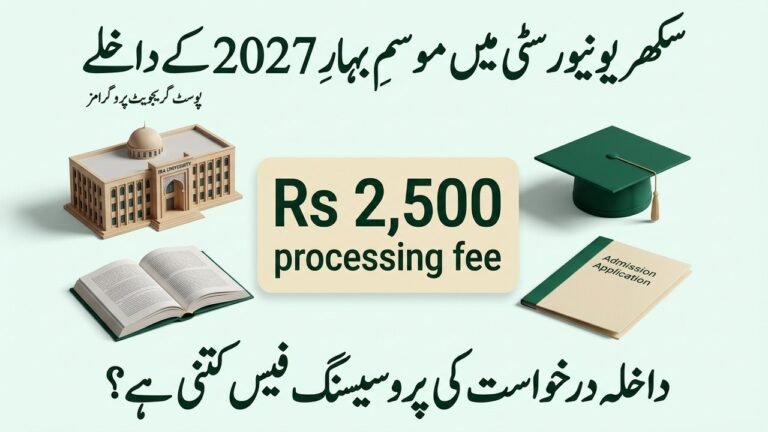
Sukkur IBA University has opened Spring 2027 admissions for MS, ME and MPhil degree programmes, offering postgraduate study opportunities in business, computer science, artificial intelligence, engineering, mathematics and education. The Sukkur IBA admissions Spring 2027 are open at the university’s main campus in Sukkur, and applications are being accepted through the official online admission portal….
Students of Gujranwala Board can relax now, because the result date is confirmed. The Board of Intermediate and Secondary Education (BISE) Gujranwala has announced the 11th Class Result 2026 for the HSSC Part 1 Annual Examination today, Thursday, 22 October 2026, at 10:00 AM (PKT) — the result is now LIVE. Students from Gujranwala, Gujrat,…
Parents and students across Punjab are asking one question as December gets closer: when will winter holidays start? The short answer is that no official date has been announced yet. The School Education Department has not issued the winter vacation notification for 2026-27. Still, the picture is becoming clear. The Punjab winter holidays 2026 expected…
Government College Lahore has launched five digital systems and adopted Punjab’s E-Filing and Office Automation System, e-FOAS, ending paper-based working at one of the province’s oldest institutions. Punjab Chief Secretary Zahid Akhtar Zaman inaugurated the systems on 4 November 2026, saying the government is extending the Chief Minister’s Digital Punjab initiatives to educational institutions and…
As of 20 October 2026, the E-Bike Scheme balloting has NOT been held and no merit list or selected students list has been published. The Punjab government has not announced an official balloting date. Verification of applications is running through October. Any website or video showing a “final selected list” right now is not official….
Applying for the PM Youth Chromebook Scheme 2026 is only the first half of the journey. The second half is selection: how students are ranked, how provincial quotas work, and what a merit list actually means in this scheme. This guide explains the selection process in plain words, so that you know exactly how the…