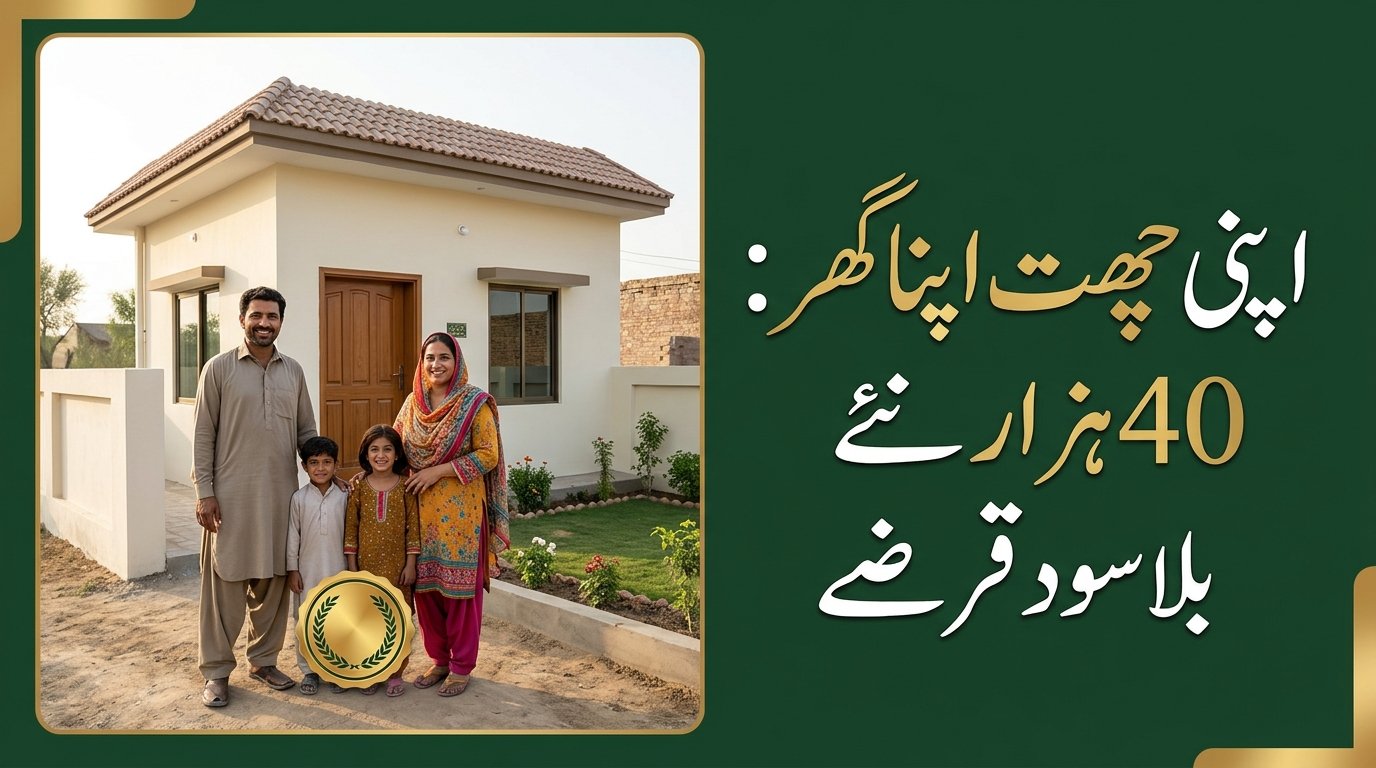
With 40,000 new interest-free loans approved on 19 October 2026, one question is on the mind of every plot owner in Punjab: do I qualify for Apni Chhat Apna Ghar? The answer comes down to four things — Punjab residency, a small residential plot, a modest income, and a clean record. The criteria have not changed with the new loan window, so if you know where you stand on each one, you already know most of the answer. This guide explains every condition in plain words, shows you who gets priority, and gives you a two-minute self-check to run before you apply.
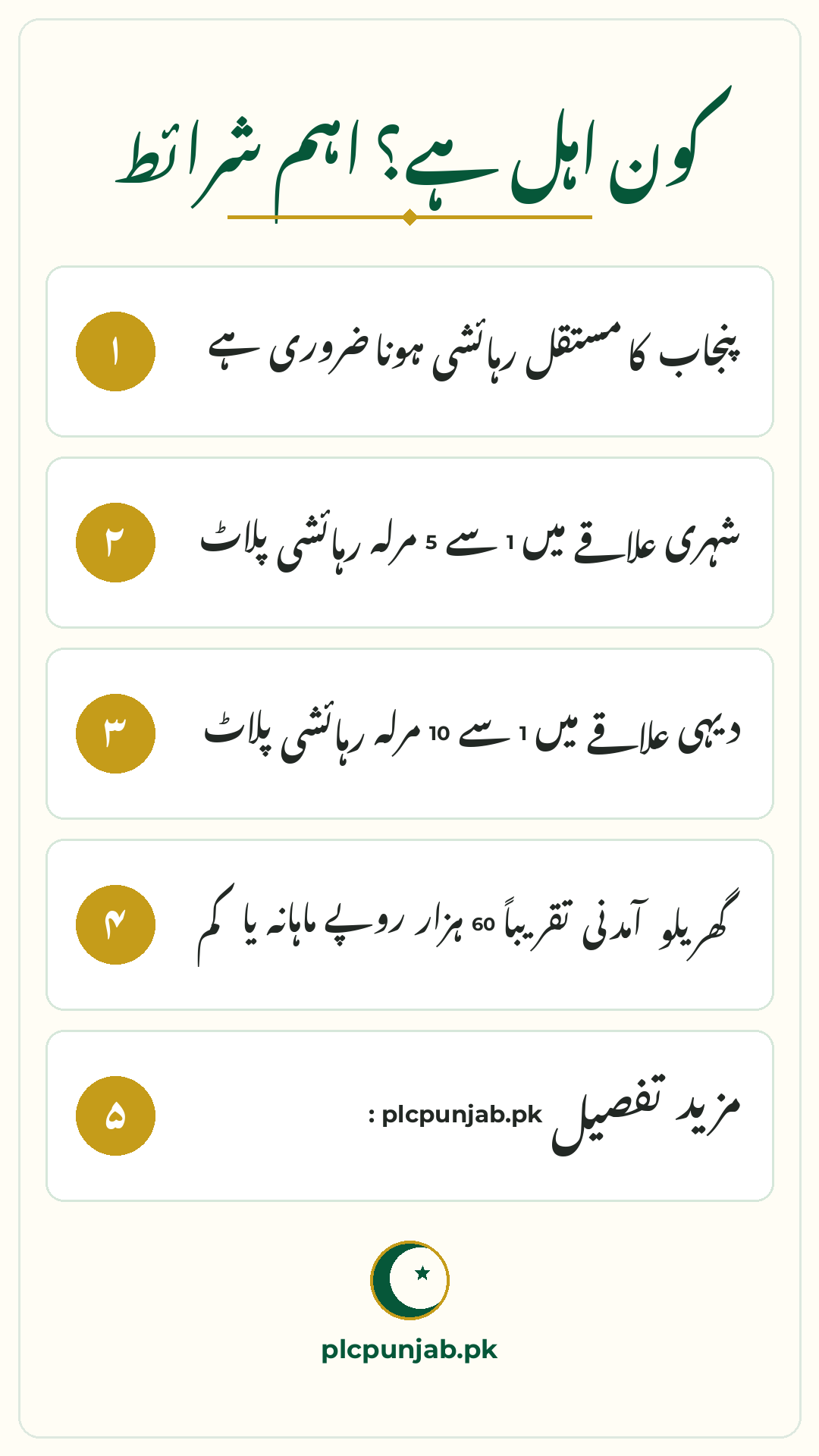
Eligibility Point
What You Need
Residency
Permanent resident of Punjab, as shown on your CNIC
Plot (urban areas)
Residential plot of 1 to 5 marla, owned by you or your family
Plot (rural areas)
Residential plot of 1 to 10 marla, owned by you or your family
Household income
About Rs 60,000 per month or less
PMT score
60 or below in the NSER survey
Record
No bank default and no criminal record
The Basic Residency Rule
The first condition is simple: you must be a permanent resident of Punjab, and your CNIC should reflect that. The applicant must also be the head of the family as per NADRA records, which usually means the eldest earning member or the person registered as family head in NADRA’s family tree. If you moved to Punjab years ago but your CNIC still shows another province, update your address at NADRA before applying, because a mismatched province is a needless reason to fail verification.
Your CNIC must show Punjab as your province.
The applicant should be the family head in NADRA records.
Families living in Punjab on a valid Punjab CNIC qualify.
Age 18 or above is the standard expectation in current scheme guides.
An outdated CNIC address should be corrected at NADRA first.
This programme is for people who have land but no house, and the plot limits are strict. They are also the single most common reason applications are rejected, so this is the condition to check first. In urban areas, your residential plot must be between 1 and 5 marla. In rural areas, it must be between 1 and 10 marla. The plot must be residential, not agricultural or commercial, and you must own it — a fard or registry in your name, or your family’s name, is the proof. No plot at all means no loan, because this scheme builds houses; it does not buy land.
Urban areas: residential plot between 1 and 5 marla.
Rural areas: residential plot between 1 and 10 marla.
The plot must be residential, not agricultural or commercial.
Ownership proof such as a fard or registry is required.
Land still in a deceased parent’s name needs an inheritance transfer first.
Check your fard or registry today and confirm the exact marla figure and the ownership name. If the ownership record is not clean when verification starts, your application will stall, so sorting out inheritance paperwork early is time well spent.
Income and PMT Score
The programme targets low and middle-income households, and two numbers decide this part of your eligibility: your household income and your NSER poverty score. The household income figure used across current scheme guides is about Rs 60,000 per month or less, and the PMT score must be 60 or below in the NSER survey. Both numbers point the same way: the loan is for families that genuinely cannot build on their own.
Household income: about Rs 60,000 per month or less.
PMT score: 60 or below in the NSER survey.
Income proof: salary slip, pension book, or an income affidavit where applicable.
If you have never done the NSER survey, your PMT score may not be on record.
Keeping your BISP or Ehsaas survey record updated helps during verification.
If your PMT score is not on record because you never took the NSER survey, do not assume you are out. The programme’s verification process handles this during application, but having your survey record updated in advance removes one more uncertainty from your file.
What Disqualifies You
Knowing the disqualifiers is just as important as knowing the qualifiers. These conditions will stop an application no matter how strong the rest of your file is, so read them honestly before you spend time on the process.
Already owning a constructed house: the scheme is for first-time builders.
Bank defaulter: an unsettled defaulted loan blocks approval.
Criminal record: applicants must have a clean record.
No Punjab residency: out-of-province applicants do not qualify.
Commercial or agricultural land: only residential plots count.
There is one humane exception worth knowing. Scheme guides describe a joint-family expansion window: families living in shared homes can get loans for extra rooms. If that is your situation, mention it clearly in your application and at the facilitation desk, rather than leaving it for verifiers to guess.
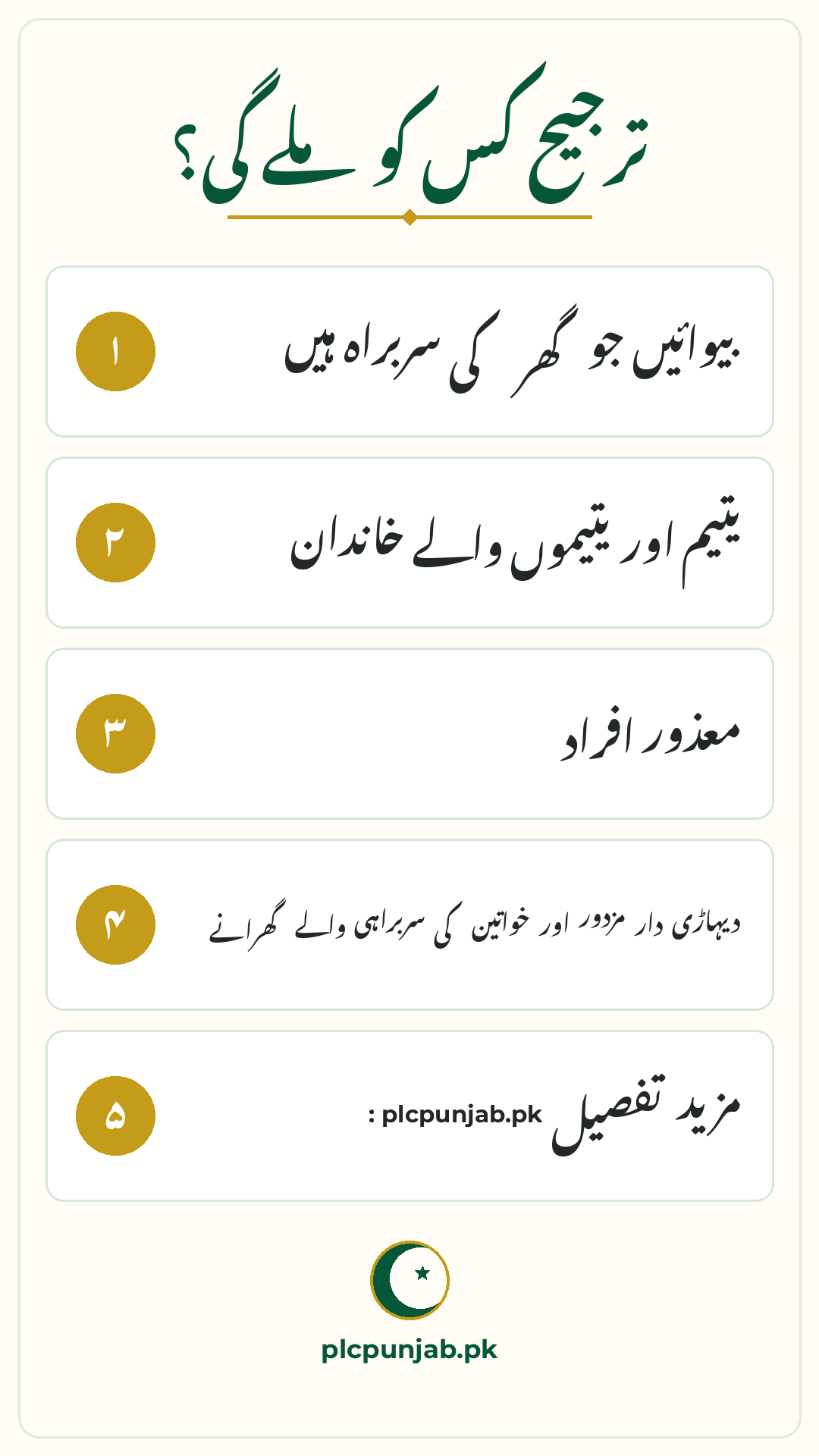
Who Gets Priority
When applications exceed the available loans, and they always do, certain categories are treated as priority. Current scheme guides consistently name the same groups, and if you belong to one of them, your file should be flagged as such from the start.
Widows heading their households.
Orphans and orphan-headed families.
Differently-abled persons.
Daily-wage workers with unstable income.
Women-headed households.
Priority does not mean automatic approval. It means your file gets attention sooner in a crowded queue. Everyone still has to pass the same verification, and a priority applicant with a failed plot check will still be refused.
Check Yourself in Two Minutes
Run this quick self-test before you apply. If you can answer yes to every line, you are in a strong position. One no does not always mean the end — fix what you can, like updating a CNIC address or transferring inherited land, and then apply. You can apply online at the official portal, or visit the DC or AC office or the PHATA facilitation desk in your district, and the toll-free helpline 0800-09100 can answer questions about the process.
Is your CNIC from Punjab? You need a yes.
Are you the family head per NADRA? You need a yes.
Do you own a 1 to 5 marla urban or 1 to 10 marla rural residential plot? You need a yes.
Is your household income about Rs 60,000 per month or less? You need a yes.
Is your PMT score 60 or below? You need a yes.
Are you free of bank default and criminal record? You need a yes.
Self-Check Question
Answer You Need
Is your CNIC from Punjab?
Yes
Are you the family head per NADRA?
Yes
Do you own a qualifying residential plot?
Yes
Is household income about Rs 60,000 per month or less?
Eligibility for the new 40,000 loans comes down to Punjab residency, a small residential plot, modest income with a PMT score of 60 or below, and a clean record. Run the two-minute self-check, fix what you can, and then apply through the official portal at acag.punjab.gov.pk. The loans are interest-free and aimed at families who have land but no house — if that describes you, and every box above is a yes, this window is worth your application.
FAQs
What plot size qualifies for Apni Chhat Apna Ghar?
A residential plot of 1 to 5 marla in urban areas, or 1 to 10 marla in rural areas, owned by the applicant’s family. Agricultural and commercial land does not qualify, and you must have ownership proof like a fard or registry.
What is the income limit for the scheme?
The programme targets low and middle-income households: about Rs 60,000 per month or less, with an NSER PMT score of 60 or below. These are the figures consistently used across current scheme guides.
Can I apply if I already own a house?
No. The scheme is for families that do not own a constructed house, and first-time builders are prioritised. Scheme guides also describe a joint-family expansion window for extra rooms in shared homes.
Who gets priority when loans are limited?
Widows, orphans, differently-abled persons, daily-wage workers and women-headed households are treated as priority categories in current scheme guides. Priority speeds up attention to your file but does not skip verification.
Shahzad Sahil is the editor of plcpunjab.pk, covering Punjab government schemes including the Livestock Card, eligibility, registration and latest updates, with information verified from official sources for readers across Punjab.
BISP Kafaalat Payment Schedule October 2026: District-Wise Dates for Rs 14,500 Every payment season brings the same question to millions of homes: on which date will our district get its BISP Kafaalat money? This October, the answer deserves honesty before anything else. BISP has not published any district-wise date list for the October to December…
CM Punjab E-Bike Phase 2 Result 2026: Check by CNIC, Balloting Status Every applicant wants the same answer: is my name in the balloting list? Here is the honest position first, then the full method. According to the latest reports, balloting will be held on 4 November 2026. Confirm the date on the official portal…
Punjab has announced a major change for farmers who do not own the land they cultivate. On 28 October 2026, Chief Minister Maryam Nawaz told a farmers’ meeting that steps are being taken to include tenant farmers and farmers cultivating leased land in the Punjab Kisan Card programme. Until now, the programme has been centred…
Gold price in Pakistan today, 3 November 2026, stands close to its latest official market close, with the 24K rate per tola reported around Rs 412,000 in early market references. According to the rates released by the All-Pakistan Gems and Jewellers Sarafa Association (APGJSA), gold gained Rs 2,400 per tola on Monday, 2 November 2026,…
Punjab’s fully electric Green Bus service is holding its fare at Rs20 even as petrol and diesel prices rise, the provincial government announced in October 2026. The service currently operates 700 buses, and the fleet is planned to expand to 3,000 buses within the next 6–8 months, reaching all 148 tehsils of the province. Travel…
Before you dream about a plot, you must know whether you even qualify for one. The Apni Zameen Apna Ghar eligibility 2026 rules were made for homeless families of Punjab, but not every applicant could enter the balloting, because the government set six clear conditions, checked every file through scrutiny, and only then allowed eligible…