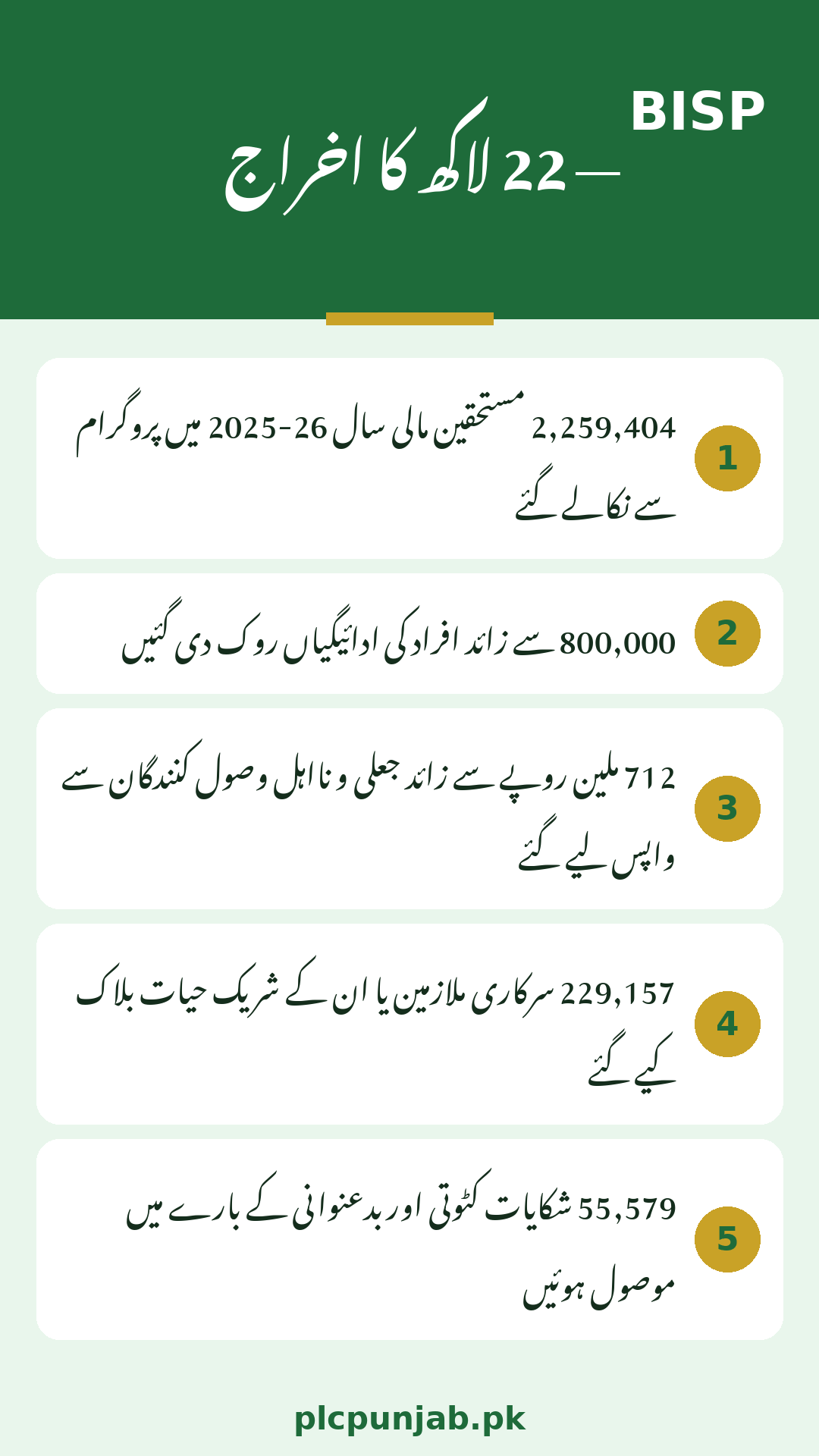
The federal government has removed 2,259,404 ineligible beneficiaries from the Benazir Income Support Programme (BISP) during the financial year 2025–26, according to a report presented to the National Assembly by the Ministry of Poverty Alleviation and Social Safety. Payments to more than 800,000 additional people identified as ineligible were also stopped. The disclosure, made during the National Assembly’s question hour, is the largest single clean-up of the country’s flagship cash-transfer programme in recent years, and it explains why many women who received payments before are now finding their status changed on the 8171 portal.
Detail
Confirmed Information
Beneficiaries removed
2,259,404 in financial year 2025–26 (1 July 2025 to 30 June 2026)
Payments stopped
More than 800,000 additional people identified as ineligible
Reported by
Ministry of Poverty Alleviation and Social Safety, in the National Assembly
Money recovered
More than Rs 712 million from fake and ineligible recipients
Programme size
About 9.3 million families; quarterly Kafaalat payment Rs 14,500
Status check
Free via SMS CNIC to 8171 or the official 8171 web portal
What the National Assembly Was Told
The ministry’s report, presented during question hour, said the 2,259,404 people removed during the year ended 30 June 2026 were described as fake beneficiaries. Separately, payments to more than 800,000 further recipients were suspended after they were identified as ineligible. The ministry also reported that more than Rs 712 million had been recovered from people who received payments fraudulently or while ineligible. Of that amount, more than Rs 545 million was recovered through the Federal Investigation Agency (FIA), more than Rs 21 million from BISP employees, and the remainder from other government departments.
2,259,404 beneficiaries removed from BISP records in FY2025–26.
800,000+ payments stopped for additional recipients found ineligible.
Rs 712 million recovered from fake and ineligible recipients.
55,579 complaints received during the year about unauthorised deductions, embezzlement and misappropriation of funds.
140,488 government employees and family members identified in a 2019–20 audit as having received BISP benefits.
The ministry said inquiries were continuing and action was being taken under the relevant laws. It did not provide a breakdown of every category of removal, and the recoverable amount may change as data updating, profiling and blocking continue.
Why Beneficiaries Were Removed: Data Profiling and NADRA Cross-Checks
The removals were driven by verification audits and data profiling, not by a single new rule. Updated records of government employees and pensioners were collected from the Controller General of Accounts, ministries, autonomous bodies and state-owned enterprises, and more than six million records were forwarded for profiling and additional review. Where the data showed a household no longer met the poverty criteria, the beneficiary was blocked or removed.
Government employees and spouses blocked: 229,157 government employees or their spouses were blocked after verification audits identified them.
Pensioners identified: pension records were part of the updated data collected for profiling.
Cross-checks with NADRA: biometric and CNIC records are matched against NADRA’s database; expired or blocked CNICs stop payments until renewed.
Asset and travel filters: ownership of a registered vehicle or large property, and international travel history, are established exclusion filters.
Tax filers excluded: a household member who is an active income tax filer is not eligible.
This is why a woman can lose eligibility even without any change she reported herself: a family member taking a government job, a vehicle registration, a pension starting, or a survey update can all change the household’s assessed position.
The PMT Score Rule: 32 or Below to Stay Eligible
At the centre of every removal decision is the Proxy Means Test (PMT) score, calculated from the National Socio-Economic Registry (NSER) household survey. The score reflects housing, land and assets, utility usage, household size and employment, rather than self-reported income alone. Households generally need a PMT score of 32 or below to remain eligible for the Kafaalat payment; for a household with a disabled member, the cut-off is 37.
Cut-off 32: standard households must score 32 or below.
Cut-off 37: households with a disabled member, on production of a disability certificate.
Score rises, payment stops: a higher score after a dynamic survey — from new assets, income or a smaller household — removes the family from the active list, even if it received earlier quarters.
Reassessment every three years: households are reassessed regularly, and families whose situation has improved can be replaced by newly eligible ones.
Score not shown online: the 8171 portal and SMS service show payment and eligibility status, not the exact PMT score; the score can be confirmed at a BISP Tehsil Office with the original CNIC.
Women who believe their score is wrong should not accept the portal result as final. The route to correction is a fresh NSER dynamic survey at the Tehsil Office, where household details can be verified and updated.
Who Is Excluded From BISP and Who Stays Eligible
BISP’s eligibility rules have not changed with this clean-up; they have been enforced more strictly through data. The table below sets out the position as it stands in 2026.
Position
Rule in 2026
Stays eligible
Woman head of household with valid CNIC, PMT 32 or below (37 with disability), biometric verification complete, NSER survey within the last three years
Excluded: government job
Any household member in government employment, including spouses identified through payroll records
Excluded: filer and pension
Active income tax filer in the household; pensioners identified through official records
Excluded: assets and travel
Registered vehicle, large property, or international travel history under the CNIC
Payment blocked, not removed
Expired or blocked CNIC, failed biometrics, or survey older than three years — fixable at NADRA or the Tehsil Office
Priority groups
Widows and disabled persons are given priority; widows must update marital status in the survey
The distinction between “removed” and “blocked” matters. A blocked payment can often be restored by renewing a CNIC, updating biometrics or completing a survey. A removal for ineligibility — a government job, a high PMT score, a tax filer in the household — stands unless the underlying facts genuinely change and are re-verified.
What Happens to the Freed Places: Newly Eligible Households
As ineligible beneficiaries leave, their places are taken by households that newly qualify through the NSER dynamic survey. BISP has said households are reassessed every three years and that families whose situation has improved can be replaced by newly eligible ones. This is the programme’s standing process: there is no separate application form, and no agent can secure a place. A household qualifies only through its own survey, its PMT score and its verified records.
Survey, not application: eligibility comes from the NSER dynamic survey at a BISP Tehsil Office, not from any online form.
Free at every step: registration, survey and status checks are completely free; anyone demanding payment is committing fraud.
Women under verification: households whose verification is still in progress should complete their survey and biometric steps, then wait for the SMS confirmation; the quarter missed during processing is not paid retrospectively.
Quarterly cycle: payments are released in quarterly cycles, and newly approved households join from the next cycle after approval.
Women who are genuinely poor, own little or nothing, and score 32 or below should therefore make sure their survey is current and their records match NADRA, rather than relying on forwarded messages about inclusion lists.
How to Check Your Status and Fix a Wrong Removal
Any beneficiary can check her position free of charge, and any error can be raised through official channels. The steps below use only official routes.
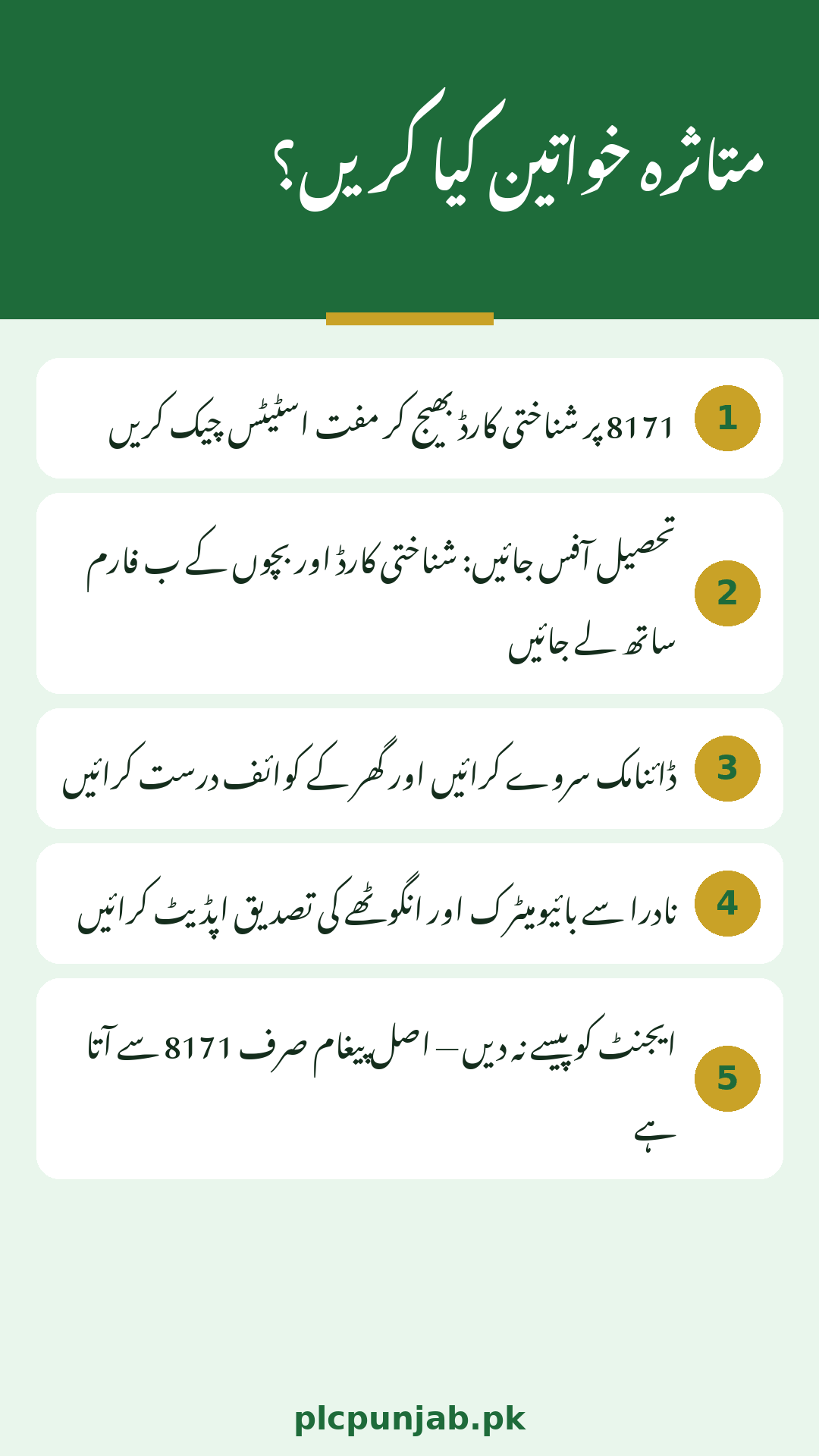
Step 1: Send your 13-digit CNIC number without dashes by SMS to 8171, or check on the official 8171 web portal to see your eligibility and payment status.
Step 2: If the status shows survey or verification required, visit the nearest BISP Tehsil Office with your original CNIC and your children’s B-Forms.
Step 3: Ask staff to verify your NSER data and confirm that all household details are accurate and current; request a fresh dynamic survey if anything has changed.
Step 4: If biometrics fail, visit NADRA to update thumb impressions and fingerprint data, then re-check after two to three weeks.
Step 5: Ignore messages from any number other than 8171. BISP has warned that official messages come only from 8171, and that promises of enrolment or payment in exchange for details or money are scams.
For complaints about deductions or fraud, the BISP helpline is 0800-26477 (toll-free). Complaints can also be filed through the 8171 web portal or the BISP Help Desk at the Tehsil Office.
Conclusion
The removal of 2,259,404 beneficiaries in FY2025–26, and the stopping of payments to more than 800,000 others, is the result of BISP’s data-driven verification drive, reported to the National Assembly. The PMT score of 32, the exclusion filters for government employment, filers, pensioners and assets, and NADRA cross-checks explain most removals. Genuinely eligible women should check their status free on 8171, keep their survey current, and never pay anyone for enrolment or restoration.
FAQs
How many beneficiaries did BISP remove in FY2025–26?
According to the Ministry of Poverty Alleviation and Social Safety’s report to the National Assembly, 2,259,404 beneficiaries were removed between 1 July 2025 and 30 June 2026, and payments to more than 800,000 additional people identified as ineligible were stopped.
Why was my BISP payment stopped even though I received it before?
The most common reasons are a PMT score rising above 32 after a dynamic survey, a household member entering government employment or becoming a tax filer, an expired or blocked CNIC, failed biometrics, or a survey older than three years. Check your status free by sending your CNIC to 8171.
Can a removed beneficiary rejoin BISP?
Yes, if the underlying facts genuinely qualify. Visit the nearest BISP Tehsil Office with your original CNIC and children’s B-Forms, request verification of your NSER data and a fresh dynamic survey, and update biometrics at NADRA if needed. If the new score is 32 or below (37 with disability) and no exclusion filter applies, the household can be added from the next quarterly cycle.
Is there any fee for BISP registration or restoration?
No. Registration, survey, status checks and restoration are completely free. BISP has warned that official messages come only from 8171, and anyone demanding money for enrolment, restoration or payment release is committing fraud.
Shahzad Sahil is the editor of plcpunjab.pk, covering Punjab government schemes including the Livestock Card, eligibility, registration and latest updates, with information verified from official sources for readers across Punjab.
Gold price in Pakistan today, 3 November 2026, stands close to its latest official market close, with the 24K rate per tola reported around Rs 412,000 in early market references. According to the rates released by the All-Pakistan Gems and Jewellers Sarafa Association (APGJSA), gold gained Rs 2,400 per tola on Monday, 2 November 2026,…
If you have seen posts saying the Green Tractor Scheme Phase V is still open, please read this first. Phase V did open on 23 September 2026, offering a subsidy of Rs 1,000,000 on high-power tractors of 75 to 125 HP. But that window has now closed. The last date to apply was 5 October…
Shopkeepers in Lahore are asking the same questions again and again: how much is the fine for littering, what happens if the front of a shop is left dirty, and is burning waste really punished with jail? The Suthra Punjab fine list 2026 answers those questions, but only if you read the current Lahore e-challan…
Punjab’s fully electric Green Bus service is holding its fare at Rs20 even as petrol and diesel prices rise, the provincial government announced in October 2026. The service currently operates 700 buses, and the fleet is planned to expand to 3,000 buses within the next 6–8 months, reaching all 148 tehsils of the province. Travel…
Lahore’s air turned dangerous again at the start of November, and parents are asking the same question every smog season: are schools closing? According to the latest official position, the Punjab Smog November 2026 situation is serious, with Lahore’s air quality index reaching 509 on Monday 2 November, yet no school closure has been ordered…
Young people who want to start or expand a business can get a loan from the federal government at low or zero markup. The PM Youth Business Loan Scheme 2026 — formally the Prime Minister’s Youth Business and Agriculture Loan Scheme — offers up to Rs 7.5 million in three tiers, starting with Rs 0.5…