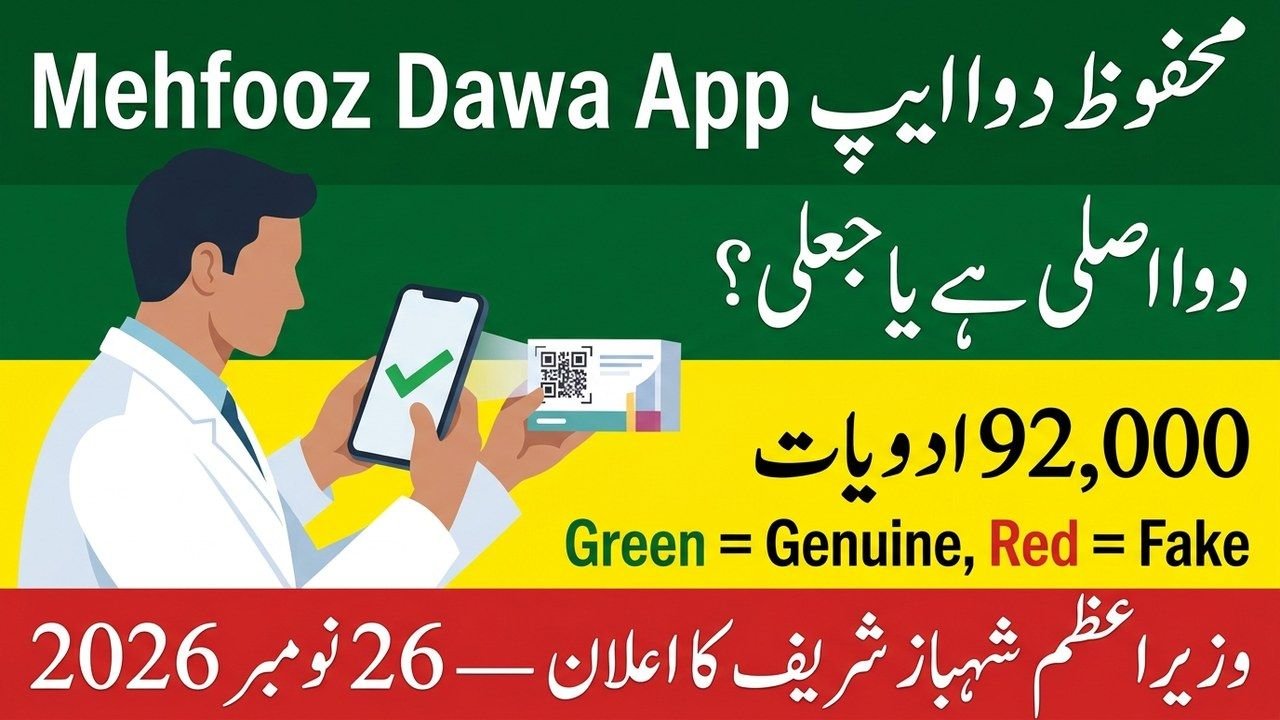
Prime Minister Shehbaz Sharif launched the Mehfooz Dawa app on Thursday, 26 November 2026, giving every Pakistani a way to check whether the medicine in their hand is genuine before they take it. At a ceremony in Islamabad, the prime minister scanned a medicine packet with the app himself and called the launch a major milestone that would help restore public confidence in the healthcare system.
The Mehfooz Dawa app comes from the Ministry of National Health Services and is built on the Drug Regulatory Authority of Pakistan (DRAP) track-and-trace system. It lets users scan the 2D barcode on a medicine pack, check it against a database of around 92,000 products, report a fake medicine, and report a shortage. For families who have ever worried that a tablet from a pharmacy might be counterfeit, this is the first official tool that answers that question in seconds.
Mehfooz Dawa App Launched: What the Prime Minister Announced
Prime Minister Shehbaz Sharif formally launched the Mehfooz Dawa app at a ceremony in Islamabad on Thursday, 26 November 2026. Federal Minister for National Health Services Mustafa Kamal and DRAP Chief Executive Officer Dr Obaidullah also addressed the event, and the prime minister demonstrated the application himself by scanning a medicine packet to check its authenticity in front of the audience.
What Mehfooz Dawa means: The name translates to “Safe Medicine” in Urdu, and the app is designed to protect people from counterfeit and substandard medicines.
Who spoke at the ceremony: Health Minister Mustafa Kamal said the application was developed with the aim of protecting innocent lives, and noted a lack of trust among the public when it came to obtaining medicines. DRAP chief Dr Obaidullah explained how the app works and what it covers.
What the prime minister asked for next: He directed the health ministry to work with the IT and Information ministries to raise public awareness about the app, and urged officials to publicise it and work with drugmakers and provincial governments to make medicines more affordable.
What was not announced: No price cuts or subsidies were announced at the ceremony. The prime minister did say, however, that medicine prices should be in line with what ordinary people can afford.
The launch matters because it turns a long-delayed government system into something ordinary citizens can actually use. The barcode idea was first proposed in 2015 and approved by the federal cabinet in 2017, but bureaucratic delays held it back for years. DRAP had set 1 October 2026 as the cut-off date for the barcode system, and the track-and-trace system behind it became operational on 9 October 2026. With the Mehfooz Dawa app launched on 26 November, that system now reaches the public directly through their phones.
How to Check Your Medicine with the Mehfooz Dawa App
Using the Mehfooz Dawa app is simple, and it needs no registration details or paperwork. The check happens at the pharmacy counter or at home, before the medicine is taken, and the result appears on the phone screen within moments of scanning.
Step 1 — Open the app: Open the Mehfooz Dawa application on your phone and go to the medicine verification feature.
Step 2 — Scan the pack: Scan the 2D barcode printed on the medicine packaging, or enter the medicine’s batch number, which the app then checks against the DRAP database.
Step 3 — Read the result: The application displays a green screen if the medicine is genuine and a red screen if it is counterfeit, so the answer is clear even for someone using the app for the first time.
Step 4 — Complain if it is fake: If a medicine is found to be counterfeit, consumers have the option to lodge a complaint through the app itself, so the report reaches the regulator instead of being lost.
Step 5 — Report a shortage: Users can also report medicine shortages through the application, which helps the authorities see where a medicine is missing from the market.
The three features of the app — medicine verification, complaints and shortage reporting — were explained at the ceremony by DRAP chief Dr Obaidullah, who said the app sought to address three problems at once: counterfeit medicines, shortages and quality compliance. The prime minister called it an excellent intervention, and said the real point was that medicines must be affordable for the common man as well as genuine.
92,000 Medicines in the Database: What the App Covers
The Mehfooz Dawa app draws on a national database that DRAP has built with the cooperation of the pharmaceutical industry. Health Minister Mustafa Kamal said at the ceremony that building a database covering around 92,000 medicines and involving more than 700 companies had been an uphill task, and he praised the industry’s cooperation in making it possible.
Mehfooz Dawa App
What It Covers
Medicines in database
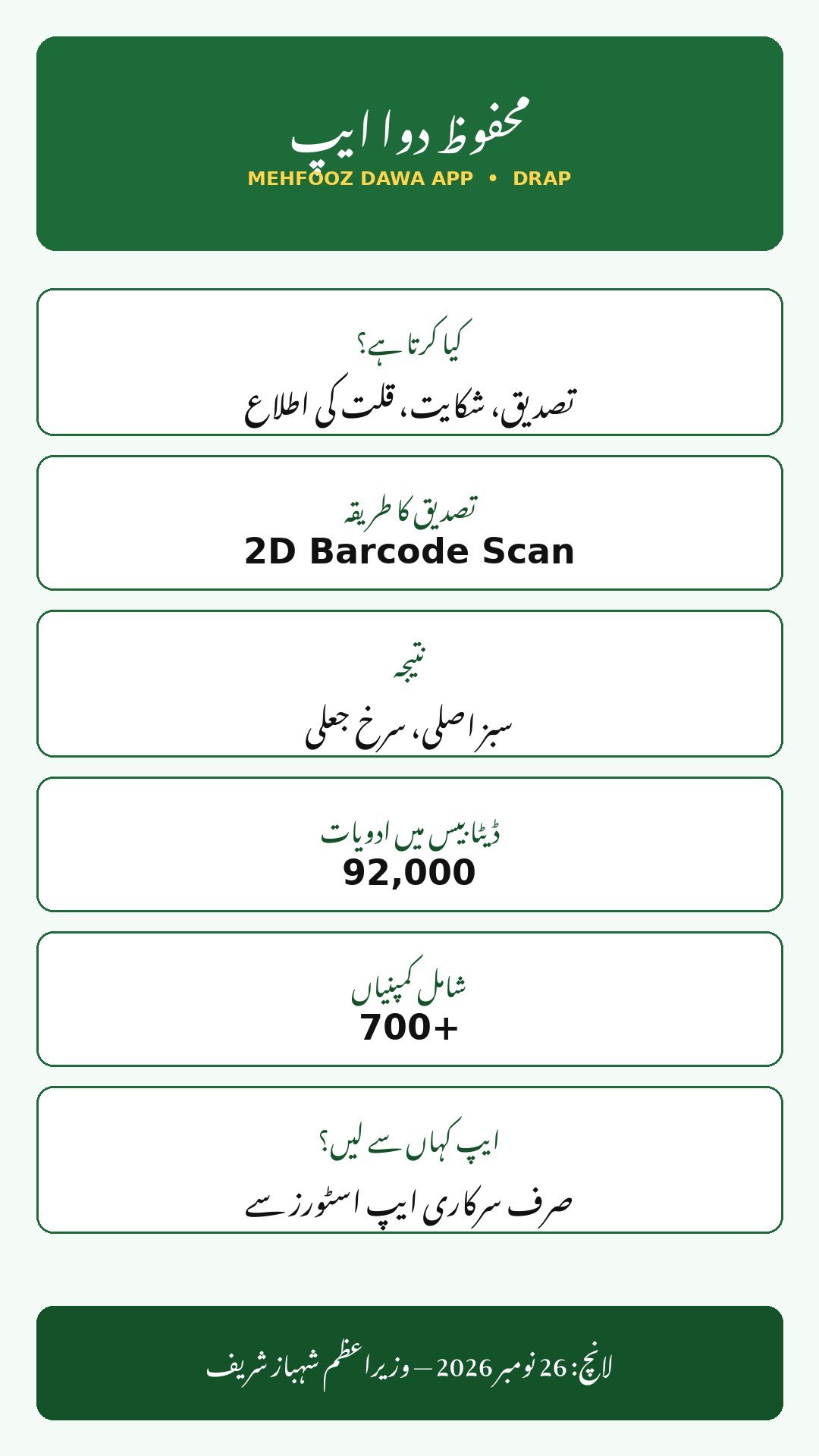
Around 92,000 registered medicines
Companies covered
More than 700 pharmaceutical companies
What the scan shows
Whether the medicine is authentic or counterfeit, its official price, and whether it is available
Track-and-trace system
Operational since 9 October 2026; lets regulators trace products through the supply chain and recall them when quality problems arise
Who can use it
Any citizen with a smartphone; no eligibility condition or registration was announced
The database is what makes the app useful in practice. With 92,000 medicines from more than 700 companies, it covers the medicines most families actually buy, from common painkillers and antibiotics to specialised treatments. The system also helps regulators trace a medicine through the supply chain and recall it when a quality problem is found, so one complaint can lead to action against a whole fake batch.
Why Mehfooz Dawa Matters: Fake Medicines in Pakistan
Counterfeit medicines are not a small problem in Pakistan, and the prime minister made that point at the launch by recalling a tragedy from 2012. At the Punjab Institute of Cardiology, counterfeit medication was blamed for the deaths of more than 100 patients. DRAP had maintained that the medication was genuine, but international testing found the medicine given to patients was actually meant to treat malaria. The prime minister called for learning from the past and preparing for the future.
The trust problem: Health Minister Mustafa Kamal said there was a lack of trust among the public when it came to obtaining medicines, and the app was developed to protect innocent lives.
The price problem: The prime minister said education and healthcare should be equally accessible to every citizen, and the federal and provincial governments must work together to ensure affordable, quality medicines.
The equality principle: He said the founding principle of government policy should be that health and education are equal for everyone, and no one should have to go begging at anyone’s door.
The scale of the risk: Fake and substandard medicines can fail to treat the illness, cause new harm, or delay proper treatment while the patient believes they are being cured.
Until now, a patient buying medicine had no practical way to tell a genuine pack from a convincing fake. The pack, the printing and even the hologram can be copied, and only a laboratory test could settle the question. The Mehfooz Dawa app gives the buyer a direct check against the regulator’s own records, using the 2D barcode on the pack. If it does not match the database, the red screen warns the buyer before the medicine is taken.
The launch ceremony is only the first step, and the government now has to make sure people actually know about the app and use it. The prime minister directed the health ministry to work with the IT and Information ministries to raise public awareness, so publicity campaigns and guidance for pharmacies and patients should follow in the coming days.
Awareness drive: The health ministry will work with the IT and Information ministries to publicise the app so that patients, pharmacists and doctors all know how to use it.
Working with the industry: The prime minister urged officials to work with drugmakers and provincial governments to make medicines more affordable, so the app’s price information should also help patients spot overcharging.
Complaints must lead to action: The complaint feature will only build trust if reports of fake medicines lead to raids, recalls and prosecutions, and shortage reporting will only help if it leads to supply being restored.
What to watch: The next things to look for are the official download details for the app, guidance for pharmacies on the barcode, and the first enforcement action taken on a complaint made through the app.
For now, the message for the public is simple: before taking a medicine, check it on the Mehfooz Dawa app. A green screen means the medicine matches DRAP’s records, a red screen means it does not, and a complaint through the app puts the regulator on notice. The launch on 26 November 2026 gives every Pakistani that protection for the first time.
Conclusion
The launch of the Mehfooz Dawa app on 26 November 2026 is a genuine step forward for public health in Pakistan. Prime Minister Shehbaz Sharif launched a free, official tool that lets any citizen verify a medicine by scanning its 2D barcode, see a green screen for genuine and a red screen for counterfeit, lodge a complaint about a fake medicine, and report a shortage. Behind the app sits a DRAP database of around 92,000 medicines from more than 700 companies, built on a track-and-trace system that became operational on 9 October 2026 after years of delay since the idea was first proposed in 2015. The prime minister’s own reminder of the 2012 Punjab Institute of Cardiology tragedy, in which more than 100 patients died after taking counterfeit medicine, shows exactly why this tool was needed. The app does not cut medicine prices, and no subsidy was announced, but it gives patients something they never had before: a way to check the medicine in their hand before they take it. Use it every time you buy medicine, and report anything that fails the check.
FAQs
What is the Mehfooz Dawa app? Mehfooz Dawa, meaning Safe Medicine, is a mobile application launched by Prime Minister Shehbaz Sharif on 26 November 2026. It helps citizens verify whether a medicine is genuine, report fake medicines, and report medicine shortages.
Who launched the Mehfooz Dawa app and when? Prime Minister Shehbaz Sharif launched the app on Thursday, 26 November 2026, at a ceremony in Islamabad organised by the Ministry of National Health Services.
How do I check my medicine with the Mehfooz Dawa app? Open the app, scan the 2D barcode printed on the medicine pack or enter its batch number, and the app checks it against the DRAP database. A green screen means the medicine is genuine and a red screen means it is counterfeit.
How many medicines are covered by the Mehfooz Dawa app? The DRAP database linked to the app covers around 92,000 medicines from more than 700 pharmaceutical companies.
Can I complain about a fake medicine through the app? Yes. If a medicine is found to be counterfeit, the app gives consumers the option to lodge a complaint, and users can also report medicine shortages through the application.
Does the Mehfooz Dawa app reduce medicine prices? No. No price cuts or subsidies were announced at the launch ceremony. The app shows the official price of a medicine, and the prime minister said medicine prices should be in line with what ordinary people can afford.
What is the DRAP track-and-trace system behind the app? The track-and-trace system became operational on 9 October 2026. It links medicines to a national database through 2D barcodes, lets regulators trace products through the supply chain, and helps recall products when quality problems are found. The barcode idea was first proposed in 2015 and approved by the federal cabinet in 2017.
Where can I download the Mehfooz Dawa app? Official download details were not published in the launch coverage available at the time of writing. Get the app only from the official app stores, and do not trust any third-party link or WhatsApp forward claiming to offer the app.
Shahzad Sahil is the editor of plcpunjab.pk, covering Punjab government schemes including the Livestock Card, eligibility, registration and latest updates, with information verified from official sources for readers across Punjab.
Punjab took the formal first step of its biggest economic plan in years on Friday, 30 October 2026, when Chief Minister Maryam Nawaz Sharif launched the Punjab Innovation for Value, Opportunity and Transformation (PIVOT) programme in Lahore. The launch ceremony brought together the State Bank governor, the Pakistan Business Council, investors and leading industrialists, and…
Before buying land, selling a plot or applying for a loan against property, you need proof of who owns it. That proof is the fard — the record of rights from the Jamabandi. This Punjab land record fard guide explains how to check your fard online by CNIC, and how to get a certified copy…
For a poor non-Muslim family in Punjab, a small regular payment can make the difference between managing the month and falling behind. The CM Punjab Minority Card is the provincial government’s cash support programme for such families. Approved families receive Rs 10,500 every three months through a Bank of Punjab card. It was launched in…
The BISP Kafaalat payment for the October to December 2026 quarter is Rs 14,500 per eligible family, and the first disbursement under the programme’s new six-bank payment system began on the evening of 12 November 2026. If you are a registered beneficiary, your installment may already be in your wallet, still in process, or due…
The CM Punjab E-Bike Scheme Phase 2 has reached the stage every applicant has been waiting for. After a record response from students across Punjab, the scheme has moved into verification and balloting, and the Chief Minister has announced that distribution of the 100,000 electric bikes will begin in December 2026, after the earlier 5…
Millions of motorcycle riders, rickshaw drivers and small-car owners across Pakistan are asking one question this month: is the PM Fuel Relief Scheme about to close? The question became urgent after the International Monetary Fund (IMF) asked Pakistan to phase out the fuel support scheme promptly in its October 2026 staff-level statement. The government, however,…